Unson C G, Cypess A M, Wu C R, Goldsmith P K, Merrifield R B, Sakmar T P
Rockefeller University, New York, NY 10021, USA.
Proc Natl Acad Sci U S A. 1996 Jan 9;93(1):310-5. doi: 10.1073/pnas.93.1.310.
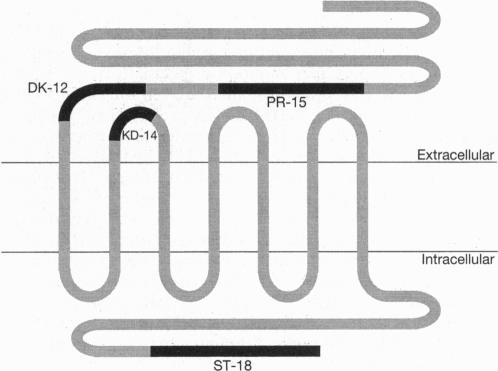
Polyclonal antibodies were prepared against synthetic peptides corresponding to four different extramembrane segments of the rat glucagon receptor. The antibodies bound specifically to native glucagon receptor as judged by immunofluorescence microscopy of cultured cells expressing a synthetic gene for the receptor. Antibodies to peptides designated PR-15 and DK-12 were directed against amino acid residues 103-117 and 126-137, respectively, of the extracellular N-terminal tail. Antibody to peptide KD-14 was directed against residues 206-219 of the first extracellular loop, and antibody to peptide ST-18, against the intracellular C-terminal tail, residues 468-485. The DK-12 and KD-14 antibodies, but not the PR-15 and ST-18 antibodies, could effectively block binding of 125I-labeled glucagon to its receptor in liver membranes. Incubation of these antibodies with rat liver membranes resulted in both a decrease in the maximal hormonal binding capacity and an apparent decrease in glucagon affinity for its receptor. These effects were abolished in the presence of excess specific peptide antigen. In addition, DK-12 and KD-14 antibodies, but not PR-15 and ST-18 antibodies, interfered with glucagon-induced adenylyl cyclase activation in rat liver membranes and behaved as functional glucagon antagonists. These results demonstrate that DK-12 and KD-14 antibodies are pharmacologically active glucagon antagonists and strongly suggest that residues 126-137 of the N-terminal tail and residues 206-219 of the first extracellular loop contain determinants of ligand binding and may comprise the primary ligand-binding site on the glucagon receptor.
针对与大鼠胰高血糖素受体四个不同膜外区段相对应的合成肽制备了多克隆抗体。通过对表达该受体合成基因的培养细胞进行免疫荧光显微镜检查判断,这些抗体与天然胰高血糖素受体特异性结合。针对分别命名为PR - 15和DK - 12的肽段的抗体,分别针对细胞外N端尾部的第103 - 117和126 - 137位氨基酸残基。针对肽段KD - 14的抗体针对第一个细胞外环的第206 - 219位残基,针对肽段ST - 18的抗体针对细胞内C端尾部的第468 - 485位残基。DK - 12和KD - 14抗体,但不是PR - 15和ST - 18抗体,能够有效阻断125I标记的胰高血糖素与其在肝细胞膜上的受体的结合。将这些抗体与大鼠肝细胞膜一起孵育导致最大激素结合能力降低以及胰高血糖素对其受体的亲和力明显降低。在存在过量特异性肽抗原的情况下,这些效应被消除。此外,DK - 12和KD - 14抗体,但不是PR - 15和ST - 18抗体,干扰了大鼠肝细胞膜中胰高血糖素诱导的腺苷酸环化酶激活,并表现为功能性胰高血糖素拮抗剂。这些结果表明,DK - 12和KD - 14抗体是具有药理活性的胰高血糖素拮抗剂,并强烈表明N端尾部的第126 - 137位残基和第一个细胞外环的第206 - 219位残基包含配体结合的决定因素,并且可能构成胰高血糖素受体上的主要配体结合位点。