Rasty S, Thatikunta P, Gordon J, Khalili K, Amini S, Glorioso J C
Department of Molecular Genetics and Biochemistry, University of Pittsburgh School of Medicine, PA 15261, USA.
Proc Natl Acad Sci U S A. 1996 Jun 11;93(12):6073-8. doi: 10.1073/pnas.93.12.6073.
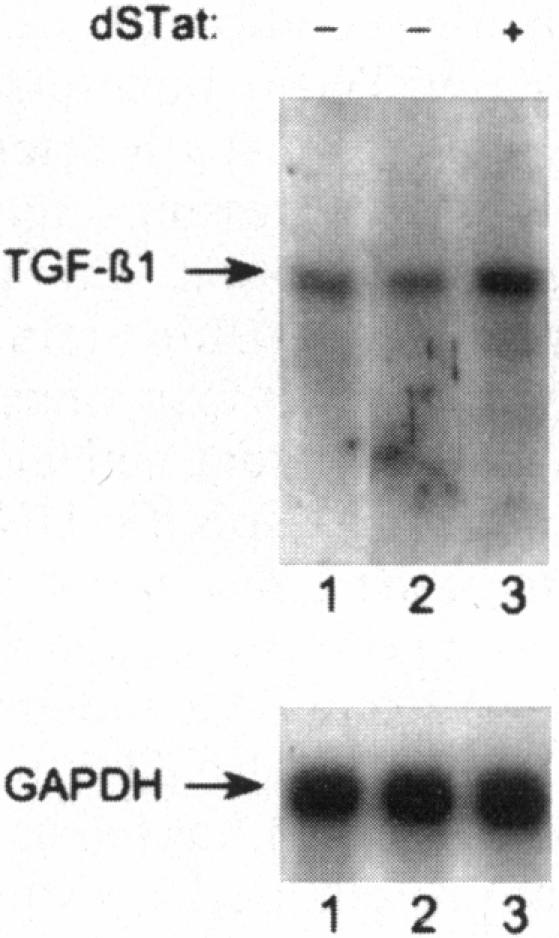
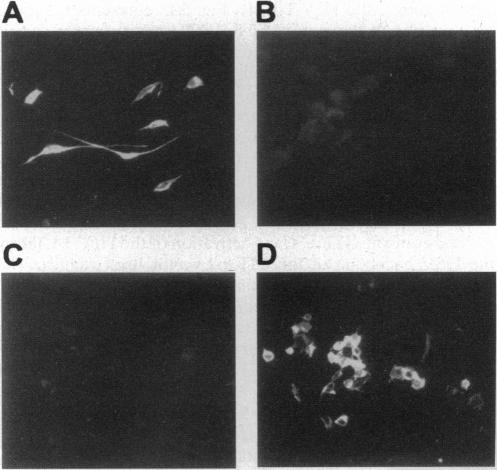
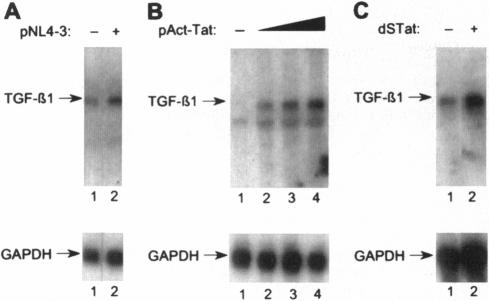
The high incidence of neurological disorders in patients afflicted with acquired immunodeficiency syndrome (AIDS) may result from human immunodeficiency virus type 1 (HIV-1) induction of chemotactic signals and cytokines within the brain by virus-encoded gene products. Transforming growth factor beta1 (TGF-beta1) is an immunomodulator and potent chemotactic molecule present at elevated levels in HIV-1-infected patients, and its expression may thus be induced by viral trans-activating proteins such as Tat. In this report, a replication-defective herpes simplex virus (HSV)-1 tat gene transfer vector, dSTat, was used to transiently express HIV-1 Tat in glial cells in culture and following intracerebral inoculation in mouse brain in order to directly determine whether Tat can increase TGF-beta1 mRNA expression. dSTat infection of Vero cells transiently transfected by a panel of HIV-1 long terminal repeat deletion mutants linked to the bacterial chloramphenicol acetyltransferase reporter gene demonstrated that vector-expressed Tat activated the long terminal repeat in a trans-activation response element-dependent fashion independent of the HSV-mediated induction of the HIV-1 enhancer, or NF-kappaB domain. Northern blot analysis of human astrocytic glial U87-MG cells transfected by dSTat vector DNA resulted in a substantial increase in steady-state levels of TGF-beta1 mRNA. Furthermore, intracerebral inoculation of dSTat followed by Northern blot analysis of whole mouse brain RNA revealed an increase in levels of TGF-beta1 mRNA similar to that observed in cultured glial cells transfected by dSTat DNA. These results provided direct in vivo evidence for the involvement of HIV-1 Tat in activation of TGF-beta1 gene expression in brain. Tat-mediated stimulation of TGF-beta1 expression suggests a novel pathway by which HIV-1 may alter the expression of cytokines in the central nervous system, potentially contributing to the development of AIDS-associated neurological disease.
获得性免疫缺陷综合征(AIDS)患者中神经功能障碍的高发病率可能源于1型人类免疫缺陷病毒(HIV-1)通过病毒编码基因产物在脑内诱导趋化信号和细胞因子。转化生长因子β1(TGF-β1)是一种免疫调节剂和强效趋化分子,在HIV-1感染患者中水平升高,因此其表达可能由病毒反式激活蛋白如Tat诱导。在本报告中,一种复制缺陷型单纯疱疹病毒(HSV)-1 tat基因转移载体dSTat被用于在培养的神经胶质细胞中以及在小鼠脑内接种后瞬时表达HIV-1 Tat,以便直接确定Tat是否能增加TGF-β1 mRNA表达。用一组与细菌氯霉素乙酰转移酶报告基因相连的HIV-1长末端重复缺失突变体瞬时转染的Vero细胞经dSTat感染表明,载体表达的Tat以反式激活反应元件依赖的方式激活长末端重复,独立于HSV介导的HIV-1增强子或核因子κB结构域的诱导。用dSTat载体DNA转染人星形胶质细胞U87-MG后进行的Northern印迹分析导致TGF-β1 mRNA稳态水平大幅增加。此外,脑内接种dSTat后对全小鼠脑RNA进行Northern印迹分析显示,TGF-β1 mRNA水平增加,类似于用dSTat DNA转染的培养神经胶质细胞中观察到的情况。这些结果为HIV-1 Tat参与脑内TGF-β1基因表达的激活提供了直接的体内证据。Tat介导的TGF-β1表达刺激提示了一种新的途径,通过该途径HIV-1可能改变中枢神经系统中细胞因子的表达,这可能导致AIDS相关神经疾病的发展。