Klaeger C, de Sa L, Klaeger A J, Carlson E J, Good W V, Epstein C J
Beckman Vision Center, University of California, San Francisco, USA.
Br J Ophthalmol. 1996 May;80(5):429-34. doi: 10.1136/bjo.80.5.429.
To determine whether a higher level of copper zinc superoxide dismutase (CuZnSOD) can reduce the severity of oxygen induced retinopathy (OIR) in a mouse model.
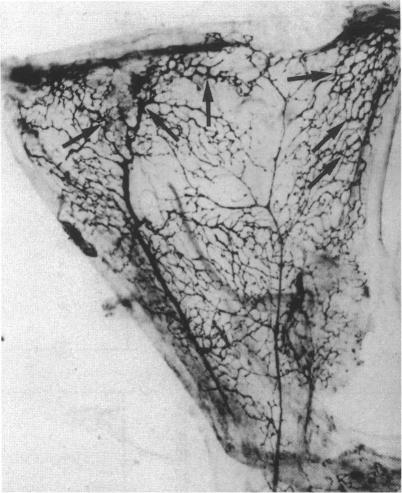
CuZnSOD transgenic mice with a threefold increase in CuZnSOD activity and control non-transgenic mice were exposed to 90% oxygen for 12 hours a day during the first 5 days of life. After oxygen treatment, all mice were reared in room air for 10 days. Another group of transgenic and non-transgenic mice were kept in room air for 15 days and served as control groups for the oxygen effect. At day 15, all mice were killed and perfused with India ink. The retinas were flat mounted on slides and examined with a light microscope.
There was a statistically significant increase in the incidence of OIR in mice exposed to high levels of oxygen, whether or not they were transgenic. However, there was no statistically significant difference in the severity of OIR between oxygen treated transgenic and non-transgenic mice.
A threefold higher CuZnSOD activity does not protect against OIR in mice. This is an unexpected finding, since oxygen radicals are considered a major factor causing OIR, and increased CuZnSOD activity has reduced oxygen radical induced damage in several neuronal and non-neuronal systems. The possibility of a damaging role for other radicals not affected by CuZnSOD cannot be excluded.
确定较高水平的铜锌超氧化物歧化酶(CuZnSOD)是否能减轻小鼠模型中氧诱导性视网膜病变(OIR)的严重程度。
将CuZnSOD活性增加三倍的CuZnSOD转基因小鼠和对照非转基因小鼠在出生后的前5天每天暴露于90%氧气中12小时。氧气处理后,所有小鼠在空气中饲养10天。另一组转基因和非转基因小鼠在空气中饲养15天,作为氧气效应的对照组。在第15天,处死所有小鼠并用印度墨汁灌注。将视网膜平铺在载玻片上,用光学显微镜检查。
无论是否为转基因小鼠,暴露于高氧环境中的小鼠OIR发病率均有统计学意义的增加。然而,经氧气处理的转基因小鼠和非转基因小鼠之间OIR的严重程度没有统计学意义的差异。
CuZnSOD活性高三倍并不能保护小鼠免受OIR影响。这是一个意外发现,因为氧自由基被认为是导致OIR的主要因素,并且CuZnSOD活性增加已在多个神经元和非神经元系统中减少了氧自由基诱导的损伤。不能排除其他不受CuZnSOD影响的自由基具有损伤作用的可能性。