Hentze M W, Kühn L C
Gene Expression Programme, European Molecular Biology Laboratory, Heidelberg, Germany.
Proc Natl Acad Sci U S A. 1996 Aug 6;93(16):8175-82. doi: 10.1073/pnas.93.16.8175.
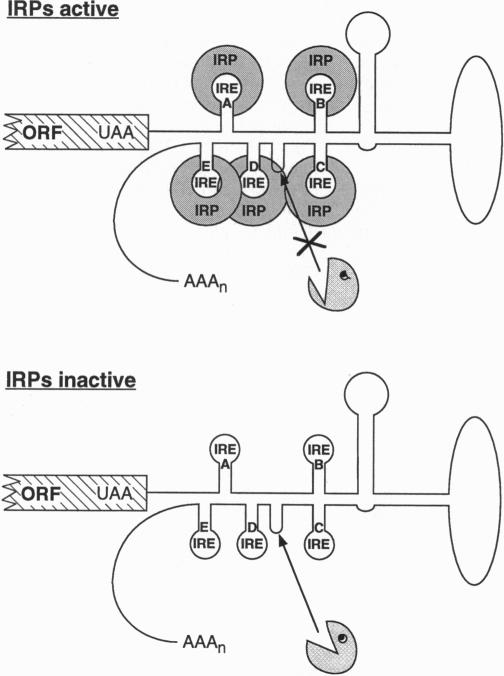
As an essential nutrient and a potential toxin, iron poses an exquisite regulatory problem in biology and medicine. At the cellular level, the basic molecular framework for the regulation of iron uptake, storage, and utilization has been defined. Two cytoplasmic RNA-binding proteins, iron-regulatory protein-1 (IRP-1) and IRP-2, respond to changes in cellular iron availability and coordinate the expression of mRNAs that harbor IRP-binding sites, iron-responsive elements (IREs). Nitric oxide (NO) and oxidative stress in the form of H2O2 also signal to IRPs and thereby influence cellular iron metabolism. The recent discovery of two IRE-regulated mRNAs encoding enzymes of the mitochondrial citric acid cycle may represent the beginnings of elucidating regulatory coupling between iron and energy metabolism. In addition to providing insights into the regulation of iron metabolism and its connections with other cellular pathways, the IRE/IRP system has emerged as a prime example for the understanding of translational regulation and mRNA stability control. Finally, IRP-1 has highlighted an unexpected role for iron sulfur clusters as post-translational regulatory switches.
作为一种必需营养素和潜在毒素,铁在生物学和医学中构成了一个精妙的调节问题。在细胞水平上,铁摄取、储存和利用调节的基本分子框架已被确定。两种细胞质RNA结合蛋白,铁调节蛋白-1(IRP-1)和IRP-2,对细胞内铁可用性的变化做出反应,并协调含有IRP结合位点即铁反应元件(IRE)的mRNA的表达。一氧化氮(NO)和以H2O2形式存在的氧化应激也向IRP发出信号,从而影响细胞铁代谢。最近发现的两个编码线粒体柠檬酸循环酶的IRE调节的mRNA可能代表了阐明铁与能量代谢之间调节耦合的开端。除了为铁代谢调节及其与其他细胞途径的联系提供见解外,IRE/IRP系统已成为理解翻译调节和mRNA稳定性控制的一个主要例子。最后,IRP-1突出了铁硫簇作为翻译后调节开关的意外作用。