Sasai Y, Lu B, Piccolo S, De Robertis E M
Department of Biological Chemistry, University of California, Los Angeles 90095-1737, USA.
EMBO J. 1996 Sep 2;15(17):4547-55.
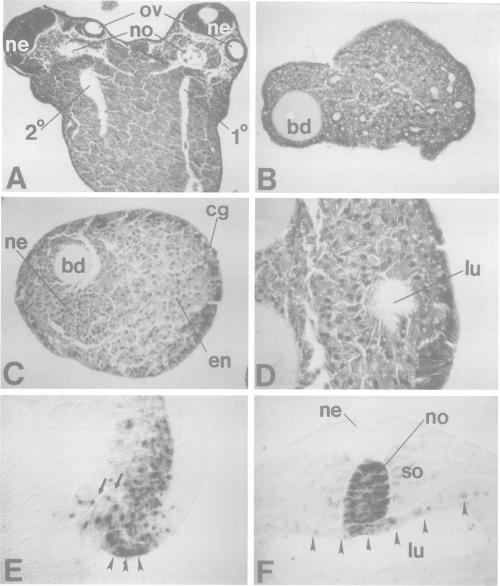
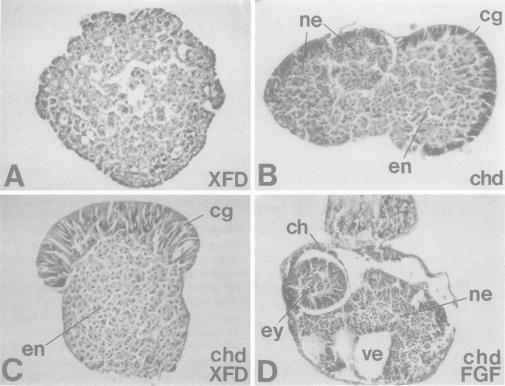
Spemann's organizer has potent neural inducing and mesoderm dorsalizing activities in the Xenopus gastrula. A third activity, the organizer's ability to induce a secondary gut, has been difficult to analyze experimentally due to the lack of early gene markers. Here we introduce endodermin, a pan-endodermal gene marker, and use it to demonstrate that chordin (Chd), a protein secreted by the organizer region, is able to induce endodermal differentiation in Xenopus. The ability of chd, as well as that of noggin, to induce endoderm in animal cap explants is repressed by the ventralizing factor BMP-4. When FGF signaling is blocked by a dominant-negative FGF receptor in chd-injected animal caps, neural induction is inhibited and most of the explant is induced to become endoderm. The results suggest that proteins secreted by the organizer, acting together with known peptide growth factors, regulate differentiation of the endodermal germ layer.
在非洲爪蟾原肠胚中,施佩曼组织者具有强大的神经诱导和中胚层背化活性。组织者的第三种活性,即诱导次生肠的能力,由于缺乏早期基因标记,一直难以通过实验进行分析。在此,我们引入了内胚层决定蛋白,一种泛内胚层基因标记,并利用它来证明由组织者区域分泌的蛋白质脊索蛋白(Chd)能够在非洲爪蟾中诱导内胚层分化。在动物帽外植体中,Chd以及头蛋白诱导内胚层的能力受到腹化因子骨形态发生蛋白-4(BMP-4)的抑制。当在注射了Chd的动物帽中,通过显性负性成纤维细胞生长因子(FGF)受体阻断FGF信号传导时,神经诱导受到抑制,并且大多数外植体被诱导成为内胚层。结果表明,组织者分泌的蛋白质与已知的肽生长因子共同作用,调节内胚层胚层的分化。