Holmbäck K, Danton M J, Suh T T, Daugherty C C, Degen J L
Division of Developmental Biology, Children's Hospital Research Foundation, Cincinnati, OH 45229, USA.
EMBO J. 1996 Nov 1;15(21):5760-71.
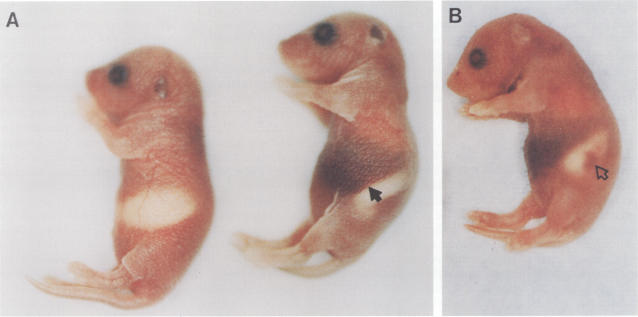
Blood loss at sites of vascular rupture is controlled by the adhesion and aggregation of platelets and the formation of an insoluble fibrin matrix. Fibrinogen is considered to be critical in these processes by both providing an abundant dimeric ligand for alpha IIb beta 3-mediated platelet aggregation, and serving as the fundamental building block of the fibrin polymer. To establish an in vivo model system to examine in detail the importance of alpha IIb beta 3-fibrinogen interactions in platelet function, hemostasis, response to injury and vasoocclusive disease, and to test the prevailing hypothesis that the C-terminal segment of the fibrinogen gamma chain is essential for alpha IIb beta 3 binding, we have used gene-targeting technology in mice to eliminate the last five residues (QAGDV) from the gamma chain. Mice homozygous for the modified gamma chain gene (gamma delta 5/gamma delta 5) displayed a generally normal hematological profile, including normal platelet count, plasma fibrinogen level, clotting time and fibrin crosslinking. However, both gamma delta 5-fibrinogen binding to alpha IIb beta 3 and platelet aggregation were highly defective. Remarkably, another alpha IIb beta 3-dependent process, clot retraction, was unaffected by the gamma delta 5 mutation. Despite the preservation of clotting function, gamma delta 5/gamma delta 5 mice were unable to control blood loss following a surgical challenge and occasionally developed fatal neonatal bleeding events.
血管破裂部位的失血通过血小板的黏附和聚集以及不溶性纤维蛋白基质的形成来控制。纤维蛋白原在这些过程中被认为至关重要,它既为αIIbβ3介导的血小板聚集提供丰富的二聚体配体,又作为纤维蛋白聚合物的基本构建单元。为了建立一个体内模型系统,以详细研究αIIbβ3 - 纤维蛋白原相互作用在血小板功能、止血、损伤反应和血管闭塞性疾病中的重要性,并检验纤维蛋白原γ链的C末端片段对αIIbβ3结合至关重要这一普遍假设,我们利用小鼠基因靶向技术从γ链中去除了最后五个残基(QAGDV)。修饰后的γ链基因(γδ5/γδ5)的纯合小鼠表现出大致正常的血液学特征,包括正常的血小板计数、血浆纤维蛋白原水平、凝血时间和纤维蛋白交联。然而,γδ5 - 纤维蛋白原与αIIbβ3的结合以及血小板聚集均存在严重缺陷。值得注意的是,另一个αIIbβ3依赖的过程,即血块回缩,不受γδ5突变的影响。尽管保留了凝血功能,但γδ5/γδ5小鼠在手术刺激后无法控制失血,偶尔会发生致命的新生儿出血事件。