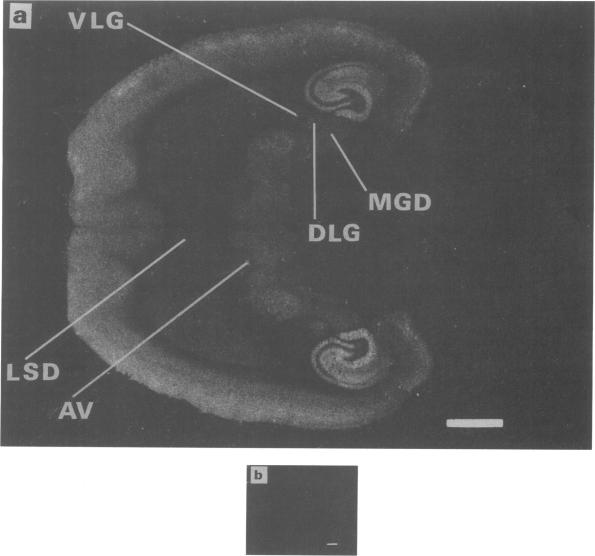
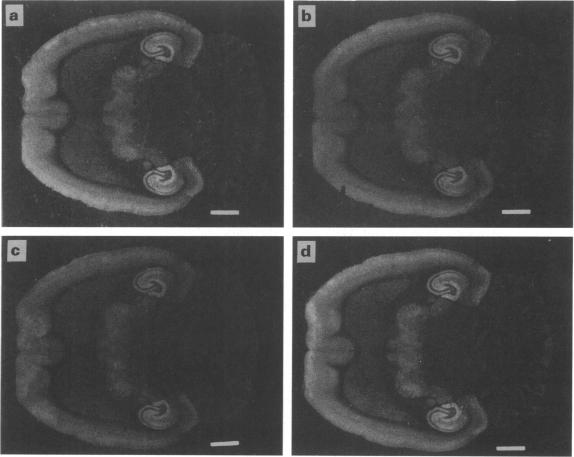
Binding of D,L-(E)-2-amino-4-[3H]-propyl-5-phosphono-3-pentenoic acid ([3H]-CGP 39653), a high affinity, selective antagonist at the glutamate site of the N-methyl-D-aspartate (NMDA) receptor, was investigated in rat brain by means of receptor binding and quantitative autoradiography techniques. 2. [3H]-CGP 39653 interacted with striatal and cerebellar membranes in a saturable manner and to a single binding site, with KD values of 15.5 nM and 10.0 nM and receptor binding densities (Bmax values) of 3.1 and 0.5 pmol mg-1 protein, respectively. These KD values were not significantly different from that previously reported in the cerebral cortex (10.7 nM). 3. Displacement analyses of [3H]-CGP 39653 in striatum and cerebellum, performed with L-glutamic acid, 3-((+/-)-2-carboxypiperazin-4-yl)propyl-1-phosphonic acid (CPP) and glycine showed a pharmacological profile similar to that reported in the cerebral cortex. L-Glutamic acid and CPP produced complete displacement of specific binding with Ki values not significantly different from the cerebral cortex. Glycine inhibited [3H]CGP 39653 binding with shallow, biphasic curves, characterized by a high and a low affinity component. Furthermore, glycine discriminated between these regions (P < 0.005, one-way ANOVA), since the apparent Ki of the high affinity component of the glycine inhibition curve (KiH) was significantly lower (Fisher's protected LSD) in the striatum than the cortex (33 nM and 104 nM, respectively). 4. Regional binding of [3H]-CGP 39653 to horizontal sections of rat brain revealed a heterogeneous distribution of binding sites, similar to that reported for other radiolabelled antagonists at the NMDA site (D-2-[3H]-amino-5-phosphonopentanoic acid ([3H]-D-AP5) and [3H]-CPP). High values of binding were detected in the hippocampal formation, cerebral cortex and thalamus, with low levels in striatum and cerebellum. 5. [3H]-CGP 39653 binding was inhibited by increasing concentrations of L-glutamic acid, CPP and glycine. L-Glutamic acid and CPP completely displaced specific binding in all regions tested, with similar IC50 values throughout. Similarly, glycine was able to inhibit the binding in all areas considered: 10 microM and 1 mM glycine reduced the binding to 80% and 65% of control (average between areas) respectively. The percentage of specific [3H]-CGP 39653 binding inhibited by 1 mM glycine varied among regions (P < 0.05, two-ways ANOVA). Multiple comparison, performed by Fisher's protected LSD method, showed that the inhibition was lower in striatum (72% of control), with respect to cortex (66% of control) and hippocampal formation (58% of control). 6. The inhibitory action of 10 microM glycine was reversed by 100 microM 7-chloro-kynurenic acid (7-CKA), a competitive antagonist of the glycine site of the NMDA receptor channel complex, in all areas tested. Moreover, reversal by 7-CKA was not the same in all regions (P < 0.05, two-ways ANOVA). In fact, in the presence of 10 microM glycine and 100 microM 7-KCA, specific [3H]-CGP 39653 binding in the striatum was 131% of control, which was significantly greater (Fisher's protected LSD) than binding in the hippocampus and the thalamus (104% and 112% of control, respectively). 7. These results demonstrate that [3H]-CGP 39653 binding can be inhibited by glycine in rat brain regions containing NMDA receptors; moreover, they suggest the existence of regionally distinct NMDA receptor subtypes with a different allosteric mechanism of [3H]-CGP 39653 binding modulation through the associated glycine site.