Machold R P, Ploegh H L
Department of Biology, Massachusetts Institute of Technology, Cambridge 02139, USA.
J Exp Med. 1996 Dec 1;184(6):2251-9. doi: 10.1084/jem.184.6.2251.
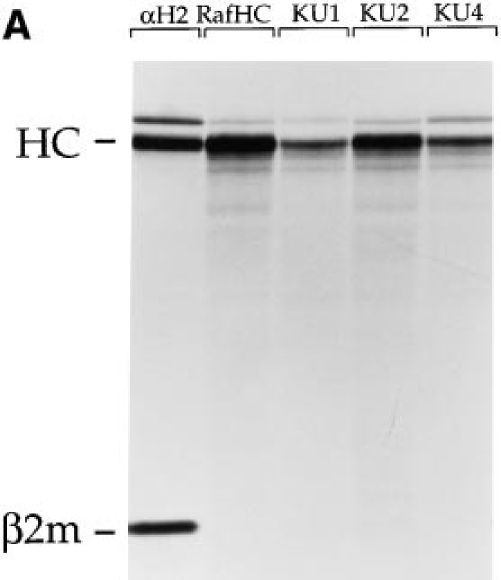
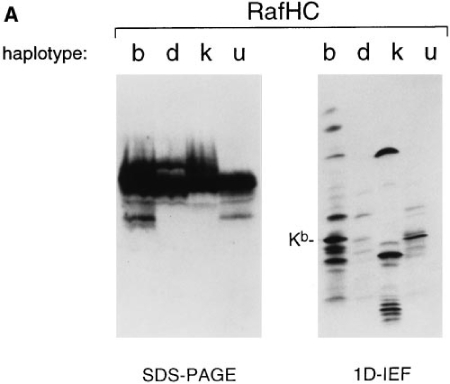
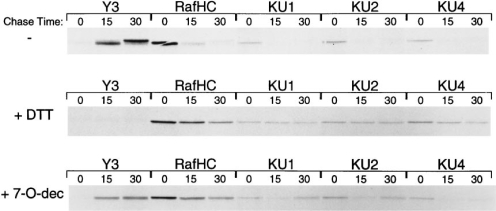
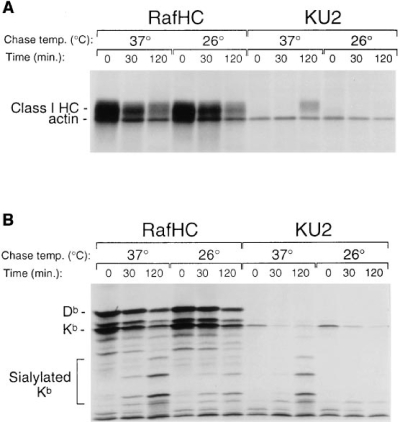
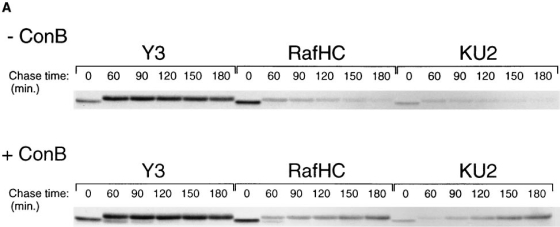
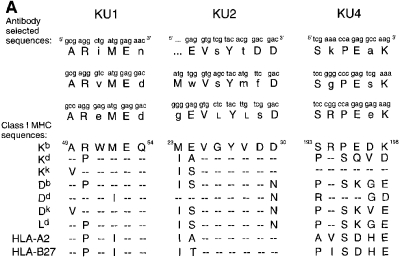
Unassembled (free) heavy chains appear during two stages of the class I MHC molecule's existence: immediately after translation but before assembly with peptide and beta 2-microglobulin, and later, upon disintegration of the heterotrimeric complex. To characterize the structures of folding and degradation intermediates of the class I heavy chain, three monoclonal antibodies have been produced that recognize epitopes along the H-2K(b) heavy chain which are obscured upon proper folding and subsequent assembly with beta 2-microglobulin (KU1: residues 49-54; KU2: residues 23-30; KU4: residues 193-198). The K(b) heavy chain is inserted into the lumen of the endoplasmic reticulum in an unfolded state reactive with KU1, KU2, and KU4. Shortly after completion of the polypeptide chain, reactivity with KU1, KU2, and KU4 is lost synchronously, suggesting that folding of the class I heavy chain is a rapid, cooperative process. Perturbation of the folding environment in intact cells with the reducing agent dithiothreitol or the trimming glucosidase inhibitor N-7-oxadecyl-deoxynojirimycin prolongs the presence of mAb-reactive K(b) heavy chains. At the cell surface, a pool of free K(b) heavy chains appears after 60-120 min of chase, whose subsequent degradation, but not their initial appearance, is impaired in the presence of concanamycin B, an inhibitor of vacuolar acidification. Thus, free heavy chains that arise at the cell surface are destroyed after internalization.
未组装(游离)重链出现在I类MHC分子存在的两个阶段:翻译后但在与肽和β2-微球蛋白组装之前,以及后来在异源三聚体复合物解体时。为了表征I类重链折叠和降解中间体的结构,制备了三种单克隆抗体,它们识别沿着H-2K(b)重链的表位,这些表位在正确折叠并随后与β2-微球蛋白组装后会被掩盖(KU1:第49 - 54位氨基酸残基;KU2:第23 - 30位氨基酸残基;KU4:第193 - 198位氨基酸残基)。K(b)重链以未折叠状态插入内质网腔中,此时可与KU1、KU2和KU4反应。多肽链完成后不久,与KU1、KU2和KU4的反应性同步丧失,这表明I类重链的折叠是一个快速的协同过程。用还原剂二硫苏糖醇或修剪葡糖苷酶抑制剂N - 7 - 氧代十六烷基 - 脱氧野尻霉素扰动完整细胞中的折叠环境,可延长单克隆抗体反应性K(b)重链的存在时间。在细胞表面,经过60 - 120分钟的追踪后会出现一群游离的K(b)重链,在液泡酸化抑制剂ConcA B存在的情况下,它们随后的降解受到损害,但它们的初始出现不受影响。因此,在细胞表面产生的游离重链在内化后被破坏。