Wilson L C, Oude Luttikhuis M E, Baraitser M, Kingston H M, Trembath R C
Department of Medicine, University of Leicester, UK.
J Med Genet. 1997 Feb;34(2):133-6. doi: 10.1136/jmg.34.2.133.
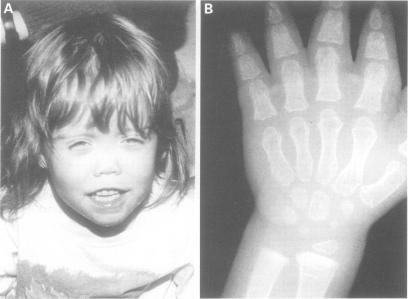
Shortening of the tubular bones of the hands and feet with cone shaped epiphyses is known as peripheral dysostosis and is common to several syndromes including acrodysostosis and Albright's hereditary osteodystrophy (AHO). The underlying defect in AHO is known to be a reduction in bioactivity of the alpha subunit of the signal transducing protein, Gs, and heterozygous deactivating mutations have been shown in the Gs alpha gene. Because of additional overlapping clinical and radiological features it has been suggested that acrodysostosis and AHO represent poles of a single diagnostic spectrum. We have measured Gs alpha bioactivity in two unrelated patients with a clinical diagnosis of acrodysostosis and found both to be normal. Mutation analysis of the Gs alpha gene showed no sequence variation in 12 of the 13 exons examined. These results indicate that, at least in a proportion of patients with acrodysostosis, the condition is aetiologically distinct from AHO.
手脚管状骨缩短并伴有锥形骨骺被称为外周性骨发育异常,在包括尖头并指(趾)发育异常和奥尔布赖特遗传性骨营养不良(AHO)在内的多种综合征中较为常见。已知AHO的潜在缺陷是信号转导蛋白Gs的α亚基生物活性降低,并且已在Gsα基因中发现杂合失活突变。由于存在其他重叠的临床和放射学特征,有人提出尖头并指(趾)发育异常和AHO代表单一诊断谱系的两极。我们测量了两名临床诊断为尖头并指(趾)发育异常的非亲缘关系患者的Gsα生物活性,发现两者均正常。对Gsα基因的突变分析显示,在所检测的13个外显子中的12个中没有序列变异。这些结果表明,至少在一部分尖头并指(趾)发育异常患者中,该病在病因上与AHO不同。