Lanoue A, Bona C, von Boehmer H, Sarukhan A
Unité Institut National de la Santé et de la Recherche Médicale 373, Institut Necker, Paris.
J Exp Med. 1997 Feb 3;185(3):405-14. doi: 10.1084/jem.185.3.405.
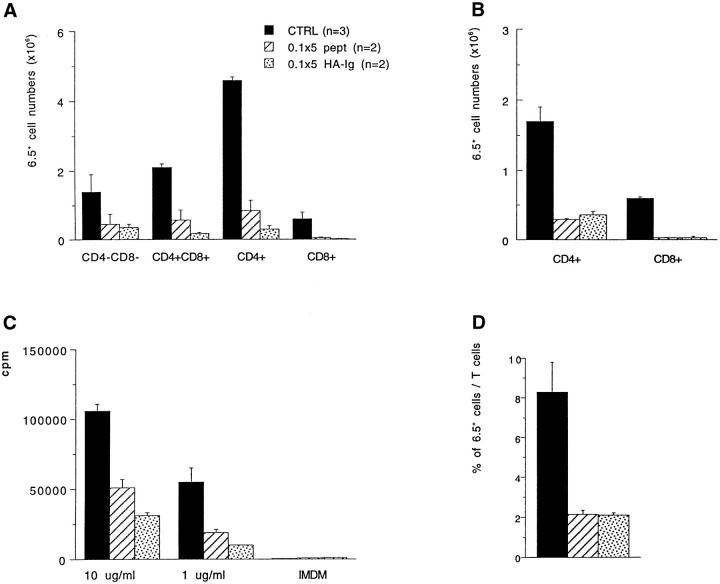
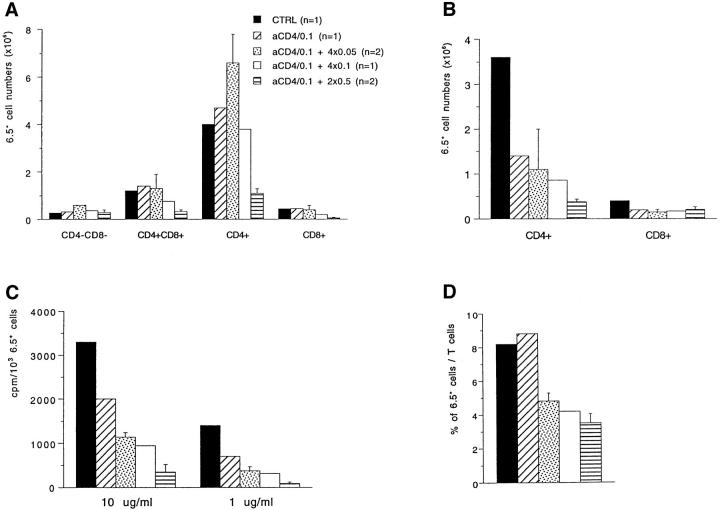
Establishment of antigen-specific tolerance among mature T cells has been a long debated, yet poorly understood issue. In this study we have used transgenic mice bearing a class II--restricted TCR specific for the hemmagglutinin of the influenza virus in order to test the behavior of CD4+ T cells upon exposure to antigen in different forms and doses. We first studied the fate of T cells expressing the transgenic TCR (6.5) in double transgenic mice where HA was expressed as a self antigen by hemapoietic cells. In these mice, we found some mature T cells in periphery that had escaped thymic deletion and that showed signs of activation but which were anergic. Mature CD4+6.5+ cells that were transferred into antigen-containing recipients went through an initial phase of expansion after which most cells were deleted and those remaining became unresponsive, as previously described for CD8+ cells. Inducing tolerance in CD4+6.5+ cells in situ in single transgenic mice proved a difficult task: classical protocols using single doses of soluble or deaggregated antigen as well as feeding antigen all failed to induce antigen-specific unresponsiveness. It was only after decreasing cell numbers by CD4 antibody treatment and by repeatedly reintroducing antigen thereafter that unresponsiveness of 6.5+ cells was achieved and maintained. In no case could we observe the appearance of antigen-specific T cells with a Th2 cytokine profile among the remaining cells and therefore conclude that deletion and anergy represent the major mechanisms of tolerance in our studies.
在成熟T细胞中建立抗原特异性耐受性一直是一个长期争论但却了解甚少的问题。在本研究中,我们使用了携带针对流感病毒血凝素的II类限制性TCR的转基因小鼠,以测试CD4 + T细胞在暴露于不同形式和剂量的抗原时的行为。我们首先研究了在双转基因小鼠中表达转基因TCR(6.5)的T细胞的命运,在这些小鼠中,造血细胞将HA作为自身抗原表达。在这些小鼠中,我们在外周发现了一些成熟T细胞,它们逃脱了胸腺缺失,表现出激活迹象,但处于无反应状态。转移到含抗原受体中的成熟CD4 + 6.5 +细胞经历了一个初始扩增阶段,之后大多数细胞被清除,剩下的细胞变得无反应,正如先前对CD8 +细胞所描述的那样。在单转基因小鼠中原位诱导CD4 + 6.5 +细胞的耐受性被证明是一项艰巨的任务:使用单剂量可溶性或解聚抗原以及喂食抗原的经典方案都未能诱导抗原特异性无反应性。只有在通过CD4抗体处理减少细胞数量并随后反复重新引入抗原后,6.5 +细胞的无反应性才得以实现并维持。在任何情况下,我们都未观察到其余细胞中出现具有Th2细胞因子谱的抗原特异性T细胞,因此得出结论,在我们的研究中,清除和无反应性是耐受性的主要机制。