Sharon D, Vorobiov D, Dascal N
Department of Physiology and Pharmacology, Sackler School of Medicine, Tel Aviv University, Ramat Aviv, Israel.
J Gen Physiol. 1997 Apr;109(4):477-90. doi: 10.1085/jgp.109.4.477.
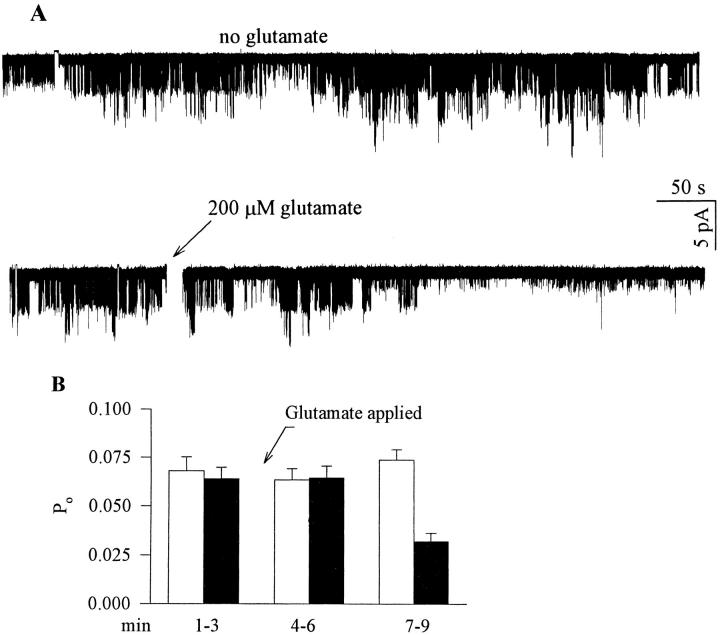
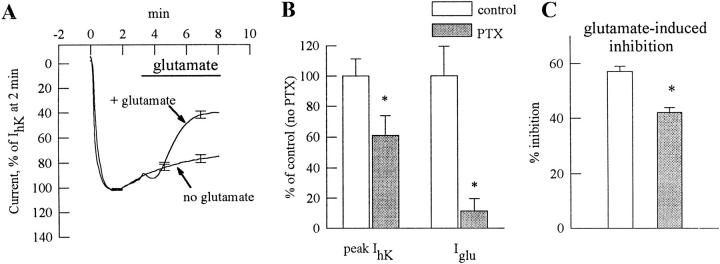
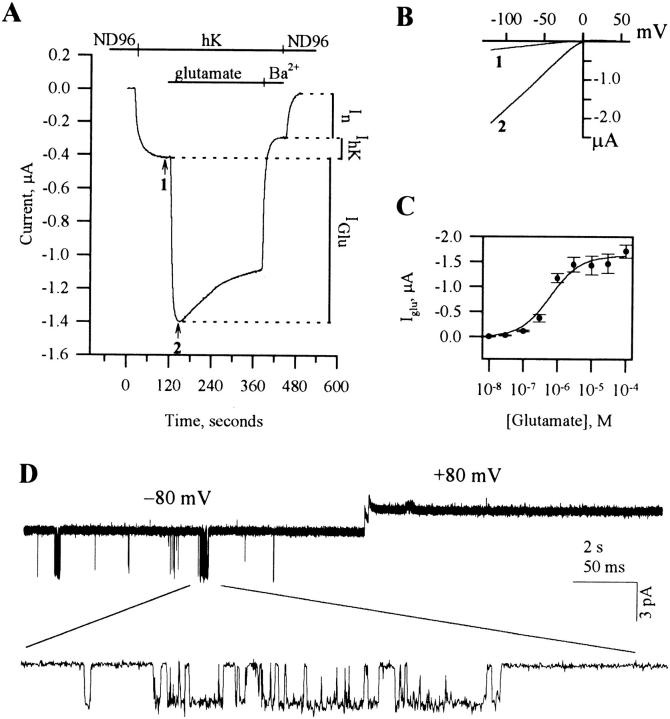
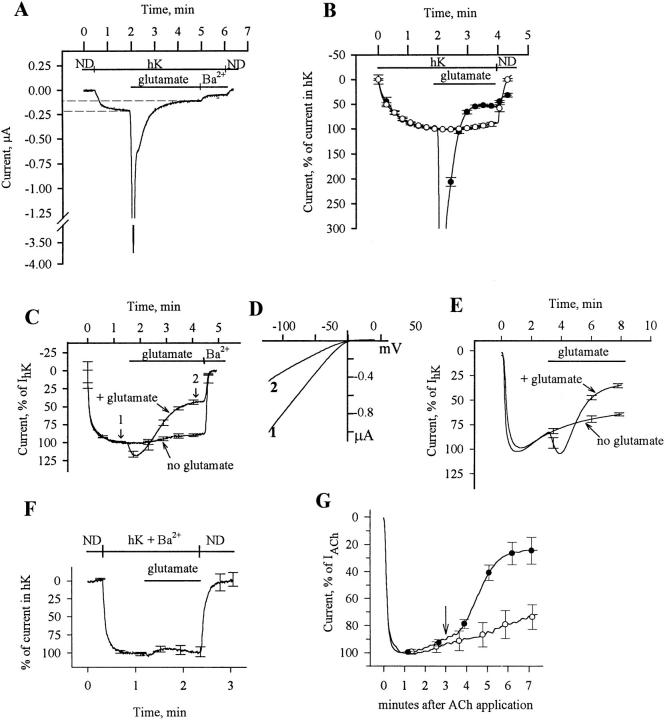
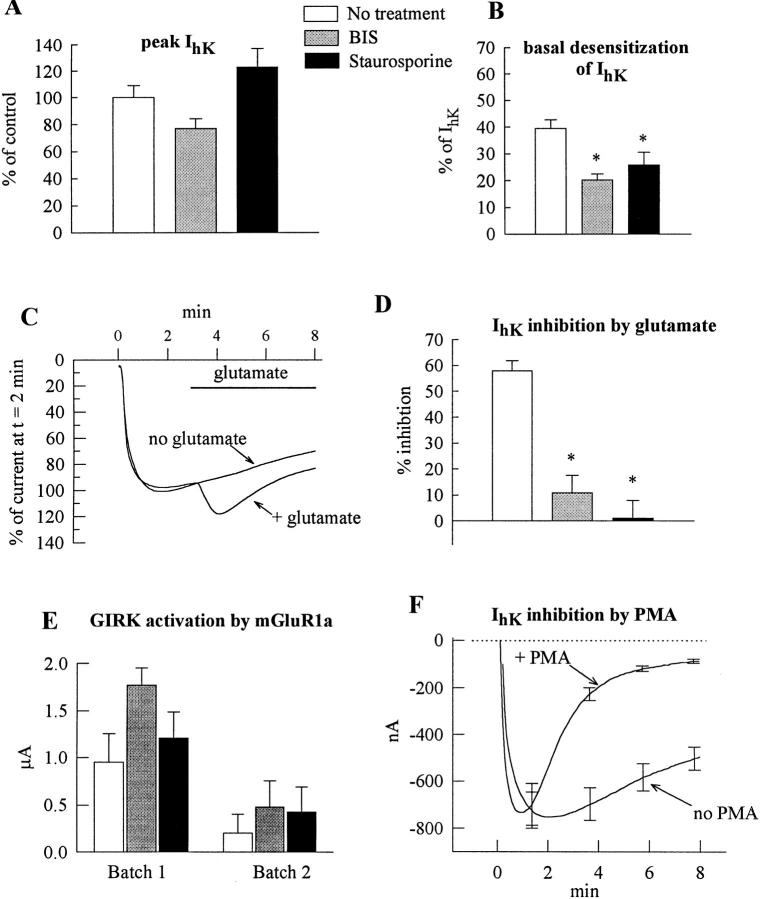
Metabotropic glutamate receptors (mGluRs) control intracellular signaling cascades through activation of G proteins. The inwardly rectifying K+ channel, GIRK, is activated by the beta gamma subunits of G proteins and is widely expressed in the brain. We investigated whether an interaction between mGluRs and GIRK is possible, using Xenopus oocytes expressing mGluRs and a cardiac/brain subunit of GIRK, GIRK1, with or without another brain subunit, GIRK2. mGluRs known to inhibit adenylyl cyclase (types 2, 3, 4, 6, and 7) activated the GIRK channel. The strongest response was observed with mGluR2; it was inhibited by pertussis toxin (PTX). This is consistent with the activation of GIRK by Gi/Go-coupled receptors. In contrast, mGluR1a and mGluR5 receptors known to activate phospholipase C, presumably via G proteins of the Gq class, inhibited the channel's activity. The inhibition was preceded by an initial weak activation, which was more prominent at higher levels of mGluR1a expression. The inhibition of GIRK activity by mGluR1a was suppressed by a broad-specificity protein kinase inhibitor, staurosporine, and by a specific protein kinase C (PKC) inhibitor, bis-indolylmaleimide, but not by PTX, Ca(2-)chelation, or calphostin C. Thus, mGluR1a inhibits the GIRK channel primarily via a pathway involving activation of a PTX-insensitive G protein and, eventually, of a subtype of PKC, possibly PKC-mu. In contrast, the initial activation of GIRK1 caused by mGluR1a was suppressed by PTX but not by the protein kinase inhibitors. Thus, this activation probably results from a promiscuous coupling of mGluR1a to a Gi/Go protein. The observed modulations may be involved in the mGluRs effects on neuronal excitability in the brain. Inhibition of GIRK by phospholipase C-activating mGluRs bears upon the problem of specificity of G protein (GIRK interaction) helping to explain why receptors coupled to Gq are inefficient in activating GIRK.
代谢型谷氨酸受体(mGluRs)通过激活G蛋白来控制细胞内信号级联反应。内向整流钾通道GIRK由G蛋白的βγ亚基激活,在大脑中广泛表达。我们利用表达mGluRs以及GIRK的心脏/脑亚基GIRK1(有或没有另一个脑亚基GIRK2)的非洲爪蟾卵母细胞,研究了mGluRs与GIRK之间是否可能存在相互作用。已知抑制腺苷酸环化酶的mGluRs(2型、3型、4型、6型和7型)激活了GIRK通道。mGluR2产生的反应最强;它被百日咳毒素(PTX)抑制。这与Gi/Go偶联受体对GIRK的激活一致。相比之下,已知通过Gq类G蛋白激活磷脂酶C的mGluR1a和mGluR5受体抑制了该通道的活性。在抑制之前有一个初始的弱激活,在较高水平的mGluR1a表达时更为明显。mGluR1a对GIRK活性的抑制被广谱特异性蛋白激酶抑制剂星形孢菌素和特异性蛋白激酶C(PKC)抑制剂双吲哚马来酰亚胺抑制,但不被PTX、Ca²⁺螯合剂或钙泊三醇C抑制。因此,mGluR1a主要通过涉及激活PTX不敏感G蛋白以及最终激活PKC亚型(可能是PKC-μ)的途径抑制GIRK通道。相比之下,mGluR1a引起的GIRK1的初始激活被PTX抑制,但不被蛋白激酶抑制剂抑制。因此,这种激活可能是由于mGluR1a与Gi/Go蛋白的混杂偶联导致的。观察到的调节作用可能参与了mGluRs对大脑中神经元兴奋性的影响。通过激活磷脂酶C的mGluRs对GIRK的抑制与G蛋白(GIRK相互作用)的特异性问题相关,有助于解释为什么与Gq偶联的受体在激活GIRK方面效率低下。