Bullock T N, Patterson A E, Franlin L L, Notidis E, Eisenlohr L C
Department of Microbiology and Immunology, Kimmel Cancer Center, Jefferson Medical College, Philadelphia, Pennsylvania 19107, USA.
J Exp Med. 1997 Oct 6;186(7):1051-8. doi: 10.1084/jem.186.7.1051.
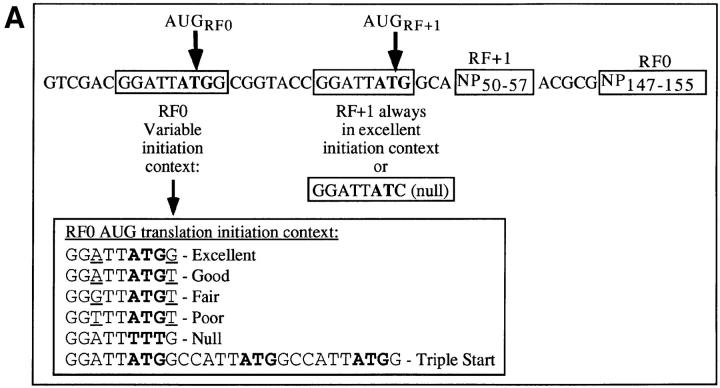
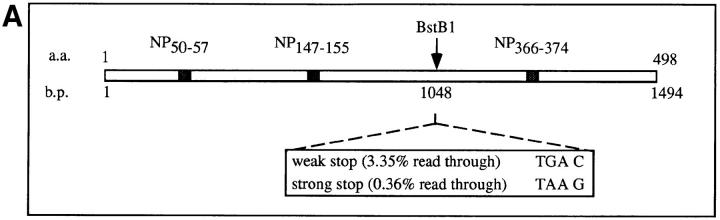
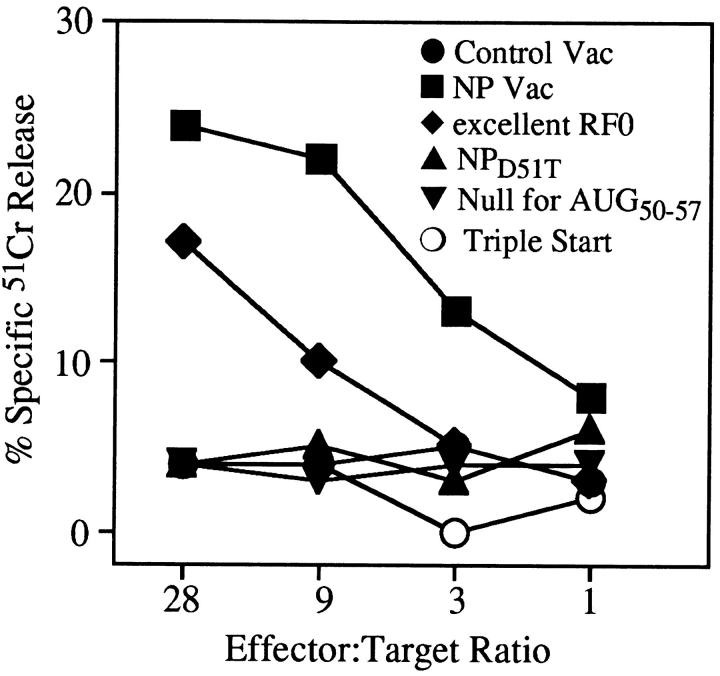
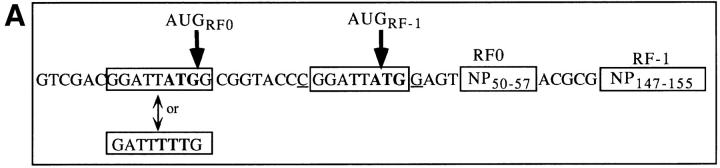
Accumulating evidence shows that the repertoire of major histocompatibility complex class I-restricted epitopes extends beyond conventional translation reading frames. Previously, we reported that scanthrough translation, where the initiating AUG of a primary open reading frame is bypassed, is most likely to account for the presentation of cryptic epitopes from alternative reading frames within the influenza A PR/8/34 nucleoprotein gene. Here, we confirm and extend these findings using an epitope cassette construct that features two well-defined CD8(+) T cell (TCD8+) epitopes in alternative reading frames, each preceded by a single start codon. Expression of one epitope depends on scanning of the ribosome over the first AUG with translation initiation occurring at the second AUG. We find that scanthrough translation has great potency in our system, with its impact being modulated, as predicted, by the base composition surrounding the first initiation codon, the number of start codons preceding the point of alternate reading frame initiation, and the efficiency with which the epitope itself is generated. Additionally, we investigated the efficiency of eukaryotic translation termination codons, to assess codon readthrough as a mechanism for cryptic epitope expression from 3' untranslated regions. In contrast with initiation codons, eukaryotic stop codons appear to be highly efficient at preventing expression of epitopes encoded in 3' untranslated regions, suggesting that 3' untranslated regions are not a common source of cryptic epitope substrate. We conclude that scanthrough is a powerful mechanism for the expression of epitopes encoded in upstream alternative open reading frames that may contribute significantly to TCD8+ responses and to tolerance induction.
越来越多的证据表明,主要组织相容性复合体I类限制性表位的库超出了传统的翻译阅读框。此前,我们报道过扫描通读翻译(即初级开放阅读框的起始AUG被跳过)最有可能解释甲型流感PR/8/34核蛋白基因内来自替代阅读框的隐蔽表位的呈递。在此,我们使用一个表位盒构建体证实并扩展了这些发现,该构建体在替代阅读框中具有两个明确的CD8⁺ T细胞(TCD8⁺)表位,每个表位之前都有一个起始密码子。一个表位的表达取决于核糖体对第一个AUG的扫描,翻译起始发生在第二个AUG。我们发现在我们的系统中扫描通读翻译具有很大的效力,其影响如预期的那样受到第一个起始密码子周围的碱基组成、替代阅读框起始点之前的起始密码子数量以及表位本身产生效率的调节。此外,我们研究了真核生物翻译终止密码子的效率,以评估密码子通读作为从3'非翻译区表达隐蔽表位的一种机制。与起始密码子不同,真核生物终止密码子似乎在防止3'非翻译区编码的表位表达方面非常有效,这表明3'非翻译区不是隐蔽表位底物的常见来源。我们得出结论,扫描通读是一种强大的机制,用于表达上游替代开放阅读框中编码的表位,这可能对TCD8⁺反应和耐受性诱导有显著贡献。