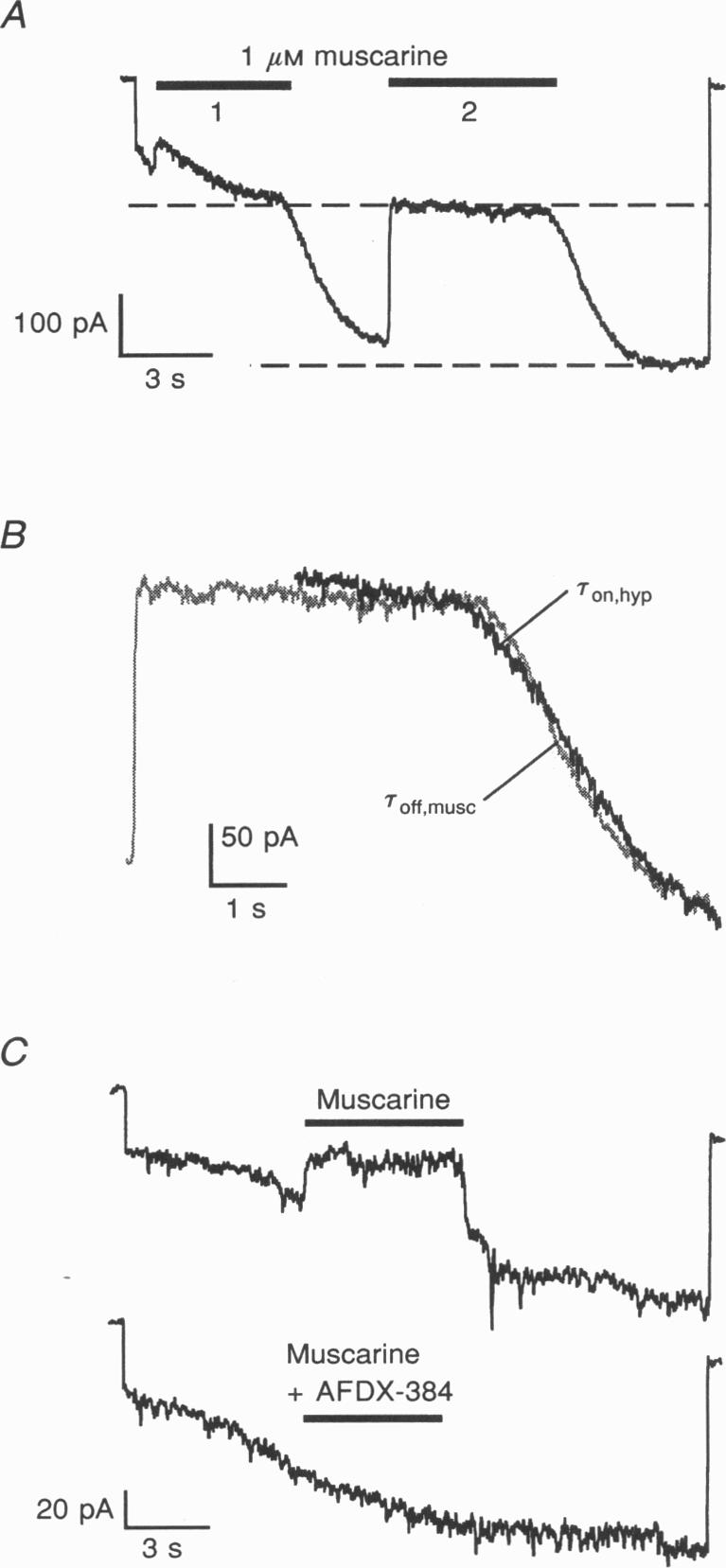
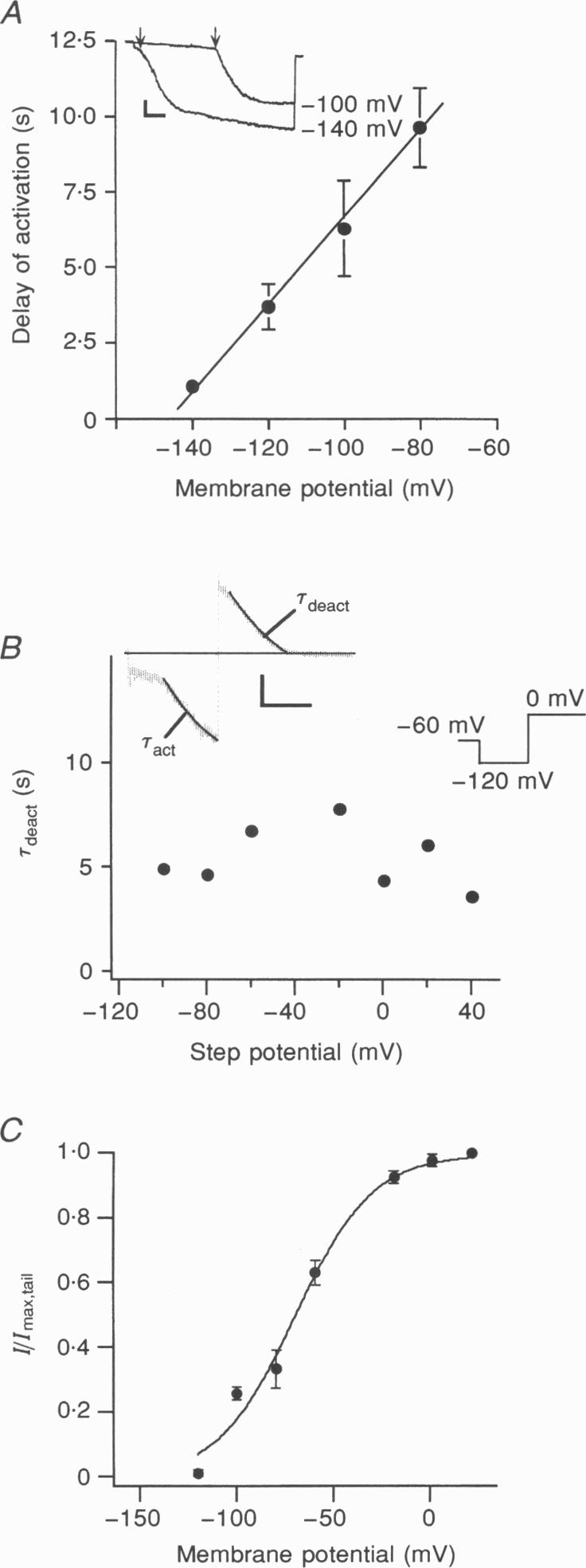
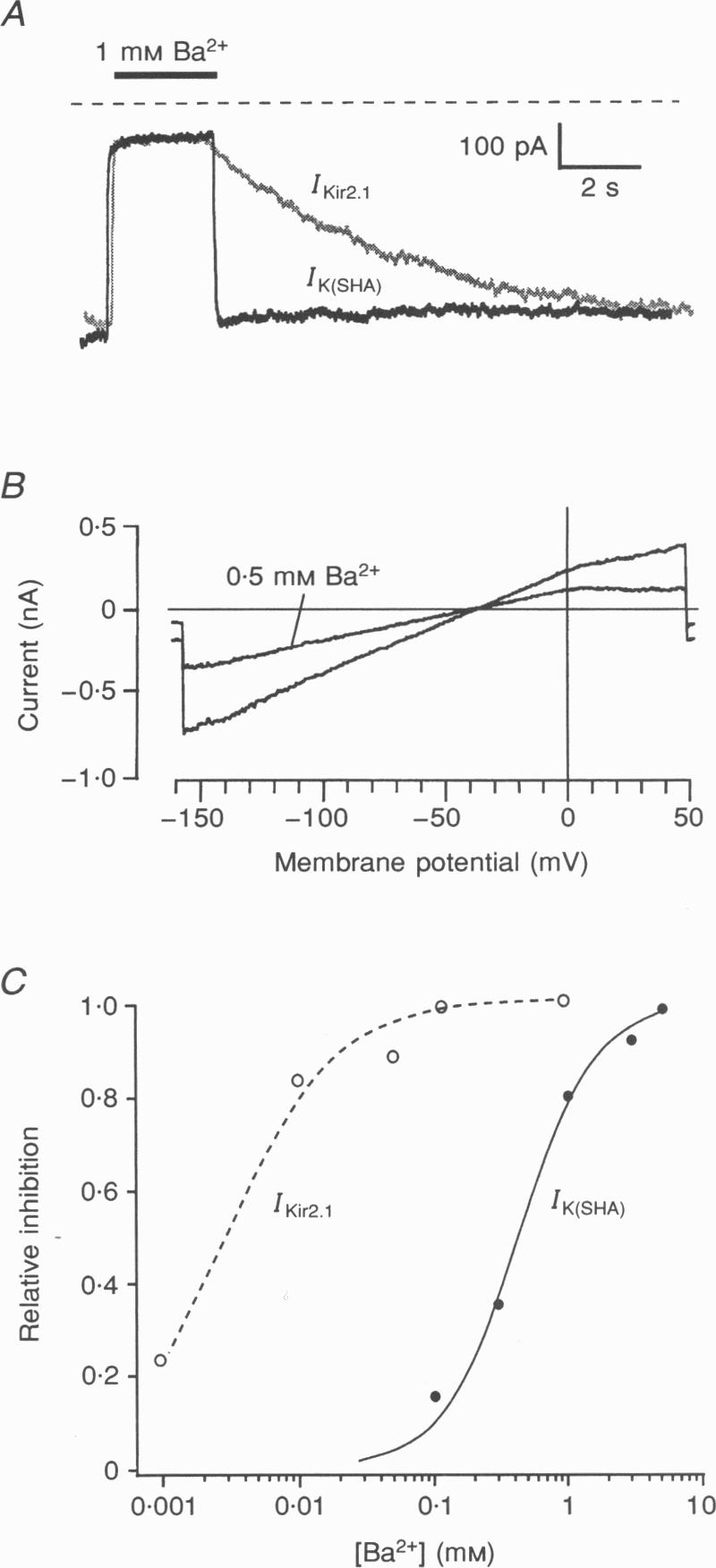
A slow hyperpolarization-activated inwardly rectifying K+ current (IK(SHA)) with novel characteristics was identified from the mouse embryonic hippocampus x neuroblastoma cell line HN9.10e. 2. The non-inactivating current activated negative to a membrane potential of -80 mV with slow and complex activation kinetics (tau act approximately 1-7 s) and a characteristic delay of 1-10 s (-80 to -140 mV) that was linearly dependent on the membrane potential. 3. Tail currents and instantaneous open channel currents determined through fast voltage ramps reversed at the K+ equilibrium potential (EK) indicating that primarily K+, but not Na+, permeated the channels. 4. IK(SHA) was unaffected by altering the intracellular Ca2+ concentration between approximately 0 and 10 microM, but was susceptible to block by 5 mM extracellular Ca2+, Ba2+ (Ki = 0.42 mM), and Cs+ (Ki = 2.77 mM) 5. In cells stably transformed with M2 muscarinic receptors, IK(SHA) was rapidly, but reversibly, suppressed by application of micromolar concentrations of muscarine. 6. At the single channel level K(SHA) channel openings were observed with the characteristic delay upon membrane hyperpolarization. Analysis of unitary currents revealed an inwardly rectifying I-V profile and a channel slope conductance of 7 pS. Channel activity persisted in the inside-out configuration for many minutes. 7. It is concluded that IK(SHA) in HN9.10e cells represents a novel K+ current, which is activated upon membrane hyperpolarization. It is functionally different from both classic inwardly rectifying IKir currents and other cationic hyperpolarization-activated IH currents that have been previously described in neuronal or glial cells.