Wieczorek D, Engels H, Viersbach R, Henke B, Schwanitz G, Passarge E
Institut für Humangenetik, Universitätsklinikum Essen, Germany.
J Med Genet. 1998 Jul;35(7):545-53. doi: 10.1136/jmg.35.7.545.
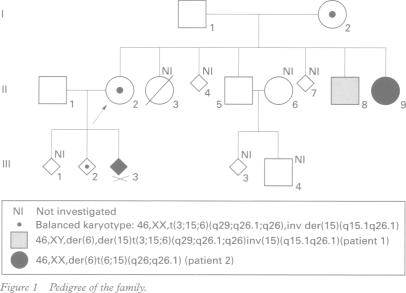
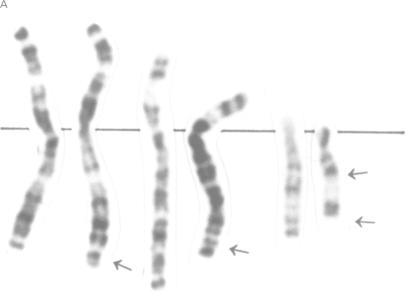
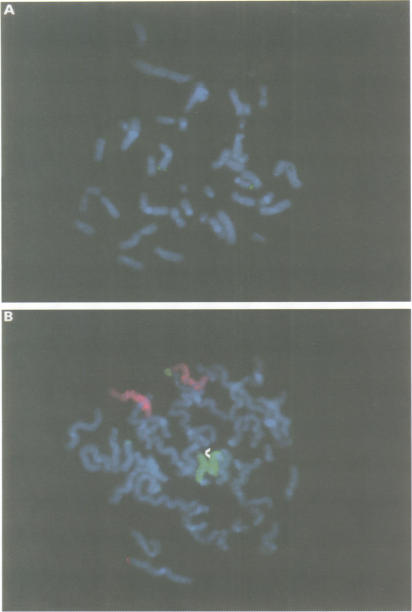
We report on a familial three way translocation involving chromosomes 3, 6, and 15 identified by prometaphase banding and fluorescence in situ hybridisation (FISH). Two mentally retarded sibs with different phenotypic abnormalities, their phenotypically normal sister and mother, and two fetuses of the phenotypically normal sister were analysed. The terminal regions of chromosomes 3q, 6q, and 15q were involved in a reciprocal translocation, in addition to a paracentric inversion of the derivative chromosome 15. Conventional cytogenetic studies with high resolution GTG banding did not resolve this rearrangement. FISH using whole chromosome paints (WCPs) identified the chromosomal regions involved, except the aberrant region of 3q, which was undetectable with these probes. Investigation of this region with the subtelomeric FISH probe D3S1445/D3S1446 showed a balanced karyotype, 46,XX,t(3;15;6) (q29;q26.1;q26), inv der(15) (q15.1q26.1) in two adult females and one fetus. It was unbalanced in two sibs, showing two different types of unbalanced translocation resulting in partial trisomy 3q in combination with partial monosomy 6q in one patient and partial trisomy 15q with partial monosomy 6q in the other patient and one fetus. These represent apparently new chromosomal phenotypes.
我们报告了一例通过早中期显带和荧光原位杂交(FISH)鉴定的涉及3号、6号和15号染色体的家族性三向易位。对两名患有不同表型异常的智力发育迟缓同胞、他们表型正常的姐妹和母亲,以及表型正常姐妹的两个胎儿进行了分析。除了衍生染色体15的臂内倒位外,3号染色体长臂(3q)、6号染色体长臂(6q)和15号染色体长臂(15q)的末端区域参与了相互易位。采用高分辨率GTG显带的传统细胞遗传学研究未能解析这种重排。使用全染色体涂染探针(WCPs)的FISH确定了所涉及的染色体区域,但3q的异常区域用这些探针无法检测到。用亚端粒FISH探针D3S1445/D3S1446对该区域进行检测,结果显示两名成年女性和一名胎儿的核型为平衡型,即46,XX,t(3;15;6) (q29;q26.1;q26),inv der(15) (q15.1q26.1)。在两名同胞中核型是不平衡的,表现为两种不同类型的不平衡易位,导致一名患者出现3q部分三体合并6q部分单体,另一名患者和一名胎儿出现15q部分三体合并6q部分单体。这些代表了明显新的染色体表型。