Gordon M, Choe N, Duffy J, Ekuan G, Heilman P, Muiznieks I, Ruszaj M, Shurtleff B B, Strand S, Wilmoth J, Newman L A
University of Washington, Dept. of Biochemistry, Seattle 98195-7350, USA.
Environ Health Perspect. 1998 Aug;106 Suppl 4(Suppl 4):1001-4. doi: 10.1289/ehp.98106s41001.
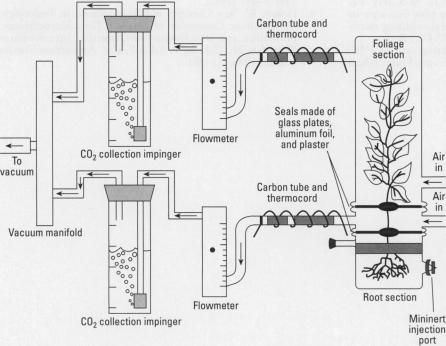
Axenic tumor cultures of poplar cells, clone H11-11, were grown in the presence of [14C]-trichloroethylene (TCE) (uniformly labeled). The cells were capable of metabolizing TCE to produce trichloroethanol, di- and trichloroacetic acid. Some of the carbon from TCE was found in insoluble, nonextractable cell residue, and small amounts were mineralized to [14C]CO2. Poplar cuttings grown in soil and exposed to TCE produced the same metabolites. In field trials, trees were planted in soil in test cells and exposed to TCE via underground water injection during the growing season. During the growing season, at least 95% of the TCE was removed from the influent water stream in cells containing trees. Mass balance studies conducted in the laboratory indicated that 70 to 90% of the TCE was transpired; however, greenhouse and field study results showed that less than 5% of the total TCE taken up by the plants is transpired. These results show that significant TCE uptake and degradation occur in poplars. Poplars appear to be useful for in situ remediation of TCE-contaminated sites under proper conditions.
杨树细胞克隆H11 - 11的无菌肿瘤培养物在[14C] - 三氯乙烯(TCE)(均匀标记)存在的情况下生长。这些细胞能够代谢TCE,产生三氯乙醇、二氯乙酸和三氯乙酸。TCE中的一些碳存在于不溶性、不可提取的细胞残渣中,少量被矿化为[14C]CO2。生长在土壤中并接触TCE的杨树插条产生了相同的代谢产物。在田间试验中,树木种植在试验单元的土壤中,在生长季节通过地下水注入接触TCE。在生长季节,含有树木的单元中,至少95%的TCE从进水水流中被去除。在实验室进行的质量平衡研究表明,70%至90%的TCE被蒸腾;然而,温室和田间研究结果表明,植物吸收的总TCE中只有不到5%被蒸腾。这些结果表明杨树对TCE有显著的吸收和降解作用。在适当条件下,杨树似乎可用于原位修复受TCE污染的场地。