Infante C, Ramos-Morales F, Fedriani C, Bornens M, Rios R M
Departamento de Microbiología, Facultad de Biología, Universidad de Sevilla Apdo. 1095, 41080-Sevilla, Spain.
J Cell Biol. 1999 Apr 5;145(1):83-98. doi: 10.1083/jcb.145.1.83.
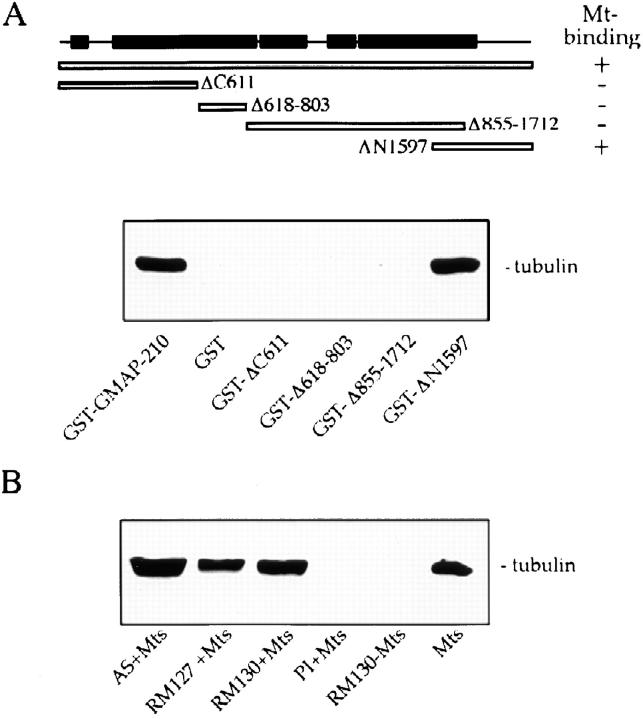
We report that a peripheral Golgi protein with a molecular mass of 210 kD localized at the cis-Golgi network (Rios, R.M., A.M. Tassin, C. Celati, C. Antony, M.C. Boissier, J.C. Homberg, and M. Bornens. 1994. J. Cell Biol. 125:997-1013) is a microtubule-binding protein that associates in situ with a subpopulation of stable microtubules. Interaction of this protein, now called GMAP-210, for Golgi microtubule-associated protein 210, with microtubules in vitro is direct, tight and nucleotide-independent. Biochemical analysis further suggests that GMAP-210 specifically binds to microtubule ends. The full-length cDNA encoding GMAP-210 predicts a protein of 1, 979 amino acids with a very long central coiled-coil domain. Deletion analyses in vitro show that the COOH terminus of GMAP-210 binds to microtubules whereas the NH2 terminus binds to Golgi membranes. Overexpression of GMAP-210-encoding cDNA induced a dramatic enlargement of the Golgi apparatus and perturbations in the microtubule network. These effects did not occur when a mutant lacking the COOH-terminal domain was expressed. When transfected in fusion with the green fluorescent protein, the NH2-terminal domain associated with the cis-Golgi network whereas the COOH-terminal microtubule-binding domain localized at the centrosome. Altogether these data support the view that GMAP-210 serves to link the cis-Golgi network to the minus ends of centrosome-nucleated microtubules. In addition, this interaction appears essential for ensuring the proper morphology and size of the Golgi apparatus.
我们报道,一种分子量为210 kD的外周高尔基体蛋白定位于顺面高尔基体网络(里奥斯,R.M.,A.M. 塔辛,C. 塞拉蒂,C. 安东尼,M.C. 布瓦西耶,J.C. 洪伯格,以及M. 博尔南斯。1994年。《细胞生物学杂志》125:997 - 1013),它是一种微管结合蛋白,在原位与稳定微管的一个亚群相关联。这种现在称为GMAP - 210(高尔基体微管相关蛋白210)的蛋白与微管在体外的相互作用是直接、紧密且不依赖核苷酸的。生化分析进一步表明GMAP - 210特异性结合微管末端。编码GMAP - 210的全长cDNA预测的蛋白质有1979个氨基酸,带有一个非常长的中央卷曲螺旋结构域。体外缺失分析表明GMAP - 210的COOH末端与微管结合,而NH2末端与高尔基体膜结合。编码GMAP - 210的cDNA的过表达导致高尔基体显著增大以及微管网络紊乱。当表达一个缺失COOH末端结构域的突变体时,这些效应并未出现。当与绿色荧光蛋白融合转染时,NH2末端结构域与顺面高尔基体网络相关联,而COOH末端微管结合结构域定位于中心体。总之,这些数据支持这样一种观点,即GMAP - 210用于将顺面高尔基体网络连接到中心体成核微管的负端。此外,这种相互作用对于确保高尔基体的正常形态和大小似乎至关重要。