Department of Medical Research, Translational Cell Therapy Center, China Medical University Hospital, Taichung, Taiwan.
Graduate Institute of Biomedical Sciences, China Medical University, Taichung, Taiwan.
Cell Commun Signal. 2023 Jun 27;21(1):156. doi: 10.1186/s12964-023-01167-4.
Golgi apparatus (GA) is assembled as a crescent-like ribbon in mammalian cells under immunofluorescence microscope without knowing the shaping mechanisms. It is estimated that roughly 1/5 of the genes encoding kinases or phosphatases in human genome participate in the assembly of Golgi ribbon, reflecting protein modifications play major roles in building Golgi ribbon.
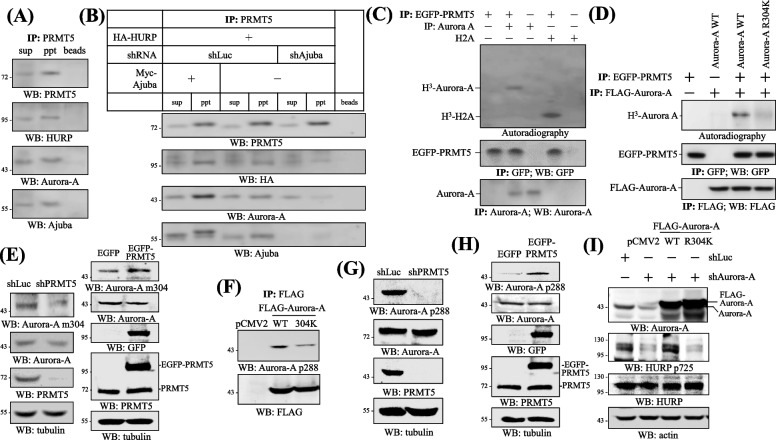
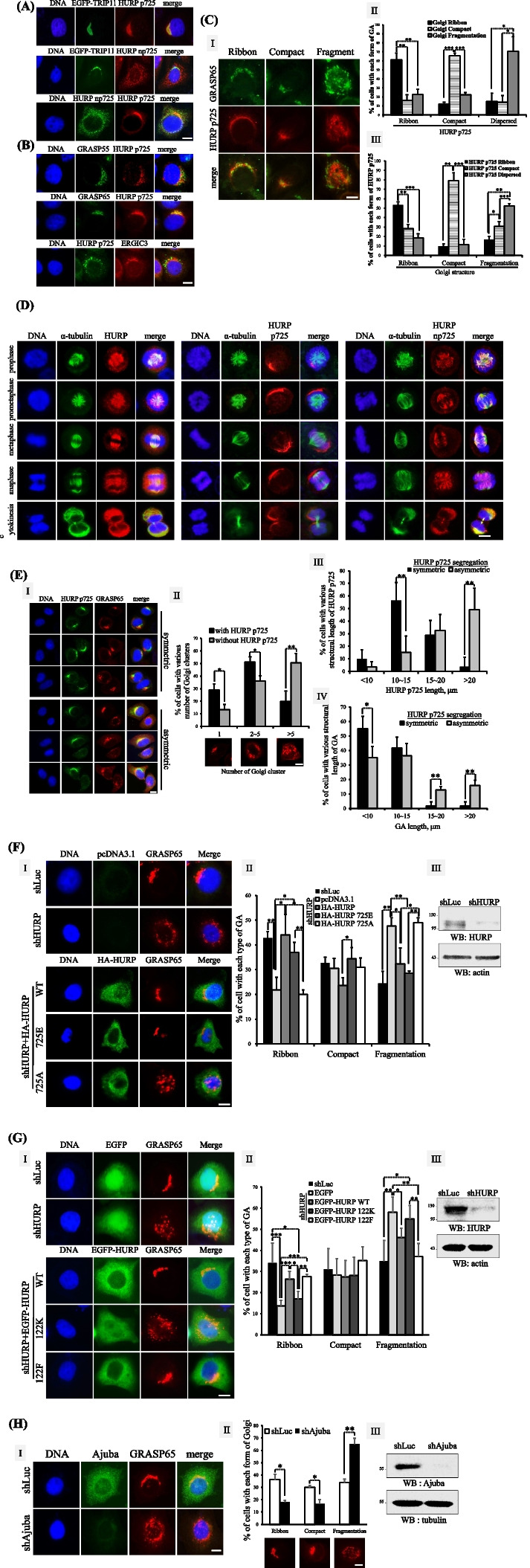
To explore how Golgi ribbon is shaped as a crescent-like structure under the guidance of protein modifications, we identified a protein complex containing the scaffold proteins Ajuba, two known GA regulators including the protein kinase Aurora-A and the protein arginine methyltransferase PRMT5, and the common substrate of Aurora-A and PRMT5, HURP. Mutual modifications and activation of PRMT5 and Aurora-A in the complex leads to methylation and in turn phosphorylation of HURP, thereby producing HURP p725. The HURP p725 localizes to GA vicinity and its distribution pattern looks like GA morphology. Correlation study of the HURP p725 statuses and GA structure, site-directed mutagenesis and knockdown-rescue experiments were employed to identify the modified HURP as a key regulator assembling GA as a crescent ribbon.
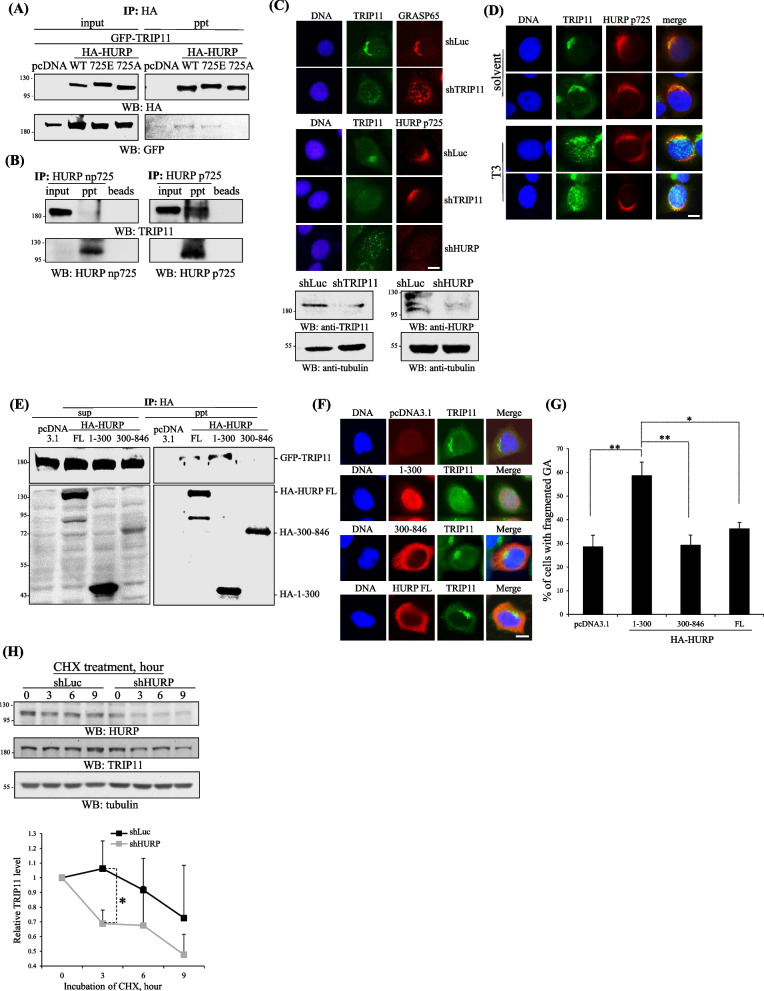
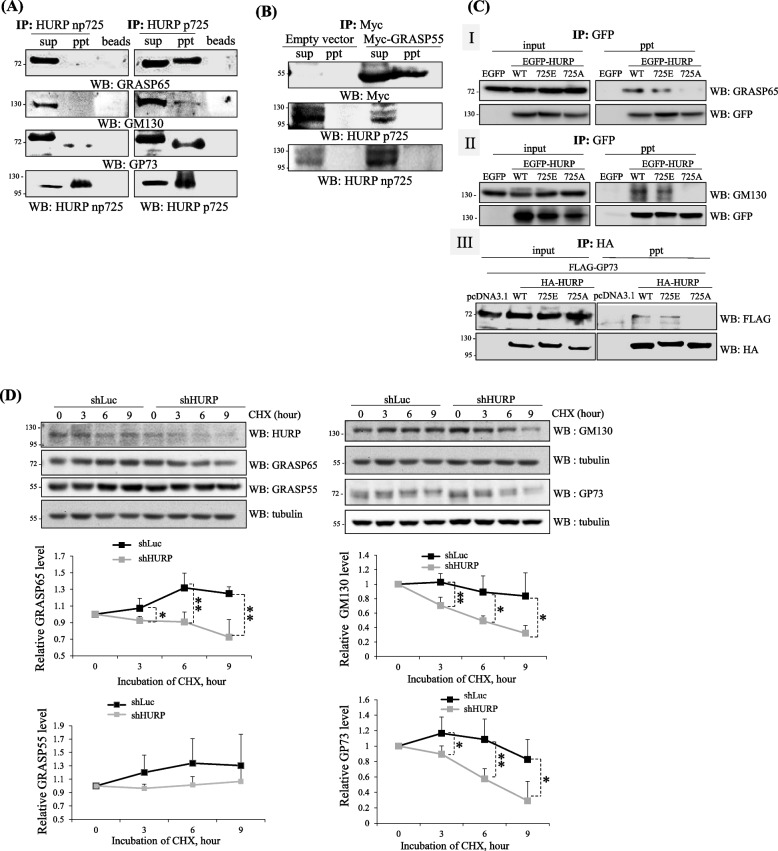
The cells containing no or extended distribution of HURP p725 have dispersed GA membranes or longer GA. Knockdown of HURP fragmentized GA and HURP wild type could, while its phosphorylation deficiency mutant 725A could not, restore crescent Golgi ribbon in HURP depleted cells, collectively indicating a crescent GA-constructing activity of HURP p725. HURP p725 is transported, by GA membrane-associated ARF1, Dynein and its cargo adaptor Golgin-160, to cell center where HURP p725 forms crescent fibers, binds and stabilizes Golgi assembly factors (GAFs) including TRIP11, GRASP65 and GM130, thereby dictating the formation of crescent Golgi ribbon at nuclear periphery.
The Ajuba/PRMT5/Aurora-A complex integrates the signals of protein methylation and phosphorylation to HURP, and the HURP p725 organizes GA by stabilizing and recruiting GAFs to its crescent-like structure, therefore shaping GA as a crescent ribbon. Therefore, the HURP p725 fiber serves a template to construct GA according to its shape. Video Abstract.
在免疫荧光显微镜下,哺乳动物细胞中的高尔基氏体(GA)呈新月形带状排列,但我们并不清楚其形成机制。据估计,人类基因组中约有 1/5 的编码蛋白激酶或磷酸酶的基因参与了高尔基带的组装,这表明蛋白修饰在构建高尔基带的过程中起着重要作用。
为了探究在蛋白修饰的指导下,高尔基带如何形成新月形结构,我们鉴定出一个包含支架蛋白 Ajuba、两种已知的 GA 调节剂(蛋白激酶 Aurora-A 和蛋白精氨酸甲基转移酶 PRMT5)以及 Aurora-A 和 PRMT5 的共同底物 HURP 的蛋白复合物。该复合物中 PRMT5 和 Aurora-A 的相互修饰和激活导致 HURP 的甲基化和随后的磷酸化,从而产生 HURP p725。HURP p725 定位于 GA 附近,其分布模式类似于 GA 形态。通过 HURP p725 状态与 GA 结构的相关性研究、定点突变和敲低-拯救实验,确定了修饰后的 HURP 是将 GA 组装成新月形带的关键调节因子。
细胞中没有 HURP p725 或其分布延伸,GA 膜就会分散或变得更长。敲低 HURP 会使 GA 碎片化,而 HURP 野生型则可以,但其磷酸化缺陷突变体 725A 则不能,这表明 HURP p725 具有新月形 GA 构建活性。HURP p725 通过与 GA 膜相关的 ARF1、Dynein 和其货物衔接蛋白 Golgin-160 一起被运输到细胞中心,在那里 HURP p725 形成新月形纤维,与包括 TRIP11、GRASP65 和 GM130 在内的 Golgi 组装因子结合并稳定它们,从而在核周形成新月形的 Golgi 带。
Ajuba/PRMT5/Aurora-A 复合物将蛋白甲基化和磷酸化信号整合到 HURP 上,而 HURP p725 通过稳定并募集 GAFs 到其新月形结构来组织 GA,从而将 GA 塑造成新月形带。因此,HURP p725 纤维根据其形状为 GA 的构建提供了一个模板。视频摘要。