Takahashi Y, Cerasoli D M, Dal Porto J M, Shimoda M, Freund R, Fang W, Telander D G, Malvey E N, Mueller D L, Behrens T W, Kelsoe G
Department of Microbiology and Immunology, University of Maryland School of Medicine, Baltimore 21201, USA.
J Exp Med. 1999 Aug 2;190(3):399-410. doi: 10.1084/jem.190.3.399.
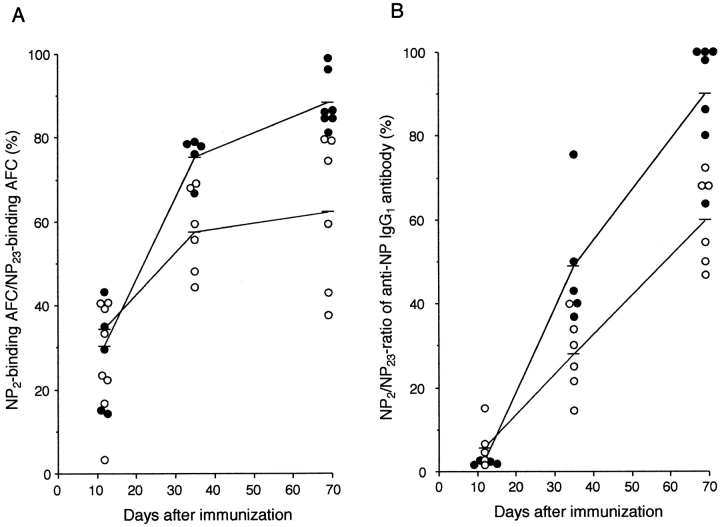
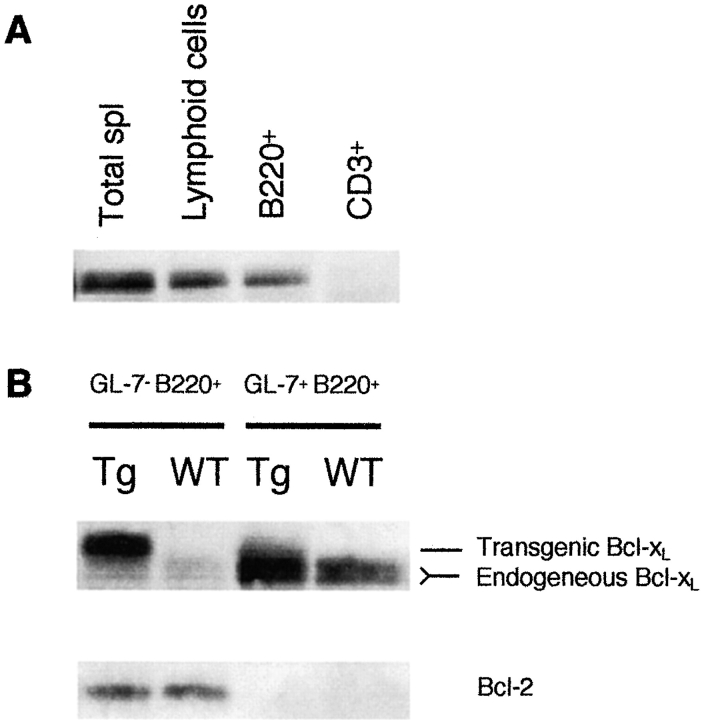
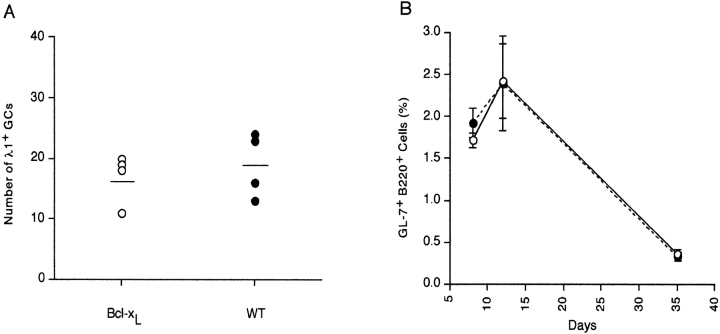
The role of apoptosis in affinity maturation was investigated by determining the affinity of (4-hydroxy-3-nitrophenyl)acetyl (NP)-specific antibody-forming cells (AFCs) and serum antibody in transgenic mice that overexpress a suppressor of apoptosis, Bcl-xL, in the B cell compartment. Although transgenic animals briefly expressed higher numbers of splenic AFCs after immunization, the bcl-xL transgene did not increase the number or size of germinal centers (GCs), alter the levels of serum antibody, or change the frequency of NP-specific, long-lived AFCs. Nonetheless, the bcl-xL transgene product, in addition to endogenous Bcl-xL, reduced apoptosis in GC B cells and resulted in the expansion of B lymphocytes bearing VDJ rearrangements that are usually rare in primary anti-NP responses. Long-lived AFCs bearing these noncanonical rearrangements were frequent in the bone marrow and secreted immunoglobulin G(1) antibodies with low affinity for NP. The abundance of noncanonical cells lowered the average affinity of long-lived AFCs and serum antibody, demonstrating that Bcl-xL and apoptosis influence clonal selection/maintenance for affinity maturation.
通过测定在B细胞区室中过表达凋亡抑制因子Bcl-xL的转基因小鼠中,(4-羟基-3-硝基苯基)乙酰(NP)特异性抗体形成细胞(AFC)和血清抗体的亲和力,研究了凋亡在亲和力成熟中的作用。尽管转基因动物在免疫后脾脏AFC的数量短暂增加,但bcl-xL转基因并未增加生发中心(GC)的数量或大小,未改变血清抗体水平,也未改变NP特异性长寿AFC的频率。尽管如此,bcl-xL转基因产物除了内源性Bcl-xL外,还减少了GC B细胞中的凋亡,并导致携带VDJ重排的B淋巴细胞扩增,而这些重排在原发性抗NP反应中通常很少见。携带这些非典型重排的长寿AFC在骨髓中很常见,并分泌对NP亲和力低的免疫球蛋白G(1)抗体。非典型细胞的大量存在降低了长寿AFC和血清抗体的平均亲和力,表明Bcl-xL和凋亡影响亲和力成熟的克隆选择/维持。