Henkart P, Blumenthal R
Proc Natl Acad Sci U S A. 1975 Jul;72(7):2789-93. doi: 10.1073/pnas.72.7.2789.
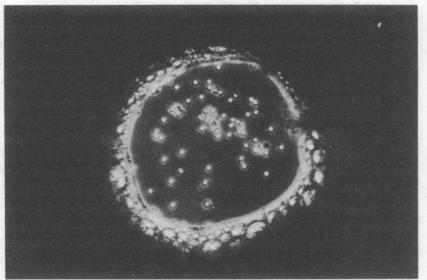
Horizontal lipid bilayer membranes were used as a model system to study lymphocyte-mediated killing of target cells. Dinitrophenylated lipid bilayers can physically support dozens of lymphocytes for periods of over one hour without breakage or increasing the electrical conductance of the membrane. However, in the presence of antibody against Dnp, human lymphocytes rapidly induced increases in membrane conductance of several orders of magnitude without membrane breakage. Such ionic permeability increases occurred only when the membrane voluage was positive on the lymphocyte side, as would be the case with a target cell membrane. The lymphocyte and antibody dependence of this conductance increase parallels that observed for lymphocyte killing of antibody-coated target cells. The results are interpreted as evidence that the primary event in lymphocyte killing of antibody-coated target cells is the creation of ion-conducting channels in the target membrane.
水平脂质双层膜被用作模型系统来研究淋巴细胞介导的靶细胞杀伤作用。二硝基苯基化脂质双层能够在数小时内物理性地支持数十个淋巴细胞,而不会出现破裂或增加膜的电导。然而,在存在抗二硝基苯基抗体的情况下,人类淋巴细胞能迅速诱导膜电导增加几个数量级,且膜不会破裂。这种离子通透性增加仅在淋巴细胞一侧的膜电位为正时才会发生,这与靶细胞膜的情况相同。这种电导增加对淋巴细胞和抗体的依赖性与观察到的淋巴细胞杀伤抗体包被靶细胞的情况相似。这些结果被解释为证据,表明淋巴细胞杀伤抗体包被靶细胞的主要事件是在靶膜中形成离子传导通道。