Jiang Y, MacKinnon R
Howard Hughes Medical Institute, Laboratory of Molecular Neurobiology and Biophysics, The Rockefeller University, New York, New York 10021, USA.
J Gen Physiol. 2000 Mar;115(3):269-72. doi: 10.1085/jgp.115.3.269.
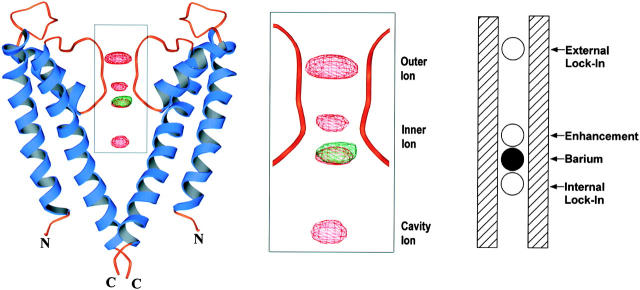
X-ray diffraction data were collected from frozen crystals (100 degrees K) of the KcsA K(+) channel equilibrated with solutions containing barium chloride. Difference electron density maps (F(barium) - F(native), 5.0 A resolution) show that Ba(2+) resides at a single location within the selectivity filter. The Ba(2+) blocking site corresponds to the internal aspect (adjacent to the central cavity) of the "inner ion" position where an alkali metal cation is found in the absence of the blocking Ba(2+) ion. The location of Ba(2+) with respect to Rb(+) ions in the pore is in good agreement with the findings on the functional interaction of Ba(2+) with K(+) (and Rb(+)) in Ca(2+)-activated K(+) channels (Neyton, J., and C. Miller. 1988. J. Gen. Physiol. 92:549-567). Taken together, these structural and functional data imply that at physiological ion concentrations a third ion may interact with two ions in the selectivity filter, perhaps by entering from one side and displacing an ion on the opposite side.
从与含氯化钡溶液平衡的KcsA钾通道的冷冻晶体(100K)收集X射线衍射数据。差分电子密度图(F(钡) - F(天然态),分辨率5.0 Å)显示钡离子(Ba(2+))位于选择性过滤器内的单个位置。钡离子阻断位点对应于“内离子”位置的内部(与中央腔相邻),在没有阻断性钡离子的情况下,此处会发现一个碱金属阳离子。钡离子在孔中相对于铷离子(Rb(+))的位置与钡离子在钙激活钾通道中与钾离子(和铷离子)功能相互作用的研究结果高度一致(内顿,J.,和C. 米勒。1988年。《普通生理学杂志》92:549 - 567)。综合来看,这些结构和功能数据表明,在生理离子浓度下,第三个离子可能与选择性过滤器中的两个离子相互作用,也许是从一侧进入并取代另一侧的离子。