Gibor Gilad, Yakubovich Daniel, Peretz Asher, Attali Bernard
Department of Physiology and Pharmacology, Sackler Medical School, Tel Aviv University, Tel Aviv 69978, Israel.
J Gen Physiol. 2004 Jul;124(1):83-102. doi: 10.1085/jgp.200409068.
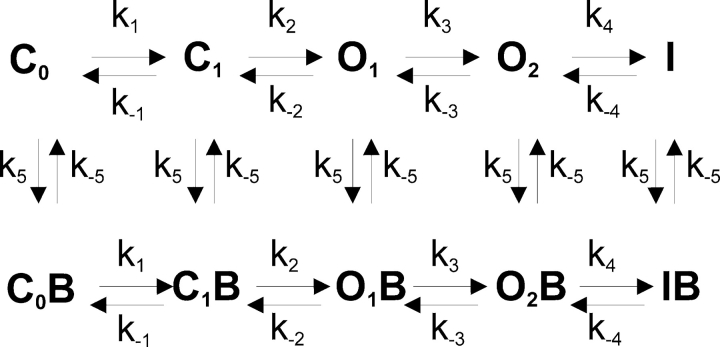
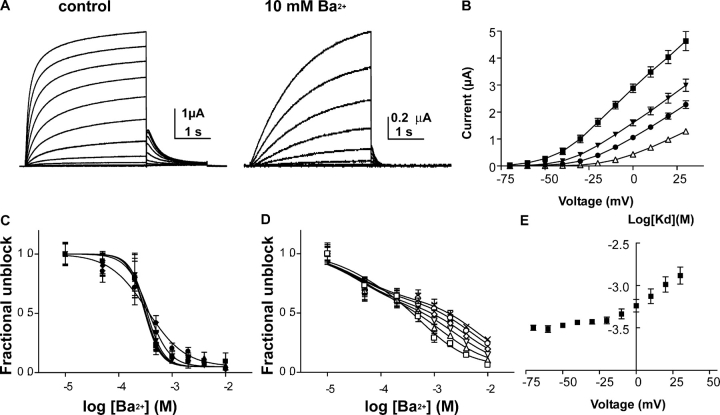
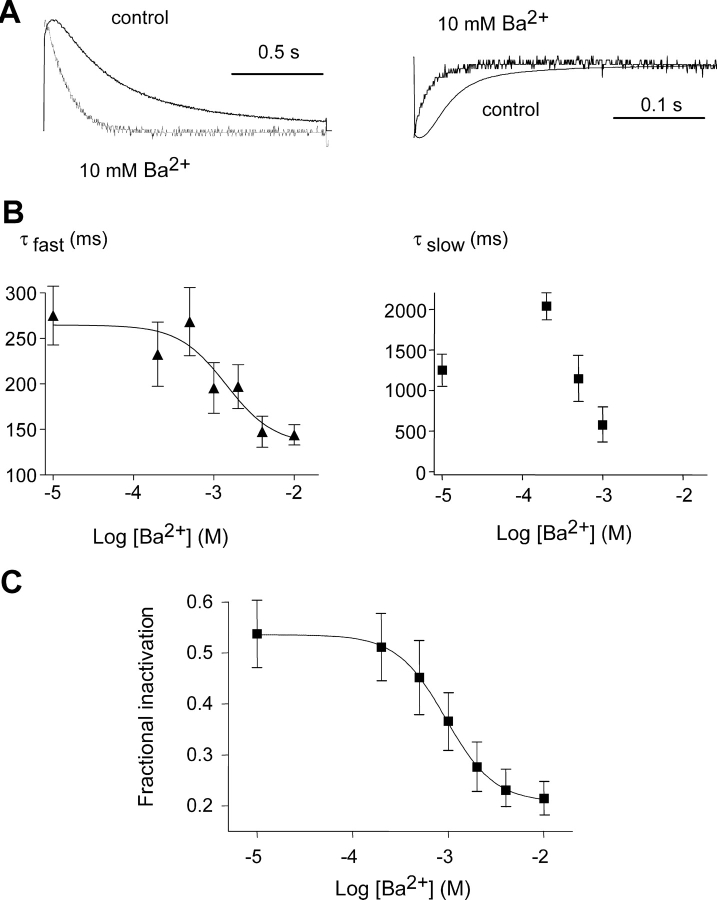
The pore properties and the reciprocal interactions between permeant ions and the gating of KCNQ channels are poorly understood. Here we used external barium to investigate the permeation characteristics of homomeric KCNQ1 channels. We assessed the Ba(2+) binding kinetics and the concentration and voltage dependence of Ba(2+) steady-state block. Our results indicate that extracellular Ba(2+) exerts a series of complex effects, including a voltage-dependent pore blockade as well as unique gating alterations. External barium interacts with the permeation pathway of KCNQ1 at two discrete and nonsequential sites. (a) A slow deep Ba(2+) site that occludes the channel pore and could be simulated by a model of voltage-dependent block. (b) A fast superficial Ba(2+) site that barely contributes to channel block and mostly affects channel gating by shifting rightward the voltage dependence of activation, slowing activation, speeding up deactivation kinetics, and inhibiting channel inactivation. A model of voltage-dependent block cannot predict the complex impact of Ba(2+) on channel gating in low external K(+) solutions. Ba(2+) binding to this superficial site likely modifies the gating transitions states of KCNQ1. Both sites appear to reside in the permeation pathway as high external K(+) attenuates Ba(2+) inhibition of channel conductance and abolishes its impact on channel gating. Our data suggest that despite the high degree of homology of the pore region among the various K(+) channels, KCNQ1 channels display significant structural and functional uniqueness.
钾离子通道(KCNQ)的孔道特性以及通透离子与通道门控之间的相互作用目前仍知之甚少。在此,我们使用外部钡离子来研究同聚体KCNQ1通道的通透特性。我们评估了钡离子(Ba²⁺)的结合动力学以及Ba²⁺稳态阻断的浓度和电压依赖性。我们的结果表明,细胞外Ba²⁺会产生一系列复杂效应,包括电压依赖性的孔道阻断以及独特的门控改变。外部钡离子在两个不连续的位点与KCNQ1的通透途径相互作用。(a)一个缓慢且深入的Ba²⁺位点,它会堵塞通道孔道,并且可以通过电压依赖性阻断模型进行模拟。(b)一个快速且浅表的Ba²⁺位点,它对通道阻断的贡献很小,主要通过使激活的电压依赖性向右移动、减慢激活速度、加快失活动力学以及抑制通道失活来影响通道门控。电压依赖性阻断模型无法预测Ba²⁺在低外部钾离子(K⁺)溶液中对通道门控的复杂影响。Ba²⁺与这个浅表位点的结合可能会改变KCNQ1的门控过渡状态。这两个位点似乎都位于通透途径中,因为高外部K⁺会减弱Ba²⁺对通道电导的抑制作用,并消除其对通道门控的影响。我们的数据表明,尽管各种钾离子通道的孔道区域具有高度同源性,但KCNQ1通道仍表现出显著的结构和功能独特性。