Avila G, Dirksen R T
Department of Pharmacology, University of Rochester School of Medicine and Dentistry, Rochester, New York 14642, USA.
J Gen Physiol. 2000 Apr;115(4):467-80. doi: 10.1085/jgp.115.4.467.
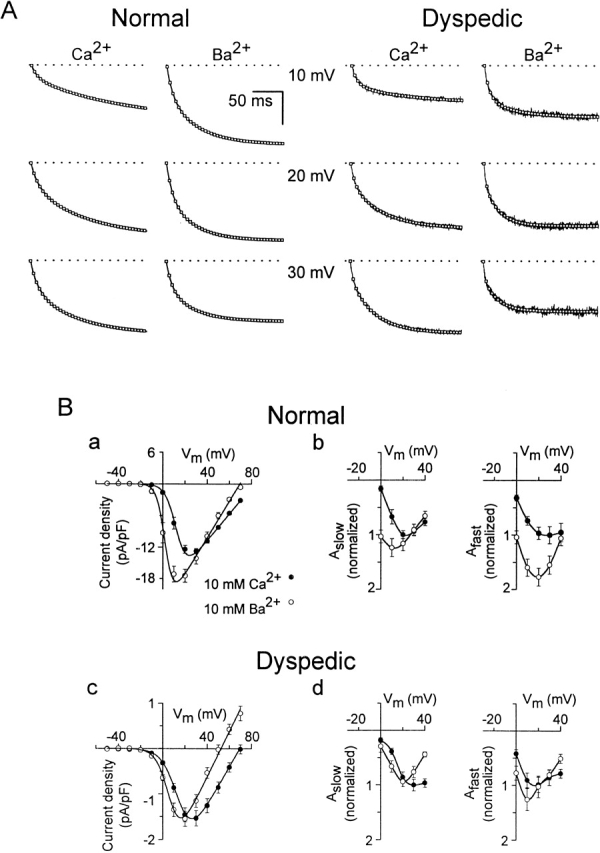
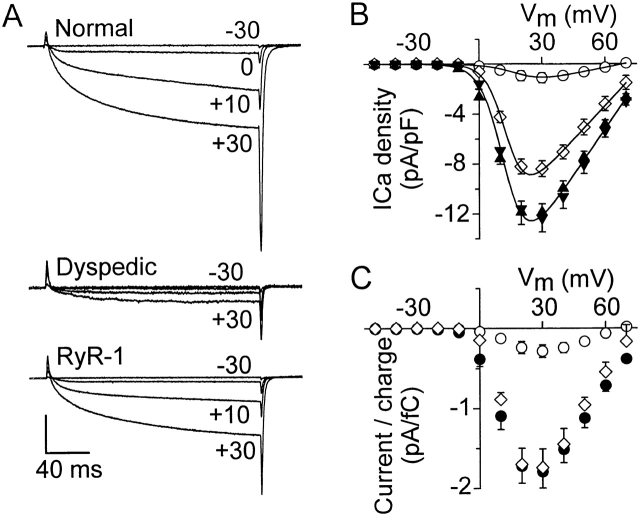
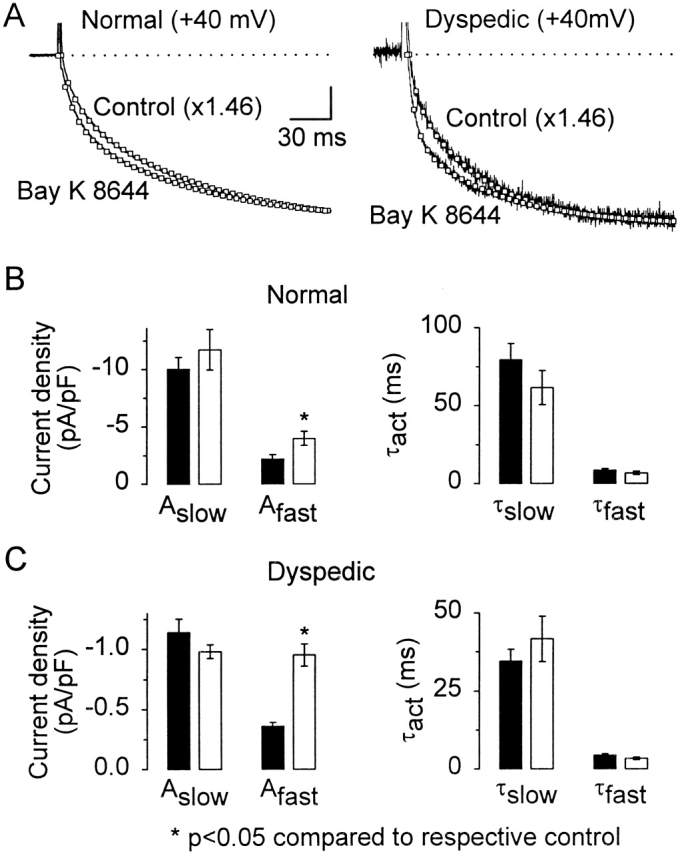
L-type Ca(2+) channel (L-channel) activity of the skeletal muscle dihydropyridine receptor is markedly enhanced by the skeletal muscle isoform of the ryanodine receptor (RyR1) (Nakai, J., R.T. Dirksen, H. T. Nguyen, I.N. Pessah, K.G. Beam, and P.D. Allen. 1996. Nature. 380:72-75.). However, the dependence of the biophysical and pharmacological properties of skeletal L-current on RyR1 has yet to be fully elucidated. Thus, we have evaluated the influence of RyR1 on the properties of macroscopic L-currents and intracellular charge movements in cultured skeletal myotubes derived from normal and "RyR1-knockout" (dyspedic) mice. Compared with normal myotubes, dyspedic myotubes exhibited a 40% reduction in the amount of maximal immobilization-resistant charge movement (Q(max), 7.5 +/- 0.8 and 4.5 +/- 0.4 nC/muF for normal and dyspedic myotubes, respectively) and an approximately fivefold reduction in the ratio of maximal L-channel conductance to charge movement (G(max)/Q(max)). Thus, RyR1 enhances both the expression level and Ca(2+) conducting activity of the skeletal L-channel. For both normal and dyspedic myotubes, the sum of two exponentials was required to fit L-current activation and resulted in extraction of the amplitudes (A(fast) and A(slow)) and time constants (tau(slow) and tau(fast)) for each component of the macroscopic current. In spite of a >10-fold in difference current density, L-currents in normal and dyspedic myotubes exhibited similar relative contributions of fast and slow components (at +40 mV; A(fast)/[A(fast) + A(slow)] approximately 0.25). However, both tau(fast) and tau(slow) were significantly (P < 0.02) faster for myotubes lacking the RyR1 protein (tau(fast), 8.5 +/- 1.2 and 4.4 +/- 0.5 ms; tau(slow), 79.5 +/- 10.5 and 34.6 +/- 3.7 ms at +40 mV for normal and dyspedic myotubes, respectively). In both normal and dyspedic myotubes, (-) Bay K 8644 (5 microM) caused a hyperpolarizing shift (approximately 10 mV) in the voltage dependence of channel activation and an 80% increase in peak L-current. However, the increase in peak L-current correlated with moderate increases in both A(slow) and A(fast) in normal myotubes, but a large increase in only A(fast) in dyspedic myotubes. Equimolar substitution of Ba(2+) for extracellular Ca(2+) increased both A(fast) and A(slow) in normal myotubes. The identical substitution in dyspedic myotubes failed to significantly alter the magnitude of either A(fast) or A(slow). These results demonstrate that RyR1 influences essential properties of skeletal L-channels (expression level, activation kinetics, modulation by dihydropyridine agonist, and divalent conductance) and supports the notion that RyR1 acts as an important allosteric modulator of the skeletal L-channel, analogous to that of a Ca(2+) channel accessory subunit.

骨骼肌二氢吡啶受体的L型钙通道(L通道)活性被兰尼碱受体(RyR1)的骨骼肌亚型显著增强(中井,J.,R.T. 德克森,H.T. 阮,I.N. 佩萨,K.G. 比姆,以及P.D. 艾伦。1996年。《自然》。380:72 - 75)。然而,骨骼肌L电流的生物物理和药理学特性对RyR1的依赖性尚未完全阐明。因此,我们评估了RyR1对源自正常和“RyR1基因敲除”(运动失调)小鼠的培养骨骼肌肌管中宏观L电流特性和细胞内电荷移动的影响。与正常肌管相比,运动失调肌管中最大抗固定电荷移动量(Q(max),正常和运动失调肌管分别为7.5±0.8和4.5±0.4 nC/μF)减少了40%,最大L通道电导与电荷移动的比率(G(max)/Q(max))降低了约五倍。因此,RyR1增强了骨骼肌L通道的表达水平和钙传导活性。对于正常和运动失调肌管,都需要用两个指数之和来拟合L电流激活,并得出宏观电流各组分的幅度(A(fast)和A(slow))以及时间常数(tau(slow)和tau(fast))。尽管电流密度相差10倍以上,但正常和运动失调肌管中的L电流在快速和慢速组分的相对贡献方面表现相似(在 +40 mV时;A(fast)/[A(fast) + A(slow)]约为0.25)。然而,对于缺乏RyR1蛋白的肌管,tau(fast)和tau(slow)都显著更快(P < 0.02)(在 +40 mV时,正常和运动失调肌管的tau(fast)分别为8.5±1.2和4.4±0.5 ms;tau(slow)分别为