Siegel C T, Schreiber K, Meredith S C, Beck-Engeser G B, Lancki D W, Lazarski C A, Fu Y X, Rowley D A, Schreiber H
Department of Pathology, The University of Chicago, IL 60637, USA.
J Exp Med. 2000 Jun 5;191(11):1945-56. doi: 10.1084/jem.191.11.1945.
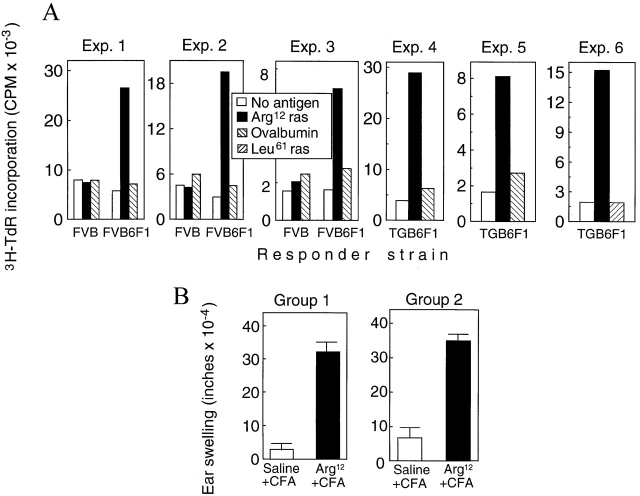
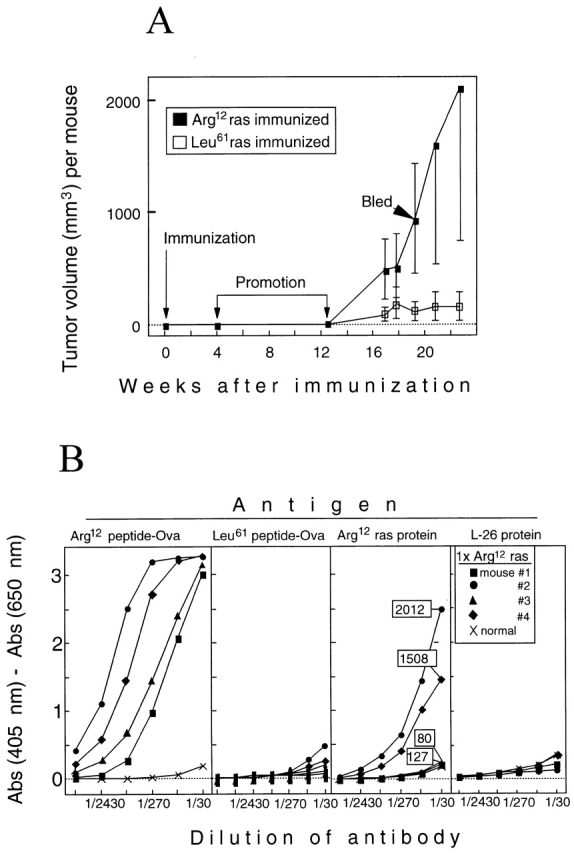
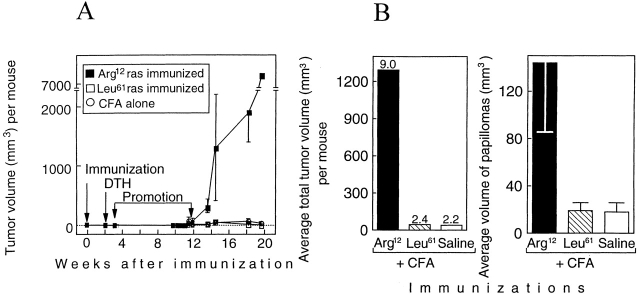
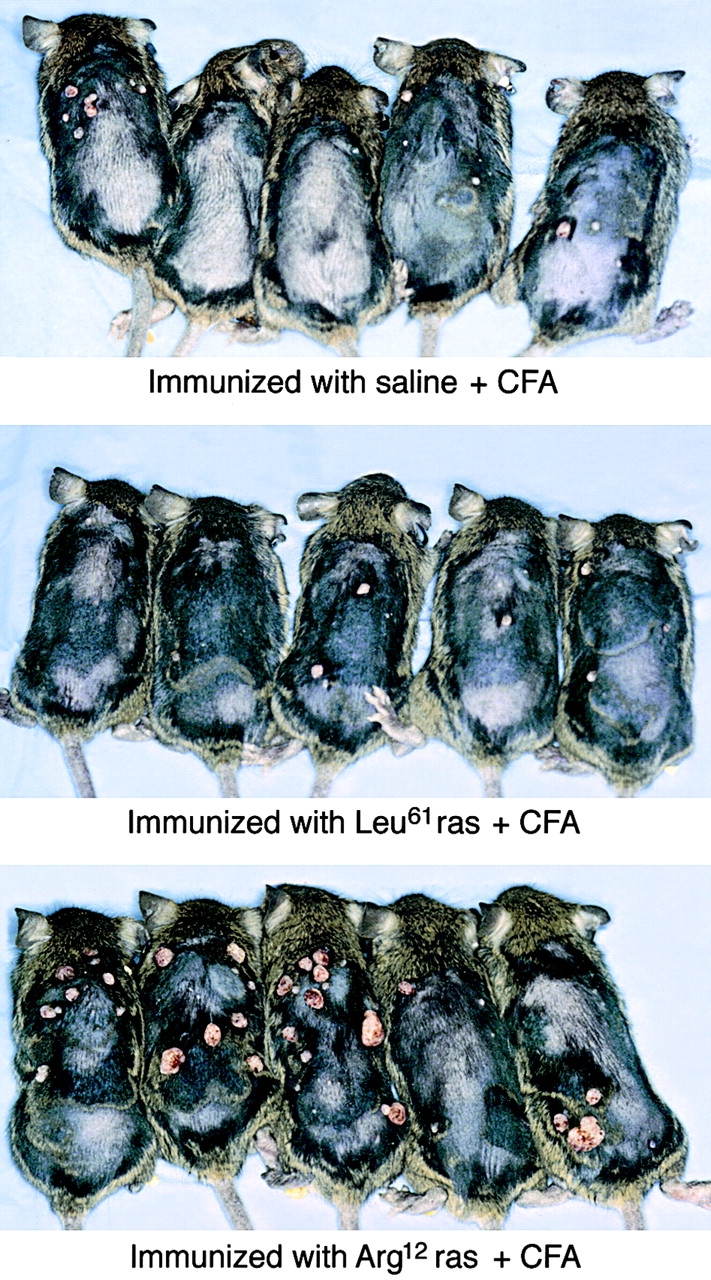
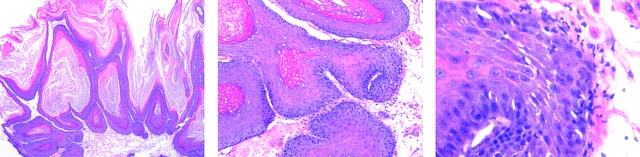
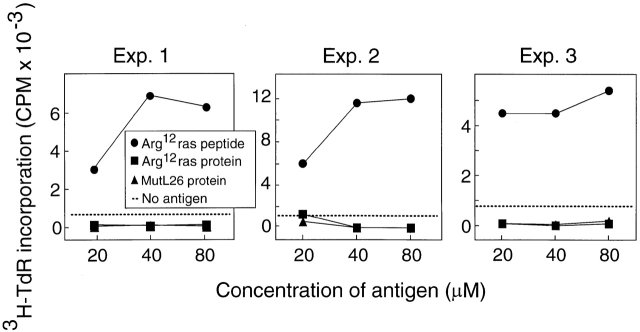
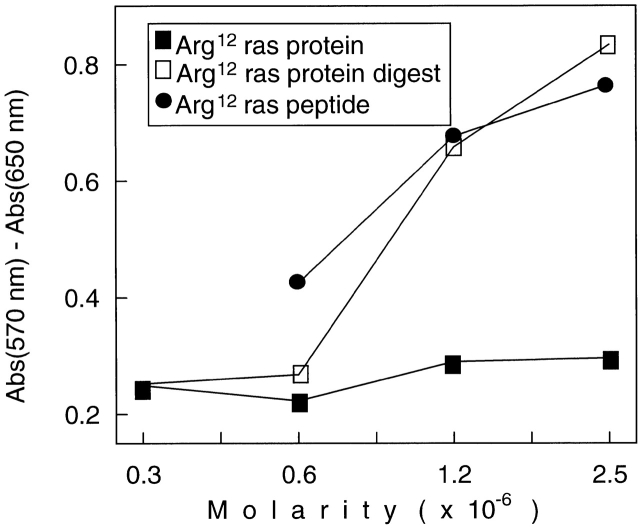
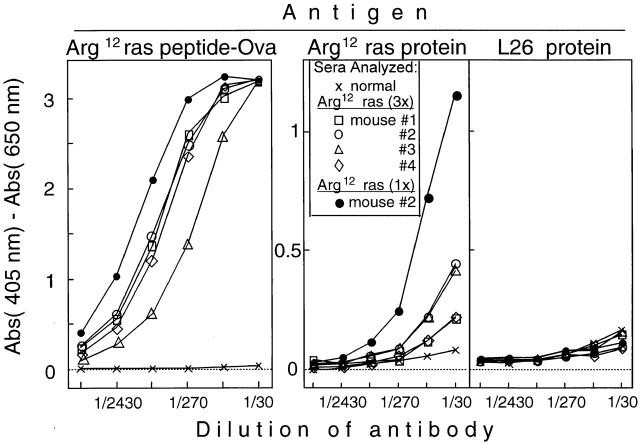
One major objective of tumor immunologists is to prevent cancer development in individuals at high risk. (TG.AC x C57BL/6)F1 mice serve as a model for testing the feasibility of this objective. The mice carry in the germline a mutant ras oncogene that has an arginine at codon 12 instead of glycine present in the wild-type, and after physical (wounding) or chemical promotion, these mice have a high probability for developing papillomas that progress to cancer. Furthermore, F1 mice immunized with Arg(12) mutant ras peptide in complete Freund's adjuvant (CFA) develop T cells within 10 d that proliferate in vitro on stimulation with the Arg(12) mutant ras peptide. Within 14 d, these mice have delayed-type hypersensitivity to the peptide. Immunization with CFA alone or with a different Arg(12) mutant ras peptide in CFA induced neither response. To determine the effect of immunization on development of tumors, mice immunized 3 wk earlier were painted on the back with phorbol 12-myristate 13-acetate every 3 d for 8 wk. The time of appearance and the number of papillomas were about the same in immunized and control mice, but the tumors grew faster and became much larger in the mice immunized with the Arg(12) mutant ras peptide. Thus, the immunization failed to protect against growth of papillomas. The peptide-induced CD4(+) T cells preferentially recognized the peptide but not the native mutant ras protein. On the other hand, mice immunized with Arg(12) mutant ras peptide and bearing papillomas had serum antibodies that did bind native mutant ras protein. Together, these studies indicate that active immunization of cancer-prone individuals may result in immune responses that fail to eradicate mutant oncogene-expressing tumor cells, but rather induce a remarkable enhancement of tumor growth.
肿瘤免疫学家的一个主要目标是预防高危个体发生癌症。(TG.AC×C57BL/6)F1小鼠可作为测试这一目标可行性的模型。这些小鼠在种系中携带一个突变的ras癌基因,该基因在第12密码子处为精氨酸而非野生型中的甘氨酸,在物理(创伤)或化学促癌后,这些小鼠发生乳头状瘤并进展为癌症的概率很高。此外,用精氨酸(12)突变型ras肽在完全弗氏佐剂(CFA)中免疫的F1小鼠在10天内产生T细胞,这些T细胞在受到精氨酸(12)突变型ras肽刺激后可在体外增殖。在14天内,这些小鼠对该肽产生迟发型超敏反应。单独用CFA或用CFA中的不同精氨酸(12)突变型ras肽免疫均未诱导出上述反应。为了确定免疫对肿瘤发生的影响,3周前免疫的小鼠每隔3天在背部涂抹佛波酯12-肉豆蔻酸酯13-乙酸酯,共8周。免疫小鼠和对照小鼠中乳头状瘤出现的时间和数量大致相同,但在用精氨酸(12)突变型ras肽免疫的小鼠中,肿瘤生长更快且长得更大。因此,免疫未能预防乳头状瘤的生长。肽诱导的CD4(+) T细胞优先识别该肽而非天然突变型ras蛋白。另一方面,用精氨酸(12)突变型ras肽免疫并患有乳头状瘤的小鼠血清抗体确实能结合天然突变型ras蛋白。总之,这些研究表明,对易患癌症个体进行主动免疫可能导致免疫反应无法根除表达突变癌基因的肿瘤细胞,反而会显著促进肿瘤生长。