Wolven A K, Belmont L D, Mahoney N M, Almo S C, Drubin D G
Department of Molecular and Cell Biology, University of California, Berkeley, Berkeley, California 94720-3202, USA.
J Cell Biol. 2000 Aug 21;150(4):895-904. doi: 10.1083/jcb.150.4.895.
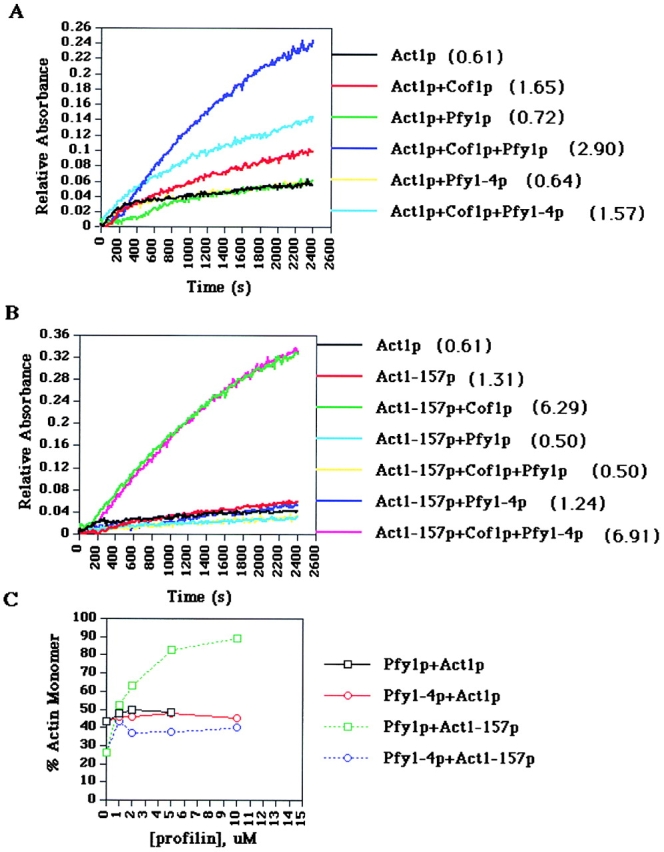
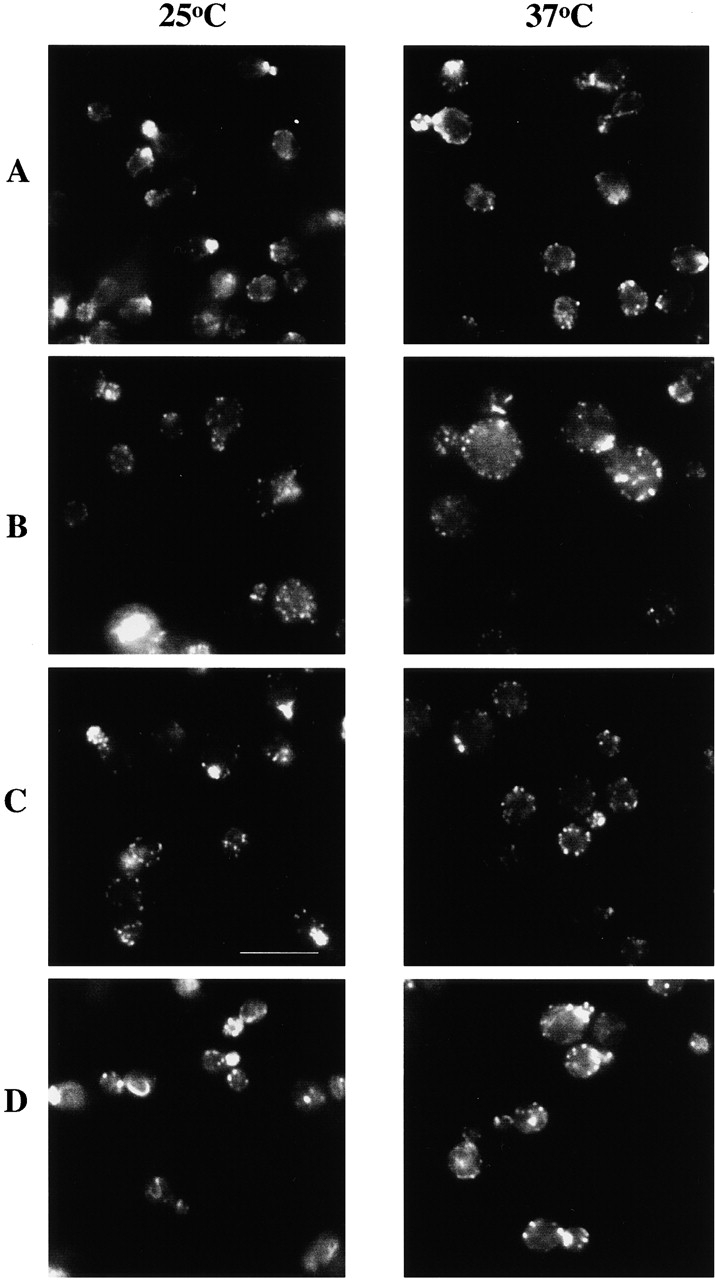
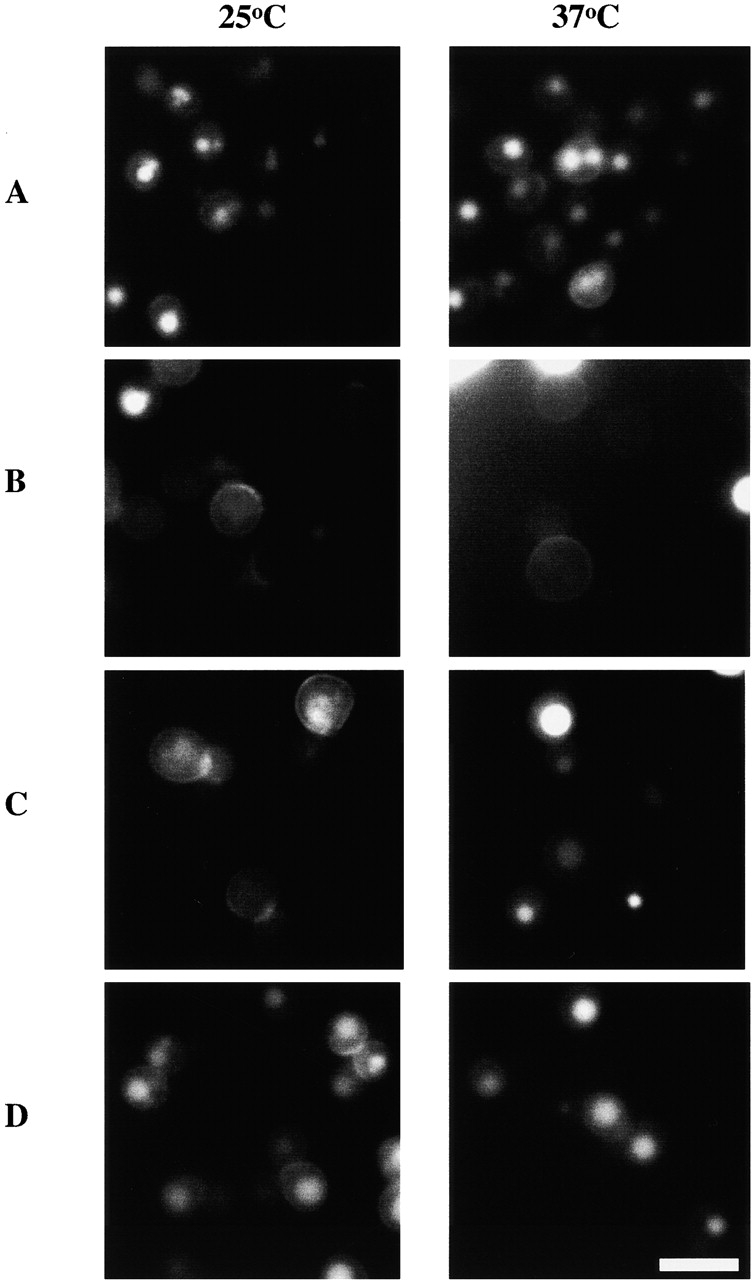
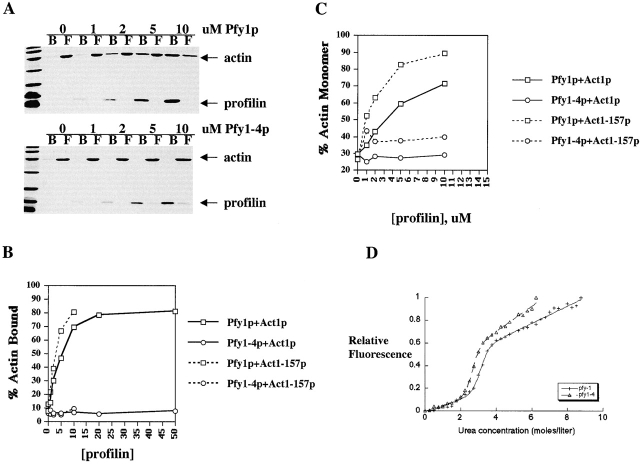
The actin monomer-binding protein, profilin, influences the dynamics of actin filaments in vitro by suppressing nucleation, enhancing nucleotide exchange on actin, and promoting barbed-end assembly. Profilin may also link signaling pathways to actin cytoskeleton organization by binding to the phosphoinositide PIP(2) and to polyproline stretches on several proteins. Although activities of profilin have been studied extensively in vitro, the significance of each of these activities in vivo needs to be tested. To study profilin function, we extensively mutagenized the Saccharomyces cerevisiae profilin gene (PFY1) and examined the consequences of specific point mutations on growth and actin organization. The actin-binding region of profilin was shown to be critical in vivo. act1-157, an actin mutant with an increased intrinsic rate of nucleotide exchange, suppressed defects in actin organization, cell growth, and fluid-phase endocytosis of pfy1-4, a profilin mutant defective in actin binding. In reactions containing actin, profilin, and cofilin, profilin was required for fast rates of actin filament turnover. However, Act1-157p circumvented the requirement for profilin. Based on the results of these studies, we conclude that in living cells profilin promotes rapid actin dynamics by regenerating ATP actin from ADP actin-cofilin generated during filament disassembly.
肌动蛋白单体结合蛋白——抑制蛋白,通过抑制成核、增强肌动蛋白上的核苷酸交换以及促进肌动蛋白丝的带刺端组装,在体外影响肌动蛋白丝的动力学。抑制蛋白还可能通过与磷酸肌醇PIP(2)以及几种蛋白质上的多脯氨酸延伸序列结合,将信号通路与肌动蛋白细胞骨架组织联系起来。尽管抑制蛋白的活性已在体外得到广泛研究,但这些活性在体内的意义仍需验证。为了研究抑制蛋白的功能,我们对酿酒酵母抑制蛋白基因(PFY1)进行了广泛的诱变,并研究了特定点突变对细胞生长和肌动蛋白组织的影响。结果表明,抑制蛋白的肌动蛋白结合区域在体内至关重要。act1-157是一种肌动蛋白突变体,其核苷酸交换的内在速率增加,它能抑制pfy1-4(一种在肌动蛋白结合方面存在缺陷的抑制蛋白突变体)在肌动蛋白组织、细胞生长和液相内吞作用方面的缺陷。在含有肌动蛋白、抑制蛋白和丝切蛋白的反应中,快速的肌动蛋白丝周转需要抑制蛋白。然而,Act1-157p绕过了对抑制蛋白的需求。基于这些研究结果,我们得出结论,在活细胞中,抑制蛋白通过从肌动蛋白丝解聚过程中产生的ADP肌动蛋白-丝切蛋白复合物中再生ATP肌动蛋白,促进了快速的肌动蛋白动力学。