Perlman D, Rownd R H
J Bacteriol. 1975 Sep;123(3):1013-34. doi: 10.1128/jb.123.3.1013-1034.1975.
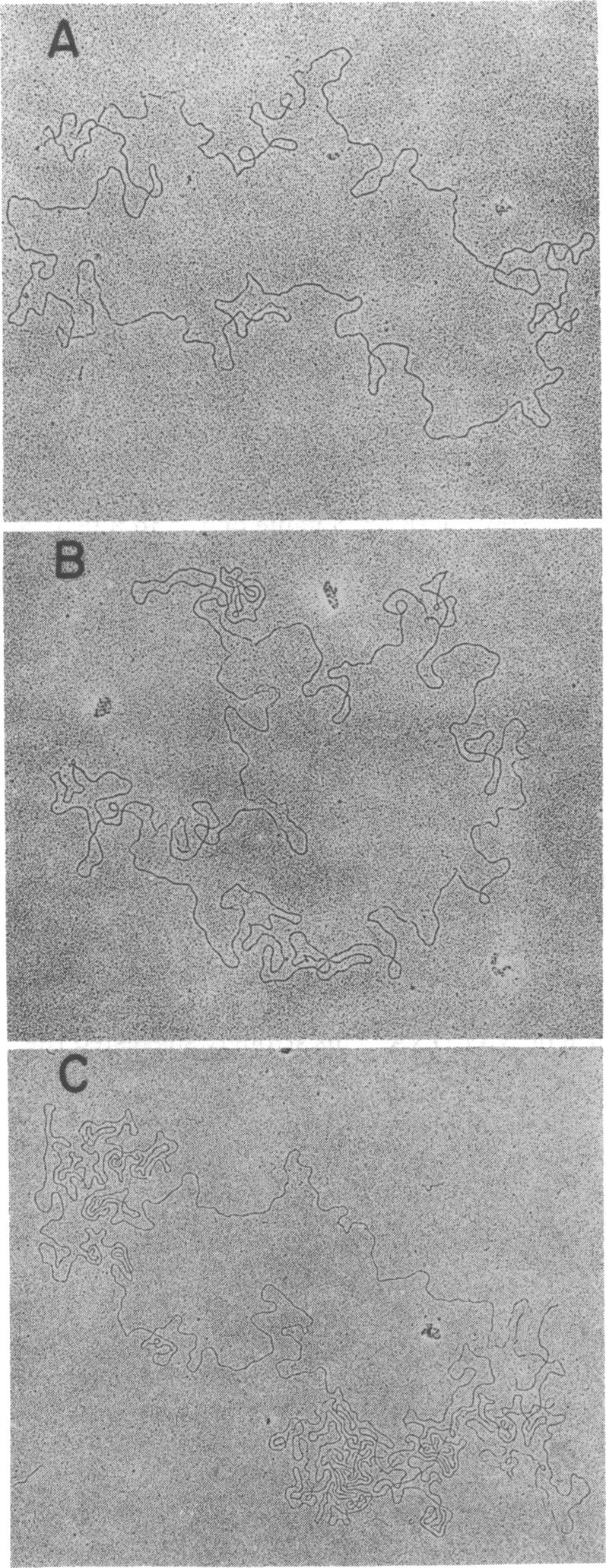
The structure of R factor NR1 DNA in Proteus mirabilis has been studied by using the techniques of CsCl density gradient centrifugation, sedimentation in neutral and alkaline sucrose gradients, and electron microscopy. It has been shown that the nontransitioned form of NR1 DNA isolated from P. mirabilis cultured in drug-free medium is a37-mum circular deoxyribonucleic acid (DNA) with a density of 1.712 g/ml in a neutral CsCl gradient. This circular molecule is a composite structure consisting of a 29-mum resistance transfer factor containing the tetracycline-resistance genes (RTF-TC) and an 8-mum r-determinants component conferring resistance to chloramphenicol (CM), streptomycin/spectinomycin, and the sulfonamides. There are one to two copies of NR1 per chromosome equivalent of DNA in exponential-phase cells cultured in Penassay broth. After growth of PM15/NR1 in medium containing 100 mug of CM per ml, the density of the NR1 DNA increased from 1.712 g/ml to approximately 1.718 g/ml and the proportion of NR1 DNA relative to the chromosome is amplified about 10-fold. The changes in R factor DNA structure which accompany this phenomenon (termed the transition) have been studied. DNA density profiles of the transitioned NR1 DNA consist of a 1.718 g/ml band which is skewed toward the less dense side. The transitioned NR1 DNA consists of molecules containing the RTF-TC element attached to multiple copies of r-determinants DNA (poly-r-determinant R factors) and multimeric and monomeric autonomous r-determinants structures. Poly-r-determinant R factors have a density intermediate between the basic composite structure (1.712 g/ml) and r-determinants DNA (1.718 g/ml). These species presumably account for the skewing of the 1.718-g/ml DNA band toward the less dense side. When transitioned cells are subsequently cultured in drug-free medium, poly-r-determinant R factors and autonomous poly-r-determinants undergo dissociation to form smaller structures containing fewer copies of r-determinants. This process continues until, after prolonged growth in drug-free medium the NR1 DNA returns to the nontransitioned state which consists of an RTF-TC and a single copy of r-determinants.
利用氯化铯密度梯度离心、中性和碱性蔗糖梯度沉降以及电子显微镜技术,对奇异变形杆菌中R因子NR1 DNA的结构进行了研究。结果表明,从无药物培养基中培养的奇异变形杆菌分离出的未转变形式的NR1 DNA是一种37μm的环状脱氧核糖核酸(DNA),在中性氯化铯梯度中的密度为1.712 g/ml。这种环状分子是一种复合结构,由一个包含四环素抗性基因(RTF-TC)的29μm抗性转移因子和一个赋予氯霉素(CM)、链霉素/壮观霉素以及磺胺类药物抗性的8μm r-决定簇成分组成。在彭纳氏肉汤中培养的指数期细胞中,每染色体当量的DNA中有一到两个NR1拷贝。在含有每毫升100μg CM的培养基中培养PM15/NR1后,NR1 DNA的密度从1.712 g/ml增加到约1.718 g/ml,并且NR1 DNA相对于染色体的比例扩增了约10倍。已经研究了伴随这种现象(称为转变)的R因子DNA结构的变化。转变后的NR1 DNA的DNA密度分布图由一个向密度较低一侧倾斜的1.718 g/ml条带组成。转变后的NR1 DNA由含有与多个r-决定簇DNA拷贝相连的RTF-TC元件的分子(多r-决定簇R因子)以及多聚体和单体自主r-决定簇结构组成。多r-决定簇R因子的密度介于基本复合结构(1.712 g/ml)和r-决定簇DNA(1.718 g/ml)之间。这些种类可能解释了1.718-g/ml DNA条带向密度较低一侧的倾斜。当转变后的细胞随后在无药物培养基中培养时,多r-决定簇R因子和自主多r-决定簇会发生解离,形成包含较少r-决定簇拷贝的较小结构。这个过程会持续进行,直到在无药物培养基中长时间生长后,NR1 DNA恢复到由RTF-TC和单个r-决定簇拷贝组成 的未转变状态。