Hallauer P L, Hastings K E
Montreal Neurological Institute and Biology Department McGill University 3801 University Street Montreal Quebec Canada H3A 2B4.
BMC Genet. 2000;1:1. doi: 10.1186/1471-2156-1-1. Epub 2000 Oct 4.
Versatile transgenic manipulation of skeletal muscle requires knowledge of the expression profiles of diverse promoter/enhancer elements in the transcriptionally specialized fiber types of which muscle is composed. "Universal" viral promoters/enhancers, e.g., cytomegalovirus IE1 (CMV IE1), are of interest as reagents that may drive broad expression. However, a previous study noted a marked heterogeneity of CMV IE1-driven transgene expression among muscle fibers, raising the possibility of fiber-type-restricted expression. The purpose of the present study was to characterize CMV IE1-driven expression in terms of fiber type.
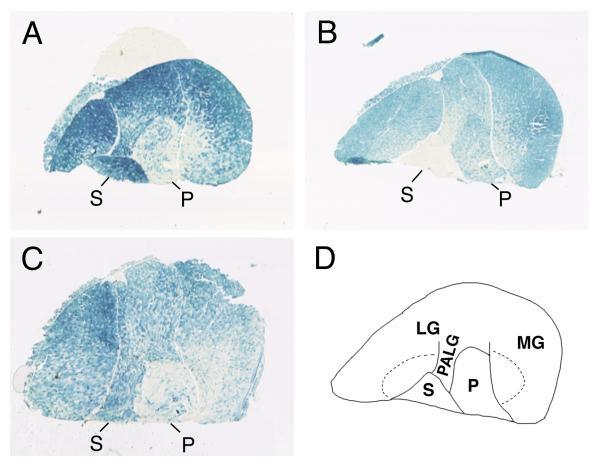
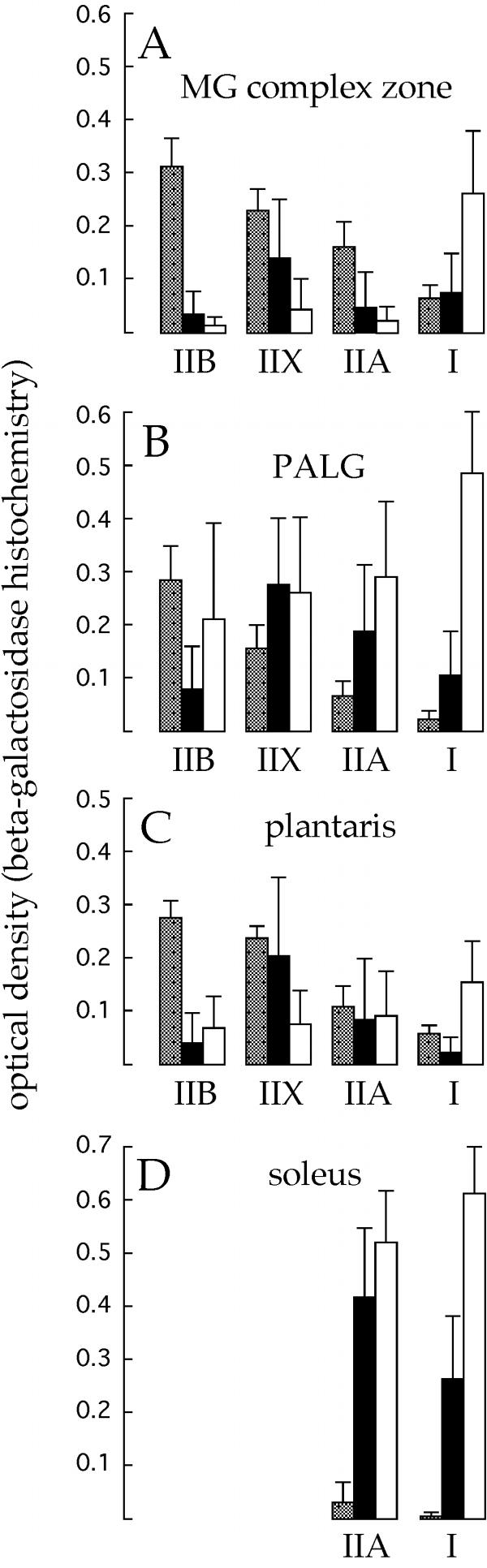
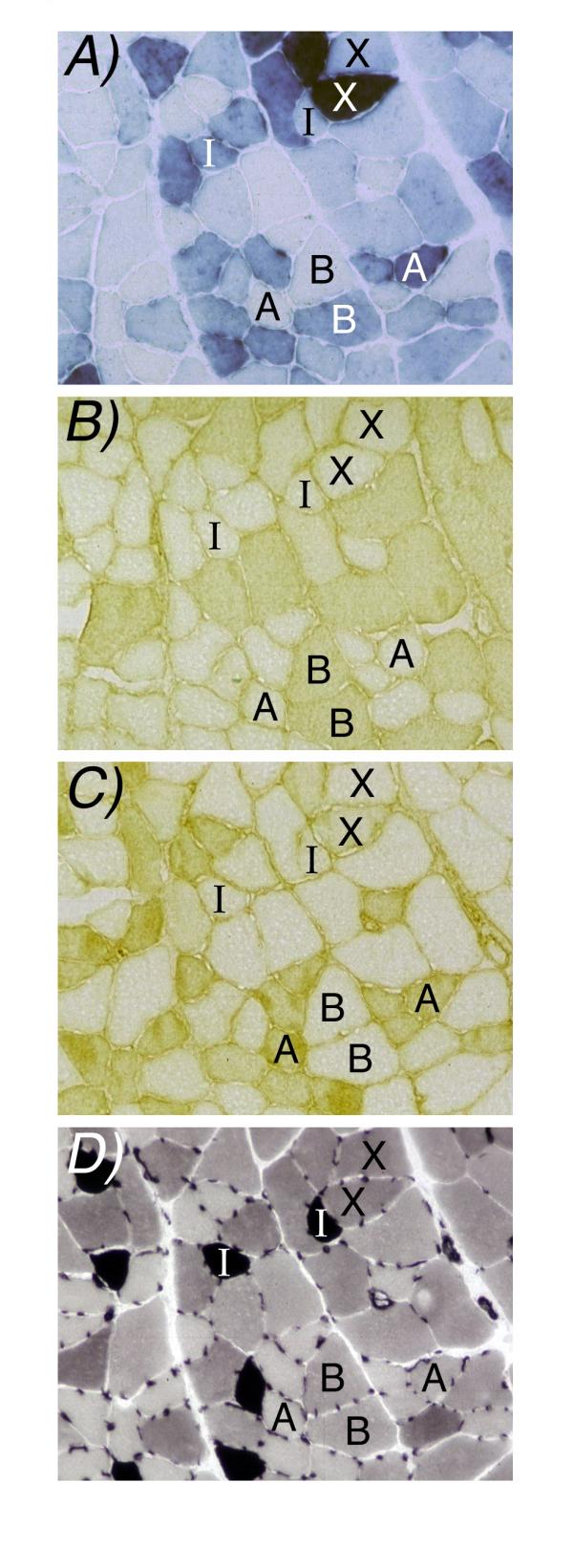
We produced two lines of transgenic mice carrying the CMV IE1/ beta-galactosidase construct CMVLacZ, and analyzed transgene expression and fiber type by histochemical analysis of hindlimb muscle sections. In both lines CMVLacZ was expressed in all four major fiber types: type I (slow) and types IIA, IIB and IIX (fast). There was no unique pattern of fiber-type-preferential expression; fiber-type quantitative differences were observed but details varied between muscle regions and between lines. Both lines showed similar fiber-type-independent regional differences in overall expression levels, and a high level of within-fiber-type variability of expression, even among nearby fibers. The soleus muscle showed strong expression and comparatively little within-fiber-type or between-fiber-type variability.
The CMV IE1 promoter/enhancer is not fiber-type-restricted and can be useful for driving germ-line transgene expression in all four fiber types. However, not all fibers express the gene at high levels due in part to regional differences in overall expression levels, and to a high level of within-fiber-type variability. Given the multinucleate syncitial nature of muscle fibers, it is not likely that this variability is due to variegating heterochromatinization. The soleus muscle would make a suitable subject for near-uniform experimental gene expression driven by CMV IE1 elements.
对骨骼肌进行多功能转基因操作需要了解构成肌肉的转录特异性纤维类型中各种启动子/增强子元件的表达谱。“通用”病毒启动子/增强子,如巨细胞病毒IE1(CMV IE1),作为可能驱动广泛表达的试剂受到关注。然而,先前的一项研究指出,CMV IE1驱动的转基因在肌纤维中的表达存在明显异质性,这增加了纤维类型限制表达的可能性。本研究的目的是根据纤维类型来表征CMV IE1驱动的表达。
我们培育了两条携带CMV IE1/β-半乳糖苷酶构建体CMVLacZ的转基因小鼠品系,并通过对后肢肌肉切片进行组织化学分析来分析转基因表达和纤维类型。在这两个品系中,CMVLacZ在所有四种主要纤维类型中均有表达:I型(慢肌)和IIA、IIB和IIX型(快肌)。不存在纤维类型优先表达的独特模式;观察到了纤维类型的定量差异,但细节在肌肉区域之间和品系之间有所不同。两个品系在整体表达水平上均表现出类似的与纤维类型无关的区域差异,并且即使在相邻纤维之间,纤维类型内的表达变异性也很高。比目鱼肌表现出强烈的表达,并且在纤维类型内或纤维类型之间的变异性相对较小。
CMV IE1启动子/增强子不受纤维类型限制,可用于驱动所有四种纤维类型中的种系转基因表达。然而,并非所有纤维都高水平表达该基因,部分原因是整体表达水平存在区域差异以及纤维类型内的变异性较高。鉴于肌纤维的多核合胞体性质,这种变异性不太可能是由于异染色质的斑驳化所致。比目鱼肌将成为由CMV IE1元件驱动近乎均匀实验性基因表达的合适研究对象。