Barbieri M A, Roberts R L, Gumusboga A, Highfield H, Alvarez-Dominguez C, Wells A, Stahl P D
Department of Cell Biology and Physiology, Washington University School of Medicine, St. Louis, Missouri 63110, USA.
J Cell Biol. 2000 Oct 30;151(3):539-50. doi: 10.1083/jcb.151.3.539.
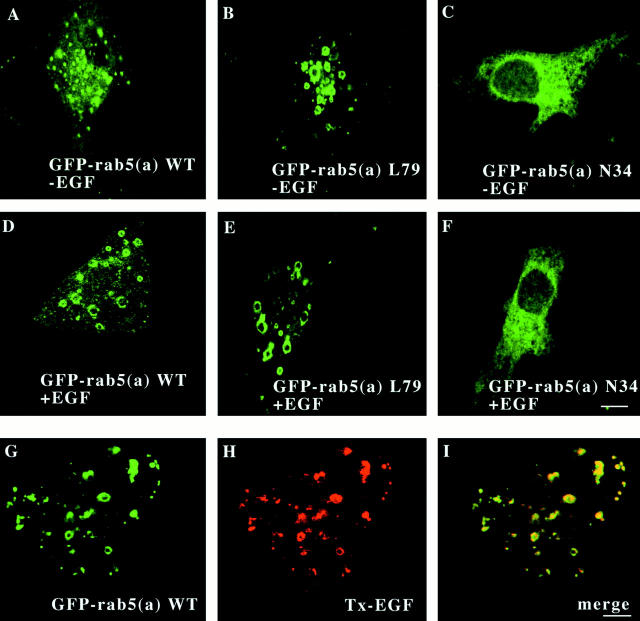
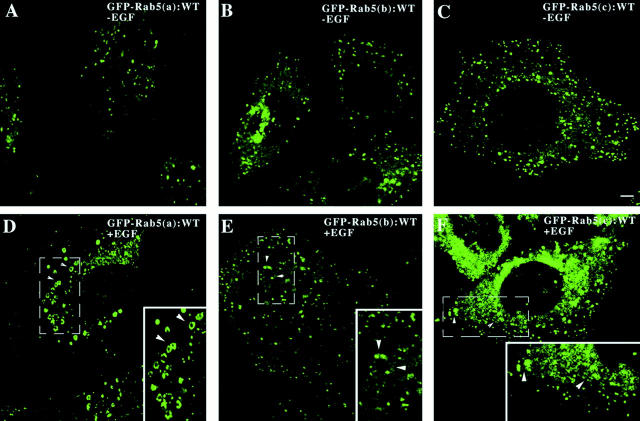
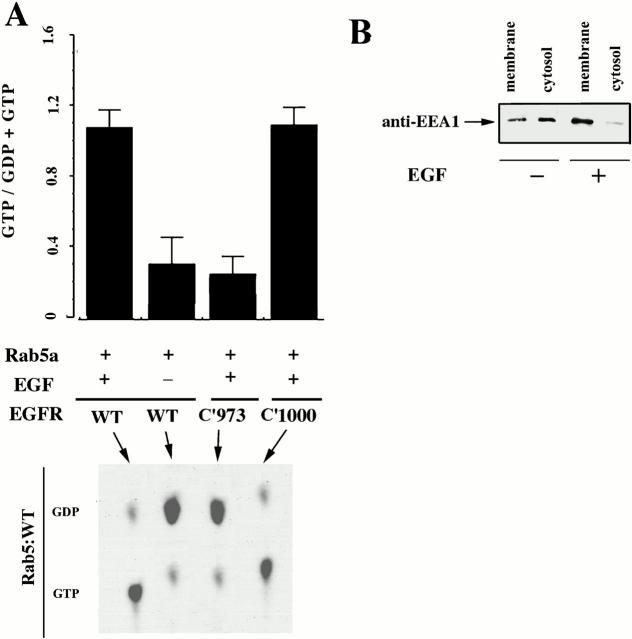
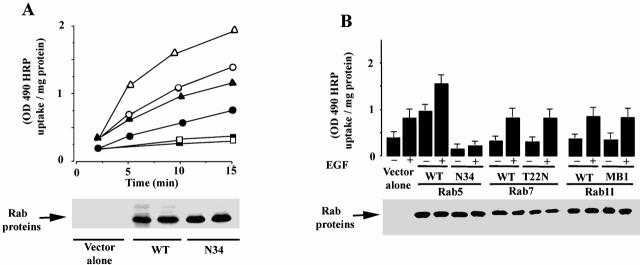
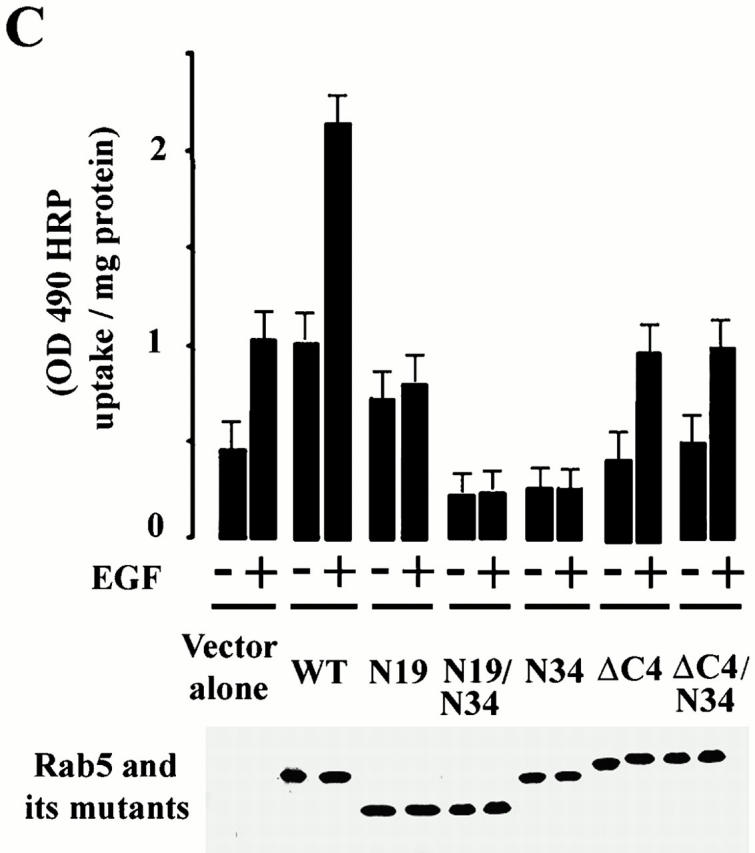
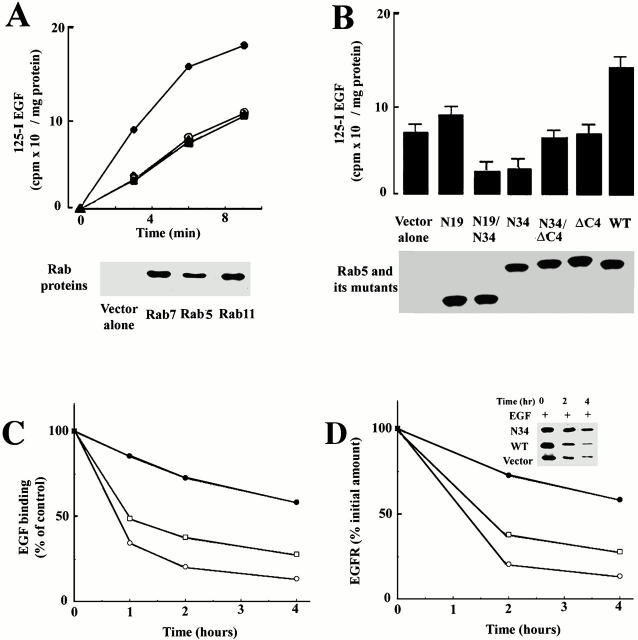
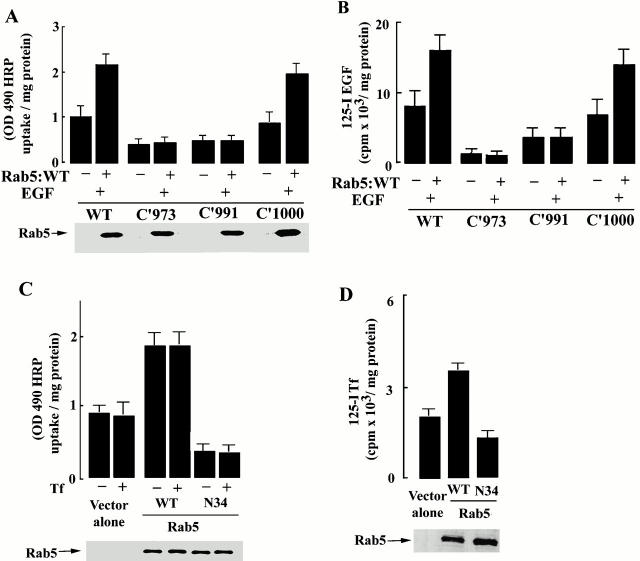
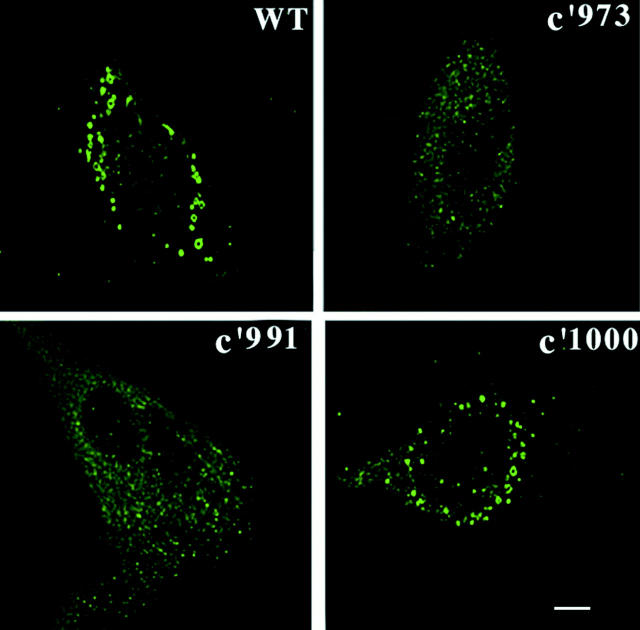
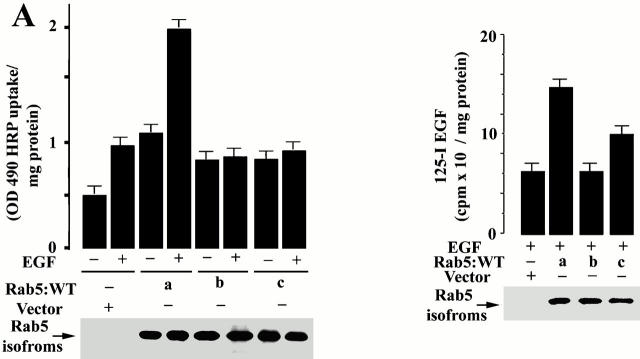
Activated epidermal growth factor receptors recruit various intracellular proteins leading to signal generation and endocytic trafficking. Although activated receptors are rapidly internalized into the endocytic compartment and subsequently degraded in lysosomes, the linkage between signaling and endocytosis is not well understood. Here we show that EGF stimulation of NR6 cells induces a specific, rapid and transient activation of Rab5a. EGF also enhanced translocation of the Rab5 effector, early endosomal autoantigen 1 (EEA1), from cytosol to membrane. The activation of endocytosis, fluid phase and receptor mediated, by EGF was enhanced by Rab5a expression, but not by Rab5b, Rab5c, or Rab5a truncated at the NH(2) and/or COOH terminus. Dominant negative Rab5a (Rab5:N34) blocked EGF-stimulated receptor-mediated and fluid-phase endocytosis. EGF activation of Rab5a function was dependent on tyrosine residues in the COOH-terminal domain of the EGF receptor (EGFR). Removal of the entire COOH terminus by truncation (c'973 and c'991) abrogated ligand-induced Rab5a activation of endocytosis. A "kinase-dead" EGFR failed to stimulate Rab5a function. However, another EGF receptor mutant (c'1000), with the kinase domain intact and a single autophosphorylation site effectively signaled Rab5 activation. These results indicate that EGFR and Rab5a are linked via a cascade that results in the activation of Rab5a and that appears essential for internalization. The results point to an interdependent relationship between receptor activation, signal generation and endocytosis.
活化的表皮生长因子受体招募各种细胞内蛋白,从而导致信号产生和内吞运输。尽管活化的受体迅速内化进入内吞区室并随后在溶酶体中降解,但信号传导与内吞作用之间的联系尚未完全清楚。在此我们表明,表皮生长因子(EGF)刺激NR6细胞可诱导Rab5a特异性、快速且短暂的活化。EGF还增强了Rab5效应蛋白早期内体自身抗原1(EEA1)从胞质溶胶到细胞膜的转位。Rab5a的表达增强了EGF对胞吞作用(液相和受体介导的)的激活,但Rab5b、Rab5c或在NH(2)和/或COOH末端截短的Rab5a则无此作用。显性负性Rab5a(Rab5:N34)阻断了EGF刺激的受体介导的和液相内吞作用。Rab5a功能的EGF激活依赖于表皮生长因子受体(EGFR)COOH末端结构域中的酪氨酸残基。通过截短去除整个COOH末端(c'973和c'991)消除了配体诱导的Rab5a对胞吞作用的激活。“激酶失活”的EGFR未能刺激Rab5a功能。然而,另一种EGF受体突变体(c'1000),其激酶结构域完整且有一个单一的自磷酸化位点,有效地发出了Rab5激活的信号。这些结果表明,EGFR和Rab5a通过一个级联反应相连,该级联反应导致Rab5a的激活,且这似乎对内化至关重要。结果表明受体激活、信号产生和内吞作用之间存在相互依存的关系。