Kim Suree, Heo Sukyeong, Brzostowski Joseph, Kang Dongmin
Fluorescence Core Imaging Center, Department of Life Science, Ewha Womans University, 52 Ewhayeodae-gil, Seodaemun-gu, Seoul 03760, Korea.
Twinbrook Imaging Facility, National Institutes of Health/NIAID, Bethesda, MD 20892, USA.
Cancers (Basel). 2021 May 16;13(10):2405. doi: 10.3390/cancers13102405.
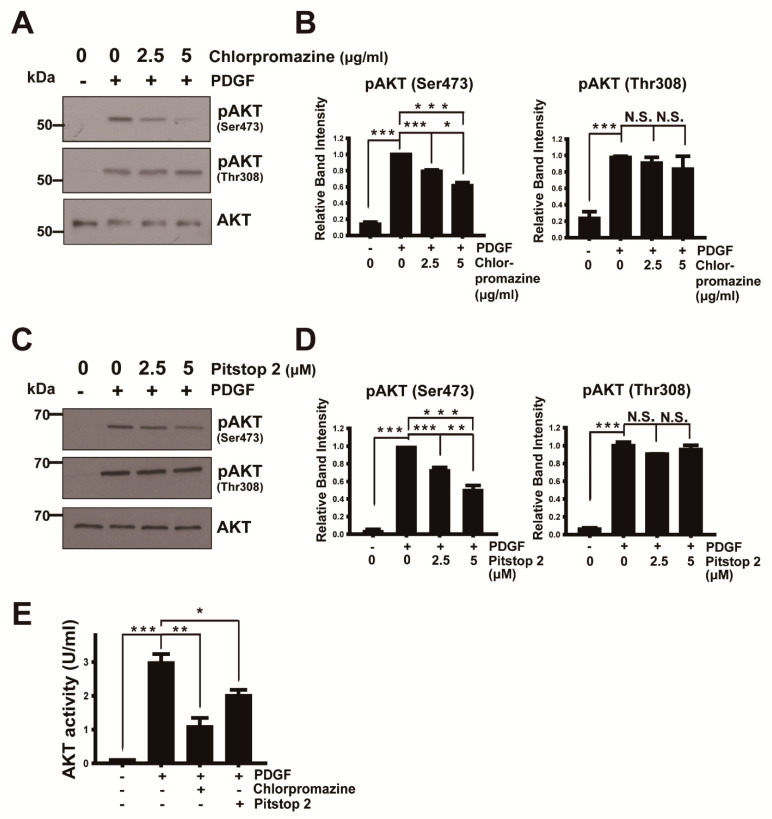
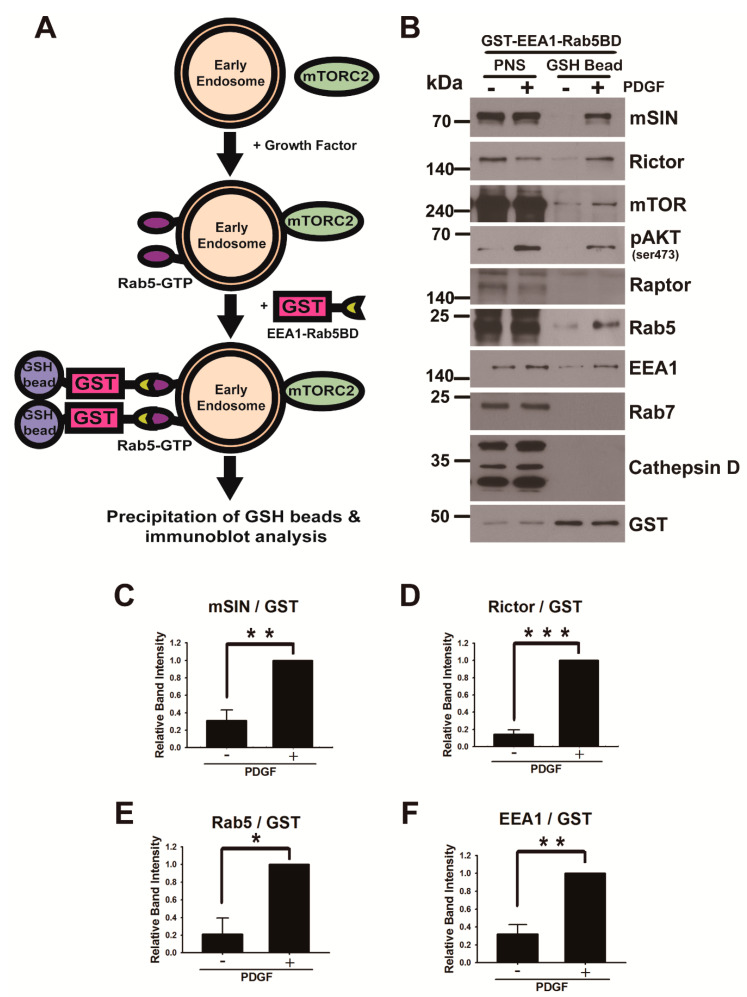
The serine/threonine kinase AKT is a major effector during phosphatidylinositol 3-kinase (PI3K)-driven cell signal transduction in response to extracellular stimuli. AKT activation mechanisms have been extensively studied; however, the mechanism underlying target of rapamycin complex 2 (mTORC2) phosphorylation of AKT at Ser473 in the cellular endomembrane system remains to be elucidated. Here, we demonstrate that endocytosis is required for AKT activation through phosphorylation at Ser473 via mTORC2 using platelet-derived growth factor-stimulated U87MG glioma cells. mTORC2 components are localized to early endosomes during growth factor activation, and the association of mTORC2 with early endosomes is responsible for the local activation of AKT, which is critical for specific signal transduction through glycogen synthase kinase-3 beta and forkhead box O1/O3 phosphorylation. Furthermore, endosomal phosphoinositide, represented by PtdIns(3,4)P, provides a binding platform for mTORC2 to phosphorylate AKT Ser473 in endosomes through mammalian Sty1/Spc1-interacting protein (mSIN), a pleckstrin homology domain-containing protein, and is dispensable for AKT phosphorylation at Thr308. This PtdIns(3,4)P-mediated endosomal AKT activation provides a means to integrate PI3K activated by diverse stimuli to mTORC2 assembly. These early endosomal events induced by endocytosis, together with the previously identified AKT activation by PtdIns(3,4,5)P, contribute to the strengthening of the transduction of AKT signaling through phosphoinositide.
丝氨酸/苏氨酸激酶AKT是磷脂酰肌醇3激酶(PI3K)驱动的细胞信号转导过程中响应细胞外刺激的主要效应器。AKT的激活机制已得到广泛研究;然而,在细胞内膜系统中雷帕霉素靶蛋白复合物2(mTORC2)使AKT的丝氨酸473位点磷酸化的潜在机制仍有待阐明。在此,我们利用血小板衍生生长因子刺激的U87MG胶质瘤细胞证明,内吞作用是通过mTORC2使AKT在丝氨酸473位点磷酸化从而激活AKT所必需的。在生长因子激活过程中,mTORC2组分定位于早期内体,mTORC2与早期内体的结合负责AKT的局部激活,这对于通过糖原合酶激酶-3β和叉头框O1/O3磷酸化进行的特定信号转导至关重要。此外,以磷脂酰肌醇-3,4-二磷酸(PtdIns(3,4)P)为代表的内体磷酸肌醇通过哺乳动物Sty1/Spc1相互作用蛋白(mSIN,一种含普列克底物蛋白同源结构域的蛋白)为mTORC2在早期内体中使AKT丝氨酸473位点磷酸化提供了一个结合平台,并且对于AKT苏氨酸308位点的磷酸化是可有可无的。这种由PtdIns(3,4)P介导的内体AKT激活提供了一种将由多种刺激激活的PI3K整合到mTORC2组装过程中的方式。由内吞作用诱导的这些早期内体事件,与之前确定的由磷脂酰肌醇-3,4,5-三磷酸(PtdIns(3,4,5)P)激活AKT一起作用,有助于通过磷酸肌醇加强AKT信号转导。