Jackson T R, Brown F D, Nie Z, Miura K, Foroni L, Sun J, Hsu V W, Donaldson J G, Randazzo P A
Laboratory of Cellular Oncology, Division of Basic Sciences, National Cancer Institute, Bethesda, Maryland 20892-4255, USA.
J Cell Biol. 2000 Oct 30;151(3):627-38. doi: 10.1083/jcb.151.3.627.
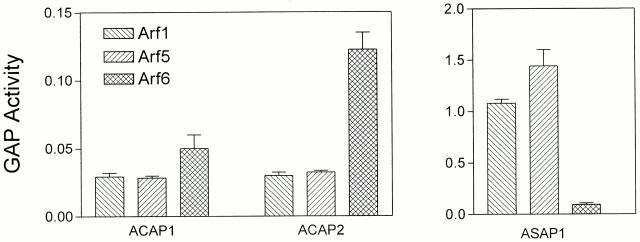
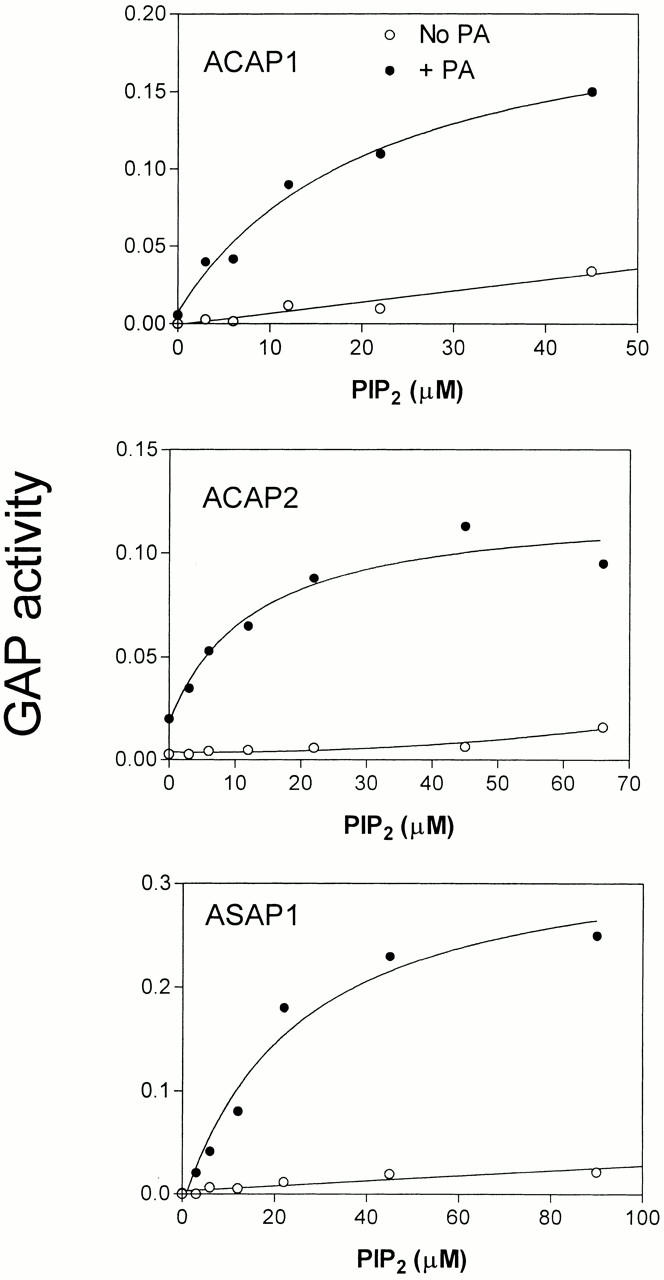
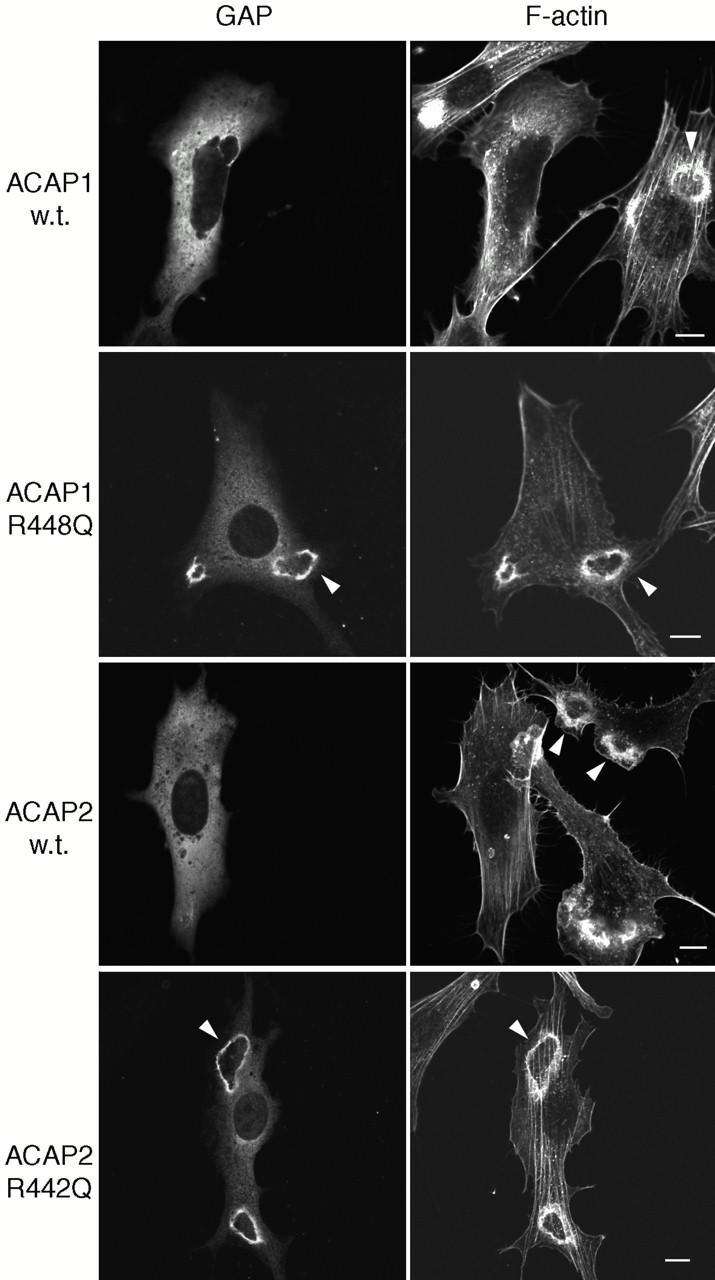
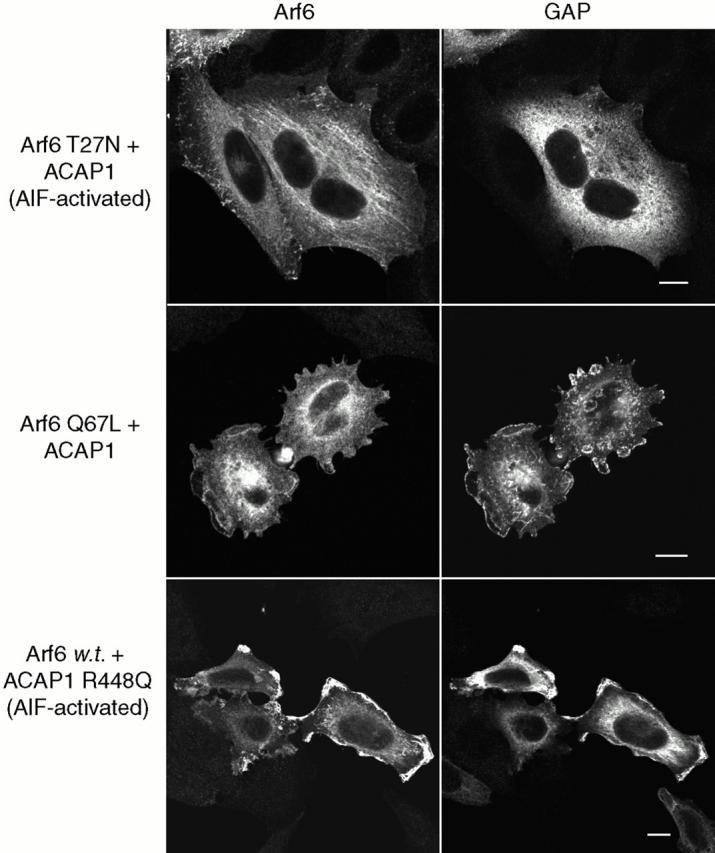
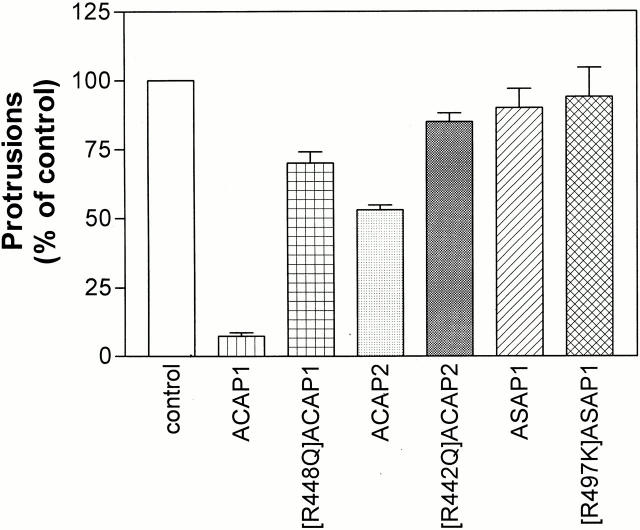
The GTP-binding protein ADP-ribosylation factor 6 (Arf6) regulates endosomal membrane trafficking and the actin cytoskeleton in the cell periphery. GTPase-activating proteins (GAPs) are critical regulators of Arf function, controlling the return of Arf to the inactive GDP-bound state. Here, we report the identification and characterization of two Arf6 GAPs, ACAP1 and ACAP2. Together with two previously described Arf GAPs, ASAP1 and PAP, they can be grouped into a protein family defined by several common structural motifs including coiled coil, pleckstrin homology, Arf GAP, and three complete ankyrin-repeat domains. All contain phosphoinositide-dependent GAP activity. ACAP1 and ACAP2 are widely expressed and occur together in the various cultured cell lines we examined. Similar to ASAP1, ACAP1 and ACAP2 were recruited to and, when overexpressed, inhibited the formation of platelet-derived growth factor (PDGF)-induced dorsal membrane ruffles in NIH 3T3 fibroblasts. However, in contrast with ASAP1, ACAP1 and ACAP2 functioned as Arf6 GAPs. In vitro, ACAP1 and ACAP2 preferred Arf6 as a substrate, rather than Arf1 and Arf5, more so than did ASAP1. In HeLa cells, overexpression of either ACAP blocked the formation of Arf6-dependent protrusions. In addition, ACAP1 and ACAP2 were recruited to peripheral, tubular membranes, where activation of Arf6 occurs to allow membrane recycling back to the plasma membrane. ASAP1 did not inhibit Arf6-dependent protrusions and was not recruited by Arf6 to tubular membranes. The additional effects of ASAP1 on PDGF-induced ruffling in fibroblasts suggest that multiple Arf GAPs function coordinately in the cell periphery.
GTP结合蛋白ADP核糖基化因子6(Arf6)调节细胞外周的内体膜运输和肌动蛋白细胞骨架。GTP酶激活蛋白(GAP)是Arf功能的关键调节因子,控制Arf返回无活性的GDP结合状态。在此,我们报告了两种Arf6 GAP,即ACAP1和ACAP2的鉴定与特性。它们与之前描述的两种Arf GAP,即ASAP1和PAP一起,可归为一个由几个共同结构基序定义的蛋白家族,这些基序包括卷曲螺旋、普列克底物蛋白同源性、Arf GAP和三个完整的锚蛋白重复结构域。所有这些蛋白都具有磷酸肌醇依赖性GAP活性。ACAP1和ACAP2广泛表达,并共同存在于我们检测的各种培养细胞系中。与ASAP1相似,ACAP1和ACAP2被募集到NIH 3T3成纤维细胞中,并且在过表达时会抑制血小板衍生生长因子(PDGF)诱导的背侧膜褶皱的形成。然而,与ASAP1不同的是,ACAP1和ACAP2作为Arf6 GAP发挥作用。在体外,ACAP1和ACAP2更倾向于以Arf6作为底物,而不是Arf1和Arf5,这一点比ASAP1更明显。在HeLa细胞中,任一ACAP的过表达都会阻断Arf6依赖性突起的形成。此外,ACAP1和ACAP2被募集到外周的管状膜上,Arf6在那里被激活,以允许膜循环回到质膜。ASAP1不抑制Arf6依赖性突起,也不会被Arf6募集到管状膜上。ASAP1对成纤维细胞中PDGF诱导的褶皱的额外影响表明,多种Arf GAP在细胞外周协同发挥作用。