Zolessi F R, Arruti C
Laboratorio de Cultivo de Tejidos, Sección Biología Celular, Facultad de Ciencias, Universidad de la República, Montevideo, Uruguay.
BMC Dev Biol. 2001;1:7. doi: 10.1186/1471-213x-1-7. Epub 2001 Apr 24.
The neural tube is formed by morphogenetic movements largely dependent on cytoskeletal dynamics. Actin and many of its associated proteins have been proposed as important mediators of neurulation. For instance, mice deficient in MARCKS, an actin cross-linking membrane-associated protein that is regulated by PKC and other kinases, present severe developmental defects, including failure of cranial neural tube closure.
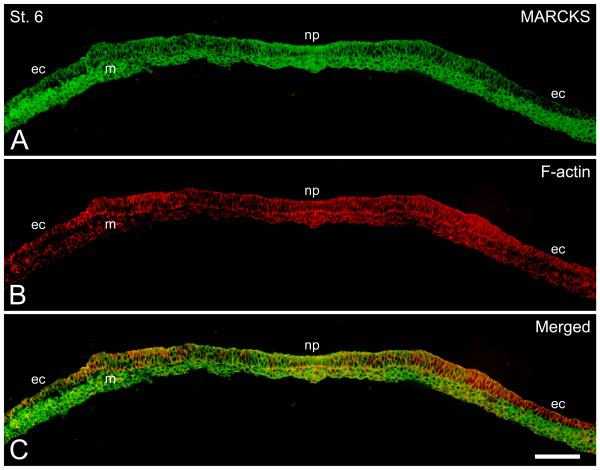
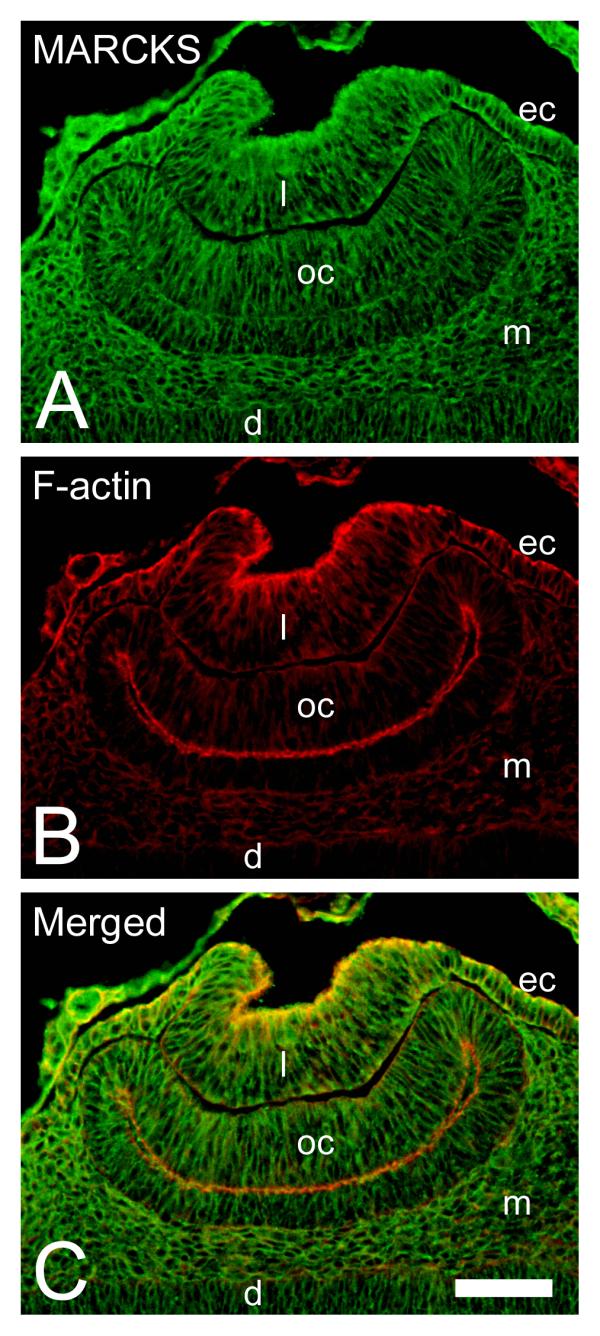
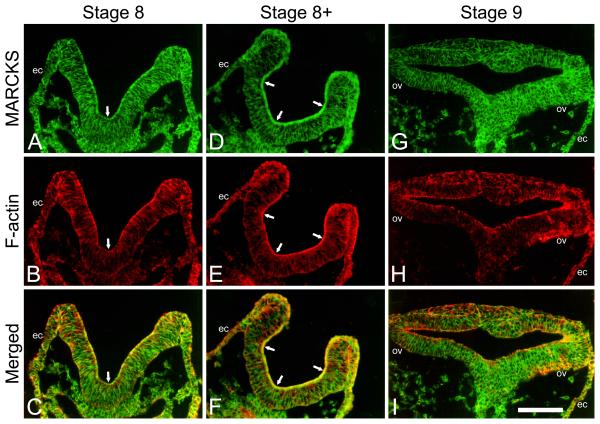
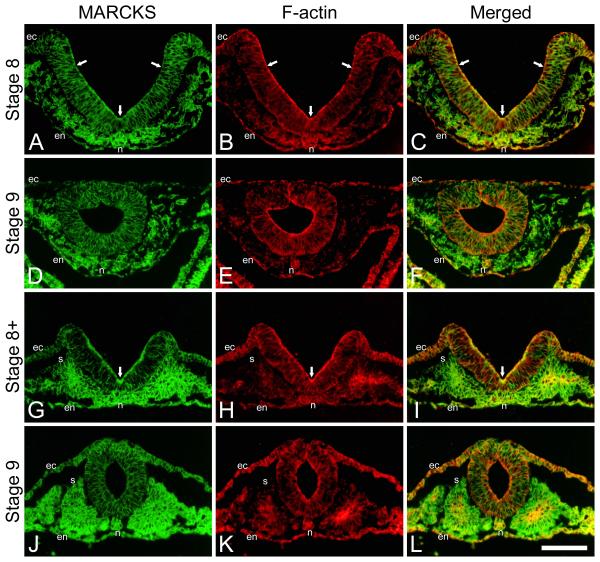
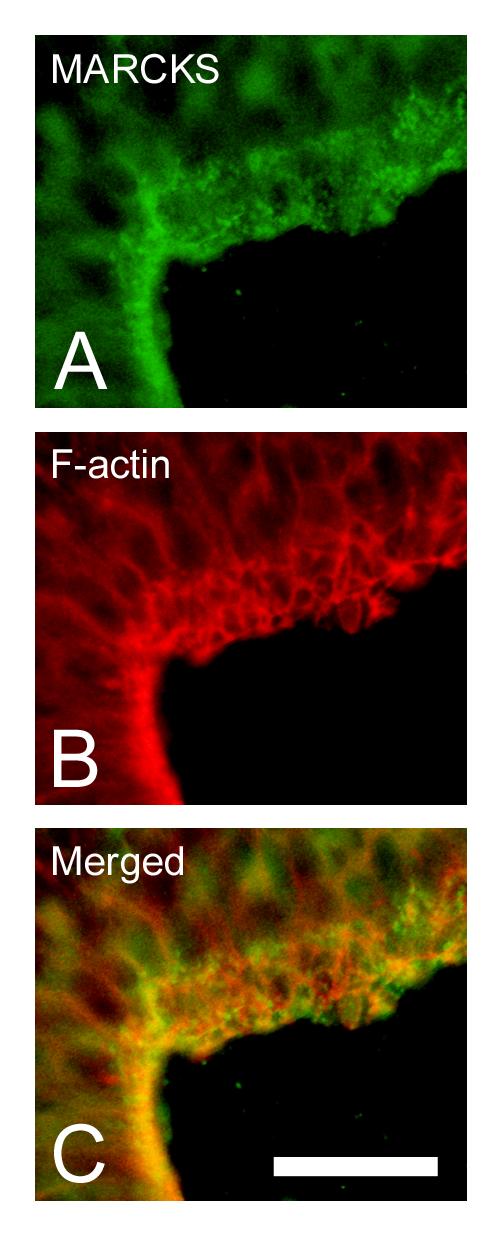
To determine the distribution of MARCKS, and its possible relationships with actin during neurulation, chick embryos were transversely sectioned and double labeled with an anti-MARCKS polyclonal antibody and phalloidin. In the neural plate, MARCKS was found ubiquitously distributed at the periphery of the cells, being conspicuously accumulated in the apical cell region, in close proximity to the apical actin meshwork. This asymmetric distribution was particularly noticeable during the bending process. After the closure of the neural tube, the apically accumulated MARCKS disappeared, and this cell region became analogous to the other peripheral cell zones in its MARCKS content. Actin did not display analogous variations, remaining highly concentrated at the cell subapical territory. The transient apical accumulation of MARCKS was found throughout the neural tube axis. The analysis of another epithelial bending movement, during the formation of the lens vesicle, revealed an identical phenomenon.
MARCKS is transiently accumulated at the apical region of neural plate and lens placode cells during processes of bending. This asymmetric subcellular distribution of MARCKS starts before the onset of neural plate bending. These results suggest possible upstream regulatory actions of MARCKS on some functions of the actin subapical meshwork.
神经管由形态发生运动形成,这在很大程度上依赖于细胞骨架动力学。肌动蛋白及其许多相关蛋白被认为是神经胚形成的重要介质。例如,缺乏MARCKS(一种受蛋白激酶C和其他激酶调节的肌动蛋白交联膜相关蛋白)的小鼠会出现严重的发育缺陷,包括颅神经管闭合失败。
为了确定MARCKS的分布及其在神经胚形成过程中与肌动蛋白的可能关系,对鸡胚进行横切,并用抗MARCKS多克隆抗体和鬼笔环肽进行双重标记。在神经板中,发现MARCKS普遍分布于细胞周边,在顶端细胞区域显著积累,紧邻顶端肌动蛋白网络。这种不对称分布在弯曲过程中尤为明显。神经管闭合后,顶端积累的MARCKS消失,该细胞区域在MARCKS含量上变得与其他周边细胞区域相似。肌动蛋白没有表现出类似的变化,仍高度集中在细胞顶端下区域。在整个神经管轴上都发现了MARCKS的短暂顶端积累。对晶状体泡形成过程中另一种上皮弯曲运动的分析揭示了相同的现象。
在弯曲过程中,MARCKS在神经板和晶状体原基细胞的顶端区域短暂积累。MARCKS这种不对称的亚细胞分布在神经板弯曲开始之前就已开始。这些结果表明MARCKS可能对顶端下肌动蛋白网络的某些功能具有上游调节作用。