Almeida A R, Borghans J A, Freitas A A
Lymphocyte Population Biology, Unité de Recherche Associée Centre National de la Recherche Scientifique 1961, Institut Pasteur, 75015 Paris, France.
J Exp Med. 2001 Sep 3;194(5):591-9. doi: 10.1084/jem.194.5.591.
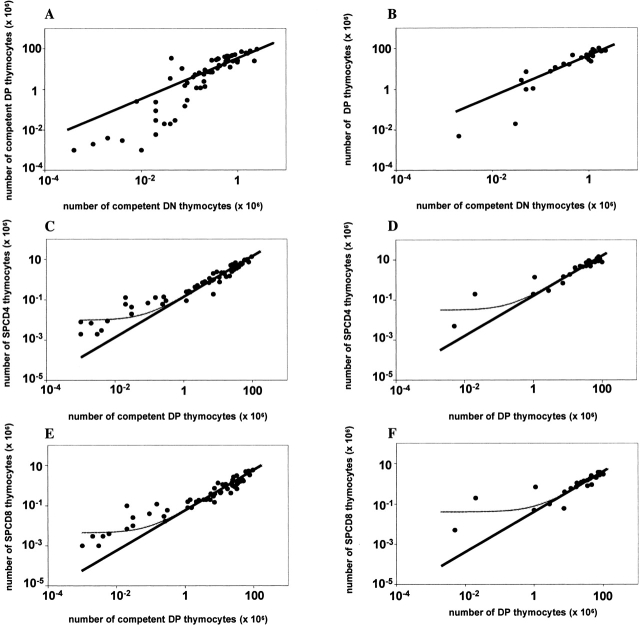
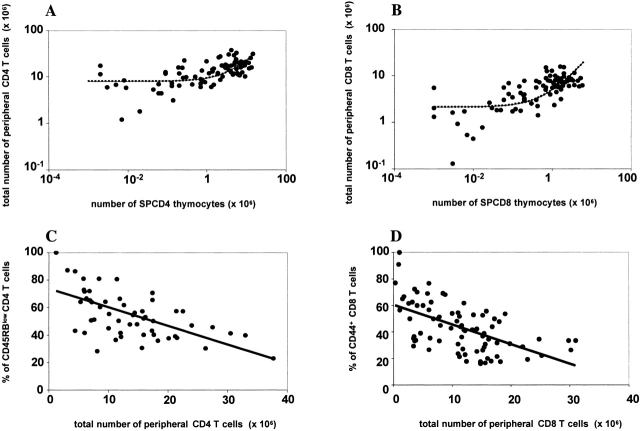
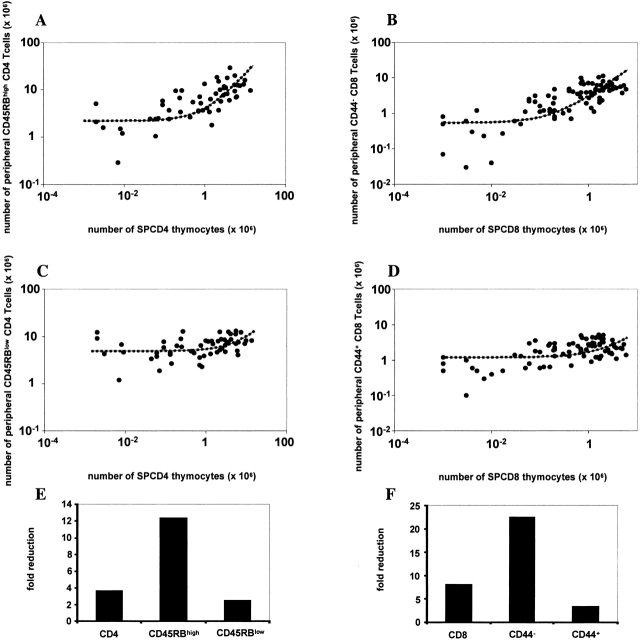
We developed a novel experimental strategy to study T cell regeneration after bone marrow transplantation. We assessed the fraction of competent precursors required to repopulate the thymus and quantified the relationship between the size of the different T cell compartments during T cell maturation in the thymus. The contribution of the thymus to the establishment and maintenance of the peripheral T cell pools was also quantified. We found that the degree of thymus restoration is determined by the availability of competent precursors and that the number of double-positive thymus cells is not under homeostatic control. In contrast, the sizes of the peripheral CD4 and CD8 T cell pools are largely independent of the number of precursors and of the number of thymus cells. Peripheral "homeostatic" proliferation and increased export and/or survival of recent thymus emigrants compensate for reduced T cell production in the thymus. In spite of these reparatory processes, mice with a reduced number of mature T cells in the thymus have an increased probability of peripheral T cell deficiency, mainly in the naive compartment.
我们开发了一种新的实验策略来研究骨髓移植后的T细胞再生。我们评估了重新填充胸腺所需的有能力的前体细胞的比例,并量化了胸腺中T细胞成熟过程中不同T细胞区室大小之间的关系。我们还量化了胸腺对建立和维持外周T细胞库的贡献。我们发现胸腺恢复的程度取决于有能力的前体细胞的可用性,并且双阳性胸腺细胞的数量不受稳态控制。相比之下,外周CD4和CD8 T细胞库的大小在很大程度上独立于前体细胞的数量和胸腺细胞的数量。外周“稳态”增殖以及近期胸腺迁出细胞输出和/或存活的增加弥补了胸腺中T细胞产生的减少。尽管有这些修复过程,但胸腺中成熟T细胞数量减少的小鼠外周T细胞缺乏的可能性增加,主要是在幼稚细胞区室。