Bender J, Mitchell T, Kappler J, Marrack P
Howard Hughes Medical Institute, National Jewish Medical and Research Center, Denver, Colorado 80206, USA.
J Exp Med. 1999 Aug 2;190(3):367-74. doi: 10.1084/jem.190.3.367.
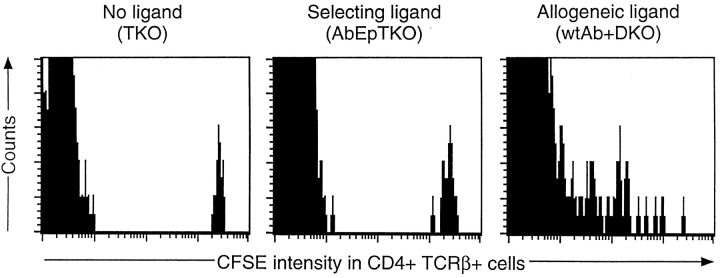
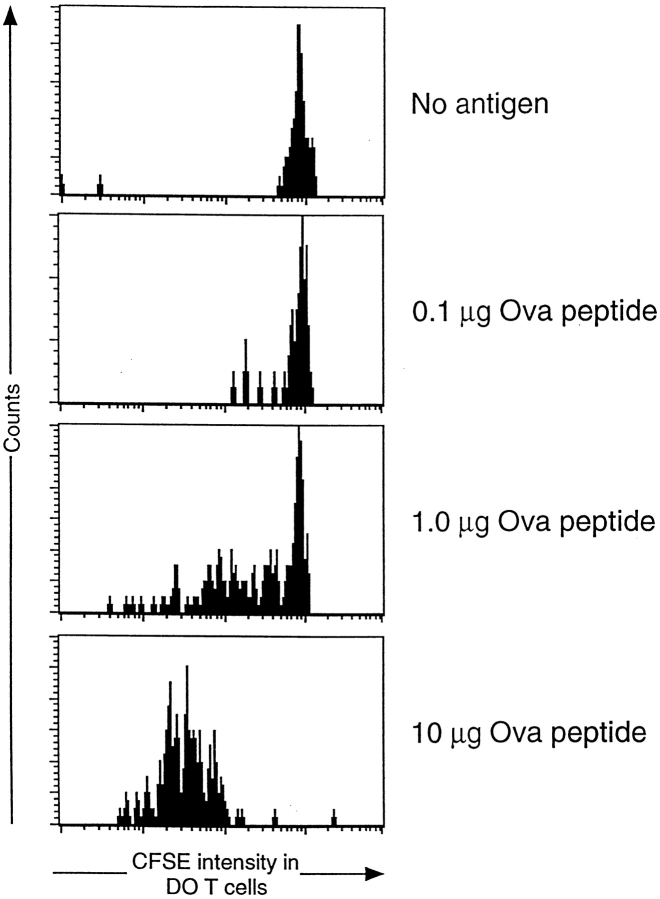
We investigated the mechanism by which alpha/beta T cells expand upon transfer to T cell-deficient host mice by injecting carboxyfluorescein diacetate succinimidyl ester-labeled T cells into mice depleted of T cells by sublethal irradiation. We found that CD4+ T cells divided when transferred to irradiated hosts and that the division of more than half of these cells required class II expression. However, division of transferred CD4+ T cells did not occur in irradiated hosts that expressed class II molecules occupied solely by the peptide responsible for thymic selection, indicating that peptides distinct from those involved in thymic selection cause the division of CD4+ T cells in irradiated mice. These data establish that class II-bound peptides control the expansion of CD4+ T cells transferred to T cell-deficient hosts and suggest that the same peptides contribute to the maintenance of T cell numbers in normal mice.
我们通过将羧基荧光素二乙酸琥珀酰亚胺酯标记的T细胞注射到经亚致死剂量照射而耗尽T细胞的小鼠体内,研究了α/β T细胞转移至T细胞缺陷宿主小鼠后发生扩增的机制。我们发现,CD4+ T细胞转移至受照射宿主后会发生分裂,且其中一半以上细胞的分裂需要II类分子的表达。然而,在表达仅被负责胸腺选择的肽占据的II类分子的受照射宿主中,转移的CD4+ T细胞不会发生分裂,这表明与胸腺选择所涉及的肽不同的肽会导致受照射小鼠中CD4+ T细胞的分裂。这些数据表明,II类分子结合的肽控制着转移至T细胞缺陷宿主的CD4+ T细胞的扩增,并提示相同的肽有助于维持正常小鼠中的T细胞数量。