Boujraf S, Luypaert R, Osteaux M
Biomedical MR Unit, AZ-VUB, Laarbeeklaan 101, B-1090 Brussels, Belgium.
J Appl Clin Med Phys. 2001 Summer;2(3):178-83. doi: 10.1120/jacmp.v2i3.2612.
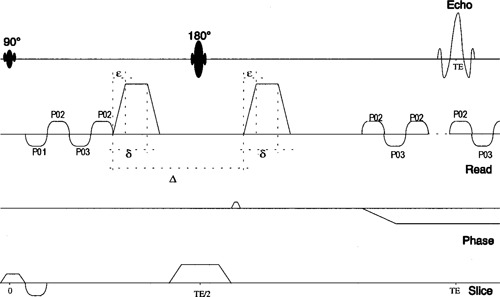
Diffusion-weighted magnetic resonance imaging (DW-MRI) is a recognized tool for early detection of infarction of the human brain. DW-MRI uses the signal loss associated with the random thermal motion of water molecules in the presence of magnetic field gradients to derive parameters that reflect the translational mobility of the water molecules in tissues. If diffusion-weighted images with different values of b matrix are acquired during one individual investigation, it is possible to calculate apparent diffusion coefficient maps that are the elements of the diffusion tensor. The diffusion tensor elements represent the apparent diffusion coefficient of protons of water molecules in each pixel in the corresponding sample. The relation between signal intensity in the diffusion-weighted images, diffusion tensor, and b matrix is derived from the Bloch equations. Our goal is to establish the magnitude of the error made in the calculation of the elements of the diffusion tensor when the imaging gradients are ignored.
扩散加权磁共振成像(DW-MRI)是一种公认的用于早期检测人脑梗死的工具。DW-MRI利用在磁场梯度存在下与水分子随机热运动相关的信号损失来推导反映水分子在组织中平移移动性的参数。如果在一次个体检查中获取具有不同b矩阵值的扩散加权图像,则可以计算出作为扩散张量元素的表观扩散系数图。扩散张量元素表示相应样本中每个像素处水分子质子的表观扩散系数。扩散加权图像中的信号强度、扩散张量和b矩阵之间的关系由布洛赫方程推导得出。我们的目标是确定在忽略成像梯度时扩散张量元素计算中所产生误差的大小。