Ghangas G S, Steffens J C
Department of Plant Breeding, Cornell University, Ithaca, NY 14853-1902, USA.
Proc Natl Acad Sci U S A. 1993 Nov 1;90(21):9911-5. doi: 10.1073/pnas.90.21.9911.
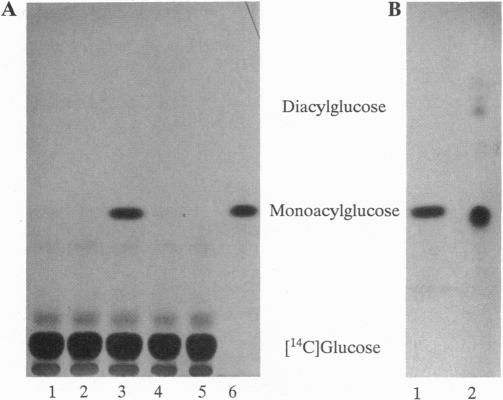
Glandular trichomes of the wild tomato Lycopersicon pennellii Corr. (D'Arcy) secrete large amounts of 2,3,4-tri-O-acylglucoses possessing straight- and branched-chain fatty acids of short to medium chain length (C4-C12). Although previous biosynthetic studies suggested that glucose acylation proceeded via acyl CoA intermediates, repeated attempts to demonstrate isobutyryl-CoA-dependent glucose acylation were unsuccessful. When [14C]isobutyrate is administered to detached L. pennellii leaves, the label is readily converted to 1-O-isobutyryl-beta-D-glucose. This is immediately followed by the appearance of di- and triacylated glucose esters. L. pennellii extracts catalyzed the formation of 1-O-isobutyryl-beta-D-glucose from isobutyrate and UDPglucose, and detached L. pennellii trichomes catalyzed transfer of the isobutyryl moiety from synthetic 1-O-isobutyryl-beta-D-glucose to D-glucose. Detached L. pennellii trichomes also catalyzed the formation of diacylglucose and triacylglucose via transfer of the isobutyryl moiety from 1-O-[14C]isobutyryl-beta-D-glucose to mono- or diacylglucoses, respectively. These studies suggest a multistep mechanism in which activation of fatty acids to their respective high-energy 1-O-acyl-beta-D-glucopyranose derivatives is followed by transfer of the 1-O-acyl moiety to non-anomeric positions of other glucose and/or partially acylated glucose molecules. This appears to be the primary mechanism of activation and fatty acid esterification to glucose in L. pennellii trichomes. Cultivated tomato, L. esculentum Mill., also activates free fatty acids to their 1-O-acyl-beta-D-glucose derivatives but lacks the acyl transfer mechanism for synthesizing polyacylated sugars.
野生番茄潘那利番茄(Lycopersicon pennellii Corr. (D'Arcy))的腺毛分泌大量含有短至中等链长(C4 - C12)的直链和支链脂肪酸的2,3,4 - 三 - O - 酰基葡萄糖。尽管先前的生物合成研究表明葡萄糖酰化是通过酰基辅酶A中间体进行的,但多次尝试证明异丁酰辅酶A依赖性葡萄糖酰化均未成功。当将[14C]异丁酸施用于离体的潘那利番茄叶片时,该标记物很容易转化为1 - O - 异丁酰基 - β - D - 葡萄糖。紧接着就会出现二酰基和三酰基葡萄糖酯。潘那利番茄提取物催化从异丁酸和UDP葡萄糖形成1 - O - 异丁酰基 - β - D - 葡萄糖,离体的潘那利番茄毛状体催化异丁酰基部分从合成的1 - O - 异丁酰基 - β - D - 葡萄糖转移至D - 葡萄糖。离体的潘那利番茄毛状体还通过将异丁酰基部分分别从1 - O - [14C]异丁酰基 - β - D - 葡萄糖转移至单酰基或二酰基葡萄糖来催化二酰基葡萄糖和三酰基葡萄糖的形成。这些研究表明了一种多步骤机制,其中脂肪酸被激活为各自的高能1 - O - 酰基 - β - D - 吡喃葡萄糖衍生物,随后1 - O - 酰基部分转移至其他葡萄糖和/或部分酰化的葡萄糖分子的非异头位置。这似乎是潘那利番茄毛状体中脂肪酸激活和葡萄糖酯化的主要机制。栽培番茄,即番茄(Lycopersicon esculentum Mill.),也能将游离脂肪酸激活为其1 - O - 酰基 - β - D - 葡萄糖衍生物,但缺乏合成多酰化糖的酰基转移机制。