Gregorius H R, Steiner W
Institut fur Forstgenetik und Forstpflanzenzüchtung Universität Göttingen, Büsgenweg 2, D-37077 Göttingen, Germany.
BMC Evol Biol. 2001;1:2. doi: 10.1186/1471-2148-1-2. Epub 2001 Aug 7.
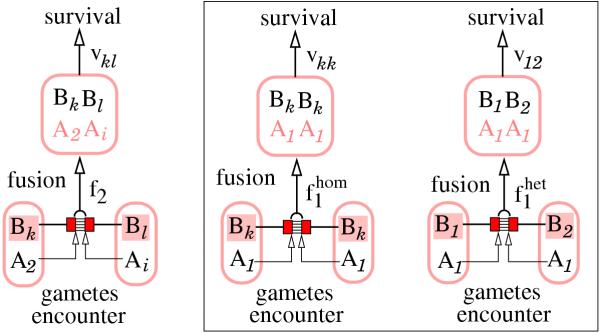
In order to maintain populations as units of reproduction and thus enable anagenetic evolution, genetic factors must exist which prevent continuing reproductive separation or enhance reproductive contact. This evolutionary principle is called genetic coherence and it marks the often ignored counterpart of cladistic evolution. Possibilities of the evolution of genetic coherence are studied with the help of a two-locus model with two alleles at each locus. The locus at which viability selection takes place is also the one that controls the fusion of gametes. The second locus acts on the first by modifying the control of the fusion probabilities. It thus acts as a mating modifier whereas the first locus plays the role of the object of selection and mating. Genetic coherence is enhanced by modifications which confer higher probabilities of fusion to heterotypic gametic combinations (resulting in heterozygous zygotes) at the object locus.
It is shown that mutants at the mating modifier locus, which increase heterotypic fusions but do not lower the homotpyic fusions relative to the resident allele at the object locus, generally replace the resident allele. Since heterozygote advantage at the object locus is a necessary condition for this result to hold true, reinforcement of genetic coherence can be claimed for this case. If the homotypic fusions are lowered, complex situations may arise which may favor or disfavor the mutant depending on initial frequencies and recombination rates. To allow for a generalized analysis including alternative models of genetic coherence as well as the estimation of its degrees in real populations, an operational concept for the measurement of this degree is developed. The resulting index is applied to the interpretation of data from crossing experiments in Alnus species designed to detect incompatibility relations.
为了将种群维持为繁殖单位,从而实现前进演化,必须存在一些遗传因素来阻止持续的生殖隔离或增强生殖接触。这种进化原则被称为遗传一致性,它标志着分支进化中常常被忽视的对应物。借助一个双位点模型(每个位点有两个等位基因)来研究遗传一致性的进化可能性。进行生存力选择的位点也是控制配子融合的位点。第二个位点通过改变融合概率的控制来作用于第一个位点。因此,它作为交配修饰基因起作用,而第一个位点则扮演选择和交配对象的角色。通过在对象位点赋予异型配子组合(产生杂合子合子)更高融合概率的修饰来增强遗传一致性。
研究表明,交配修饰基因位点上的突变体,相对于对象位点上的常驻等位基因,增加了异型融合但没有降低同型融合,通常会取代常驻等位基因。由于对象位点上的杂合子优势是这一结果成立的必要条件,因此可以认为这种情况下遗传一致性得到了加强。如果同型融合降低,可能会出现复杂的情况,这可能有利于或不利于突变体,具体取决于初始频率和重组率。为了进行包括遗传一致性替代模型在内的广义分析以及估计其在实际种群中的程度,开发了一种测量该程度的操作概念。所得指数被应用于对桤木属物种杂交实验数据的解释,这些实验旨在检测不相容关系。