Villanueva E V
Centre for Clinical Effectiveness, Monash Institute of Health Services Research, Monash University, Melbourne, Australia.
BMC Public Health. 2001;1:11. doi: 10.1186/1471-2458-1-11. Epub 2001 Nov 6.
Investigating the validity of the self-reported values of weight allows for the proper assessment of studies using questionnaire-derived data. The study examined the accuracy of gender-specific self-reported weight in a sample of adults. The effects of age, education, race and ethnicity, income, general health and medical status on the degree of discrepancy (the difference between self-reported weight and measured weight) are similarly considered.
The analysis used data from the US Third National Health and Nutrition Examination Survey. Self-reported and measured weights were abstracted and analyzed according to sex, age, measured weight, self-reported weight, and body mass index (BMI). A proportional odds model was applied.
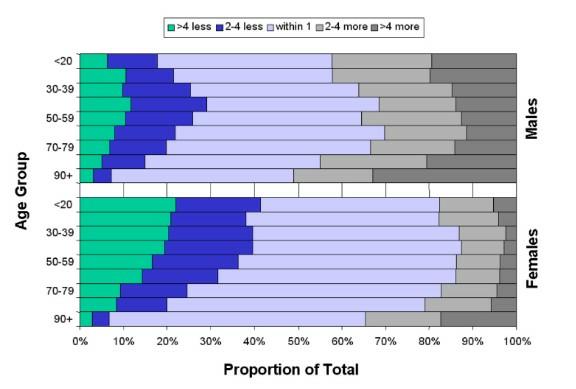
The weight discrepancy was positively associated with age, and negatively associated with measured weight and BMI. Ordered logistic regression modeling showed age, race-ethnicity, education, and BMI to be associated with the degree of discrepancy in both sexes. In men, additional predictors were consumption of more than 100 cigarettes and the desire to change weight. In women, marital status, income, activity level, and the number of months since the last doctor's visit were important.
Predictors of the degree of weight discrepancy are gender-specific, and require careful consideration when examined.
调查自我报告体重值的有效性有助于对使用问卷得出的数据的研究进行恰当评估。本研究在一个成年样本中检验了特定性别的自我报告体重的准确性。同时考虑了年龄、教育程度、种族和族裔、收入、总体健康状况和医疗状况对差异程度(自我报告体重与测量体重之间的差值)的影响。
分析采用了美国第三次全国健康和营养检查调查的数据。根据性别、年龄、测量体重、自我报告体重和体重指数(BMI)对自我报告体重和测量体重进行提取和分析。应用了比例优势模型。
体重差异与年龄呈正相关,与测量体重和BMI呈负相关。有序逻辑回归模型显示,年龄、种族 - 族裔、教育程度和BMI与两性的差异程度均有关联。在男性中,额外的预测因素是吸烟超过100支以及有改变体重的意愿。在女性中,婚姻状况、收入、活动水平以及自上次看医生以来的月数很重要。
体重差异程度的预测因素因性别而异,在研究时需要仔细考虑。