Samek Ota, Telle Helmut H, Beddows David CS
Institute of Physical Engineering, Technical University Brno, Technická 2, 616 69 Brno, Czech Republic.
BMC Oral Health. 2001;1(1):1. doi: 10.1186/1472-6831-1-1.
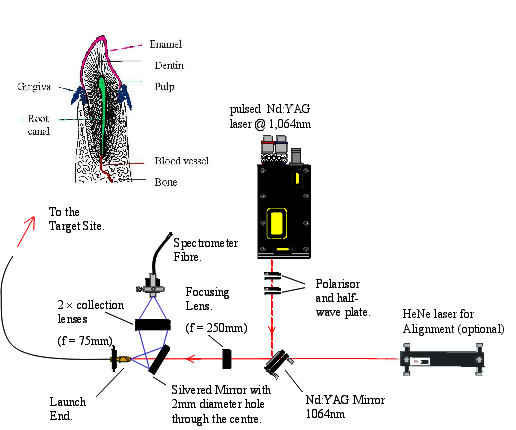
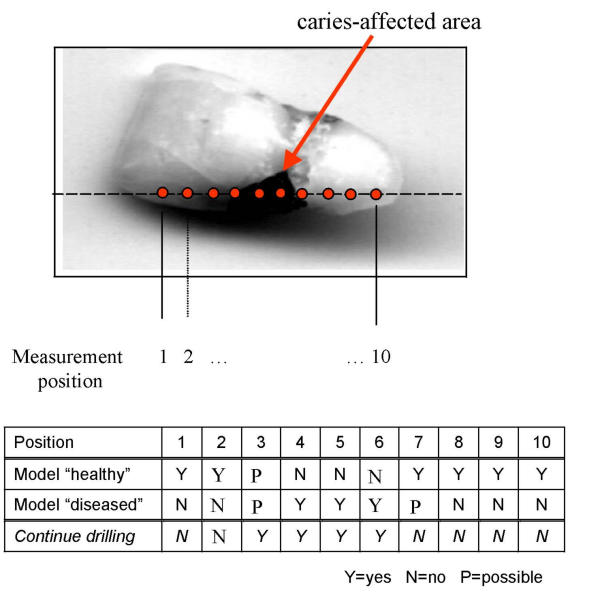
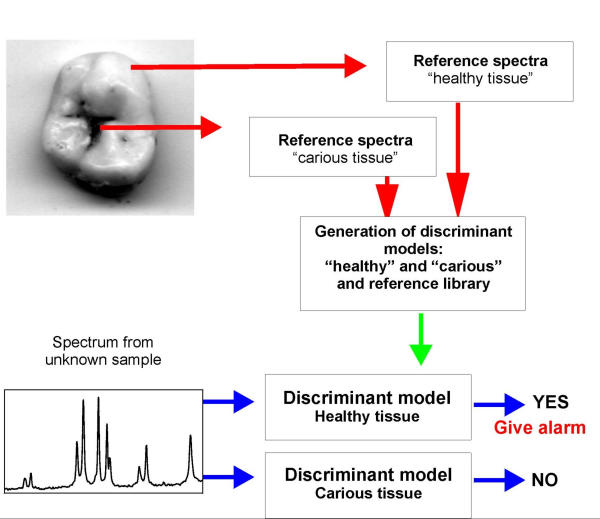
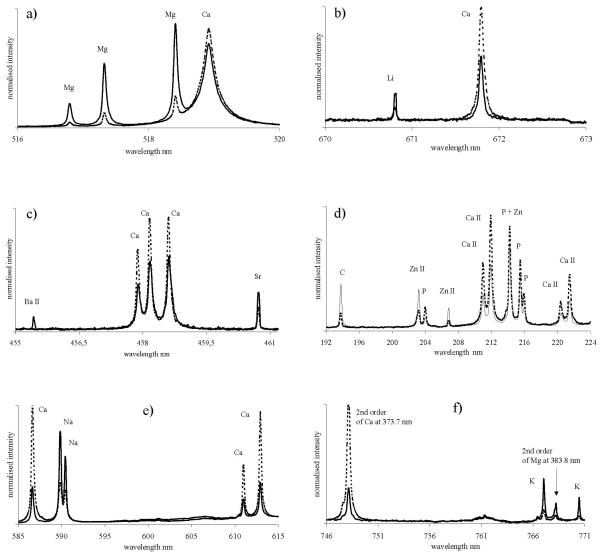
Laser Induced Breakdown Spectroscopy (LIBS) can be used to measure trace element concentrations in solids, liquids and gases, with spatial resolution and absolute quantifaction being feasible, down to parts-per-million concentration levels. Some applications of LIBS do not necessarily require exact, quantitative measurements. These include applications in dentistry, which are of a more "identify-and-sort" nature - e.g. identification of teeth affected by caries. METHODS: A one-fibre light delivery / collection assembly for LIBS analysis was used, which in principle lends itself for routine in vitro / in vivo applications in a dental practice. A number of evaluation algorithms for LIBS data can be used to assess the similarity of a spectrum, measured at specific sample locations, with a training set of reference spectra. Here, the description has been restricted to one pattern recognition algorithm, namely the so-called Mahalanobis Distance method. RESULTS: The plasma created when the laser pulse ablates the sample (in vitro / in vivo), was spectrally analysed. We demonstrated that, using the Mahalanobis Distance pattern recognition algorithm, we could unambiguously determine the identity of an "unknown" tooth sample in real time. Based on single spectra obtained from the sample, the transition from caries-affected to healthy tooth material could be distinguished, with high spatial resolution. CONCLUSIONS: The combination of LIBS and pattern recognition algorithms provides a potentially useful tool for dentists for fast material identification problems, such as for example the precise control of the laser drilling / cleaning process.
激光诱导击穿光谱技术(LIBS)可用于测量固体、液体和气体中的微量元素浓度,在百万分之一浓度水平下实现空间分辨率和绝对定量测量是可行的。LIBS的一些应用不一定需要精确的定量测量。这些应用包括牙科领域,其更具“识别和分类”性质,例如识别受龋齿影响的牙齿。
使用了一种用于LIBS分析的单光纤光传输/收集组件,原则上适用于牙科诊所的常规体外/体内应用。LIBS数据的多种评估算法可用于评估在特定样品位置测量的光谱与参考光谱训练集的相似性。这里,描述仅限于一种模式识别算法,即所谓的马氏距离法。
对激光脉冲烧蚀样品(体外/体内)时产生的等离子体进行了光谱分析。我们证明,使用马氏距离模式识别算法,我们可以实时明确确定“未知”牙齿样品的身份。基于从样品获得的单光谱,可以在高空间分辨率下区分受龋齿影响的牙齿材料和健康牙齿材料的转变。
LIBS和模式识别算法的结合为牙医提供了一个潜在有用的工具,用于解决快速材料识别问题,例如精确控制激光钻孔/清洁过程。