Kim Nacksung, Takami Masamichi, Rho Jaerang, Josien Regis, Choi Yongwon
Abramson Family Cancer Research Institute, Department of Pathology and Laboratory Medicine, University of Pennsylvania School of Medicine, Philadelphia, PA 19104, USA.
J Exp Med. 2002 Jan 21;195(2):201-9. doi: 10.1084/jem.20011681.
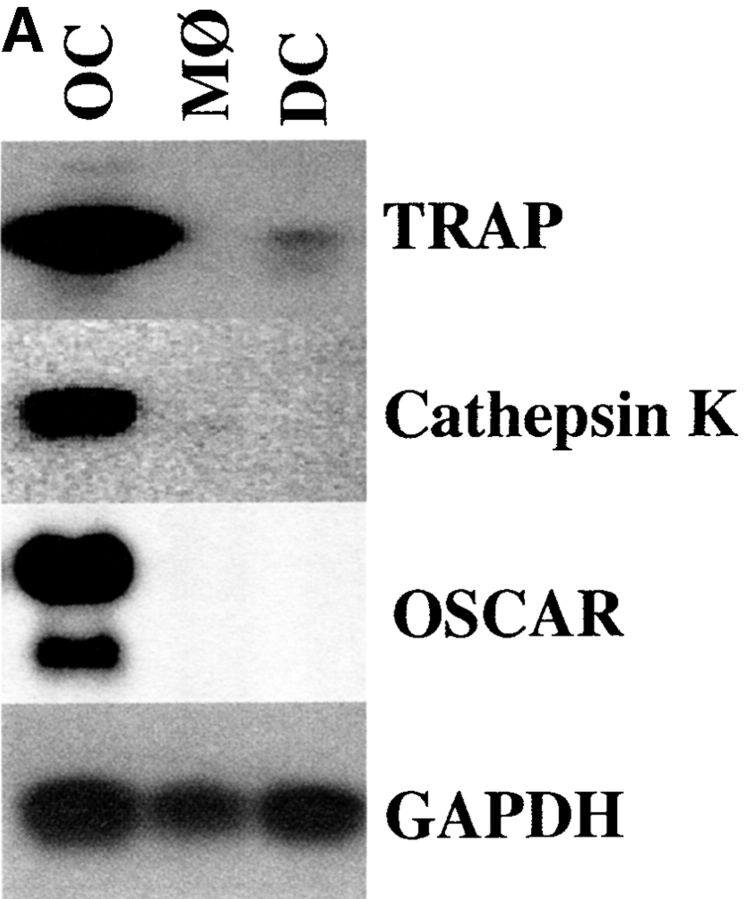
Osteoclasts (OCs) are multinucleated cells that resorb bone and are essential for bone homeostasis. They develop from hematopoietic cells of the myelomonocytic lineage. OC formation requires cell-to-cell interactions with osteoblasts and can be achieved by coculturing bone marrow precursor cells with osteoblasts/stromal cells. Two of the key factors mediating the osteoblast-induced osteoclastogenesis are macrophage-colony stimulating factor (M-CSF) and the tumor necrosis factor (TNF) family member TNF-related activation-induced cytokine (TRANCE) that are produced by osteoblasts/stromal cells in response to various bone resorbing hormones. In addition, other factors produced by osteoblasts/stromal cells further influence osteoclastogenesis. Here we report the identification and characterization of OC-associated receptor (OSCAR), a novel member of the leukocyte receptor complex (LRC)-encoded family expressed specifically in OCs. Genes in the LRC produce immunoglobulin (Ig)-like surface receptors and play critical roles in the regulation of both innate and adaptive immune responses. Different from the previously characterized members of the LRC complex, OSCAR expression is detected specifically in preosteoclasts or mature OCs. Its putative-ligand (OSCAR-L) is expressed primarily in osteoblasts/stromal cells. Moreover, addition of a soluble form of OSCAR in coculture with osteoblasts inhibits the formation of OCs from bone marrow precursor cells in the presence of bone-resorbing factors, indicating that OSCAR may be an important bone-specific regulator of OC differentiation. In addition, this study suggests that LRC-encoded genes may have evolved to regulate the physiology of cells beyond those of the immune system.
破骨细胞(OCs)是多核细胞,可吸收骨骼,对骨稳态至关重要。它们由骨髓单核细胞系的造血细胞发育而来。破骨细胞的形成需要与成骨细胞进行细胞间相互作用,可通过将骨髓前体细胞与成骨细胞/基质细胞共培养来实现。介导成骨细胞诱导破骨细胞生成的两个关键因子是巨噬细胞集落刺激因子(M-CSF)和肿瘤坏死因子(TNF)家族成员TNF相关激活诱导细胞因子(TRANCE),它们由成骨细胞/基质细胞响应各种骨吸收激素而产生。此外,成骨细胞/基质细胞产生的其他因子进一步影响破骨细胞生成。在此,我们报告破骨细胞相关受体(OSCAR)的鉴定和特征,它是白细胞受体复合物(LRC)编码家族的一个新成员,在破骨细胞中特异性表达。LRC中的基因产生免疫球蛋白(Ig)样表面受体,在先天免疫和适应性免疫反应的调节中起关键作用。与LRC复合物中先前表征的成员不同,OSCAR的表达在破骨前体细胞或成熟破骨细胞中特异性检测到。其推定配体(OSCAR-L)主要在成骨细胞/基质细胞中表达。此外,在与成骨细胞共培养中添加可溶性形式的OSCAR可在存在骨吸收因子的情况下抑制骨髓前体细胞形成破骨细胞,表明OSCAR可能是破骨细胞分化的重要骨特异性调节因子。此外,这项研究表明,LRC编码的基因可能已经进化到可调节免疫系统以外细胞的生理功能。