Halfpenny W, Hain S F, Biassoni L, Maisey M N, Sherman J A, McGurk M
Department of Oral and Maxillofacial Surgery, Guy's and St Thomas's Hospitals, St Thomas's Street, London SE1 9RT, UK.
Br J Cancer. 2002 Feb 12;86(4):512-6. doi: 10.1038/sj.bjc.6600114.
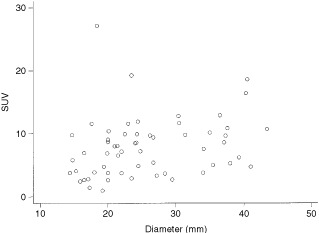
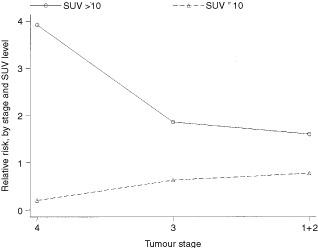
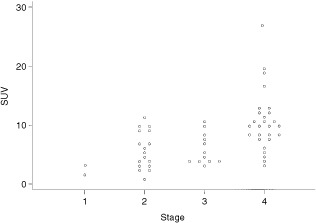
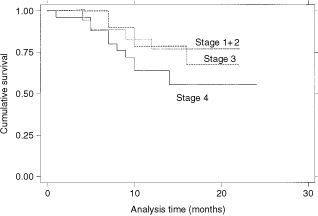
Previous studies have shown that high uptake of (18)F-fluoro-2-deoxy-glucose in head and neck cancer, as determined by the standardized uptake value on positron emission tomography scan, was associated with poor survival. The aim of this study was to confirm the association and to establish whether a high standardized uptake value had prognostic significance. Seventy-three consecutive patients with newly diagnosed squamous cell carcinoma of the head and neck underwent a positron emission tomography study before treatment. Age, gender, performance status tumour grade, stage, maximal tumour diameter and standardized uptake value were analyzed for their possible association with survival. The median standardized uptake value for all primary tumours was 7.16 (90% range 2.30 to 18.60). In univariate survival analysis the cumulative survival was decreased as the stage, tumour diameter and standardized uptake value increased. An standardized uptake value of 10 was taken as a cut-off for high and low uptake tumours. When these two groups were compared, an standardized uptake value >10 predicted for significantly worse outcome (P=0.003). Multivariate analysis demonstrated that an standardized uptake value >10 provided prognostic information independent of the tumour stage and diameter (P=0.002). We conclude that high FDG uptake (standardized uptake value>10) on positron emission tomography is an important marker for poor outcome in primary squamous cell carcinoma of the head and neck. Standardized uptake value may be useful in distinguishing those tumours with a more aggressive biological nature and hence identifying patients that require intensive treatment protocols including hyperfractionated radiotherapy and/or chemotherapy.
以往研究表明,通过正电子发射断层扫描的标准化摄取值测定,头颈部癌中(18)F - 氟 - 2 - 脱氧 - 葡萄糖摄取量高与生存率低相关。本研究的目的是证实这种关联,并确定高标准化摄取值是否具有预后意义。73例连续新诊断的头颈部鳞状细胞癌患者在治疗前接受了正电子发射断层扫描研究。分析了年龄、性别、体能状态、肿瘤分级、分期、最大肿瘤直径和标准化摄取值与生存率的可能关联。所有原发性肿瘤的标准化摄取值中位数为7.16(90%范围为2.30至18.60)。在单因素生存分析中,累积生存率随着分期、肿瘤直径和标准化摄取值的增加而降低。将标准化摄取值10作为高摄取和低摄取肿瘤的分界值。当比较这两组时,标准化摄取值>10预示着预后明显更差(P = 0.003)。多因素分析表明,标准化摄取值>10提供了独立于肿瘤分期和直径的预后信息(P = 0.002)。我们得出结论,正电子发射断层扫描上高FDG摄取(标准化摄取值>10)是头颈部原发性鳞状细胞癌预后不良的重要标志物。标准化摄取值可能有助于区分那些具有更具侵袭性生物学特性的肿瘤,从而识别需要强化治疗方案(包括超分割放疗和/或化疗)的患者。