Ohnishi Takeo, Ohnishi Ken, Takahashi Akihisa
Department of Biology, Nara Medical University, 840 Shijo-cho, Kashihara, Nara 634-8521, Japan.
BMC Biotechnol. 2002 Apr 19;2:6. doi: 10.1186/1472-6750-2-6.
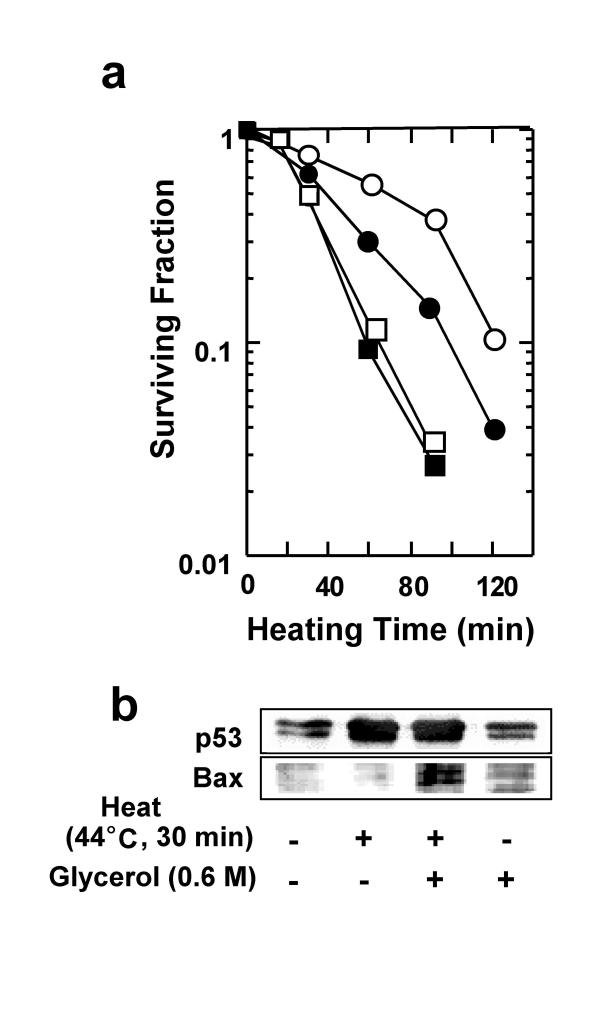
We have previously reported that glycerol acts as a chemical chaperone to restore the expression of WAF1 in some human cancer cell lines bearing mutant p53. Since the expression of WAF1 is up-regulated by activated wildtype p53, glycerol appears to restore wtp53 function. The aim of the present study is to examine the restoration of heat-induced p53-dependent apoptosis by glycerol in human glioblastoma cells (A-172) transfected with a vector carrying a mutant p53 gene (A-172/mp53 cells) or neo control vector (A-172/neo cells).
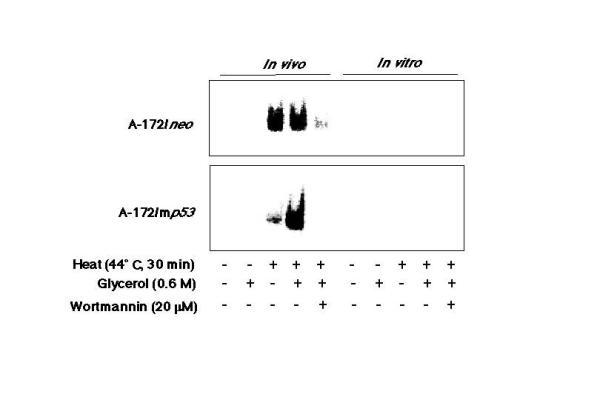
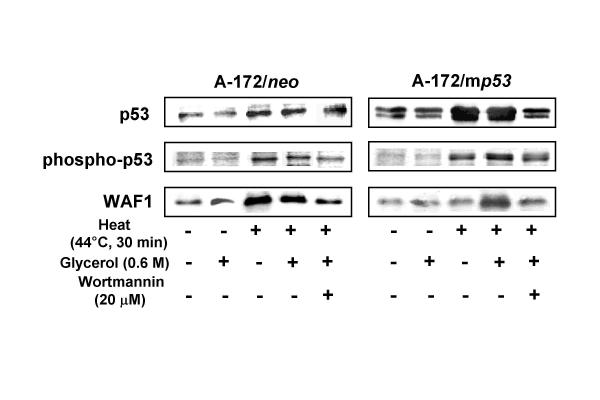
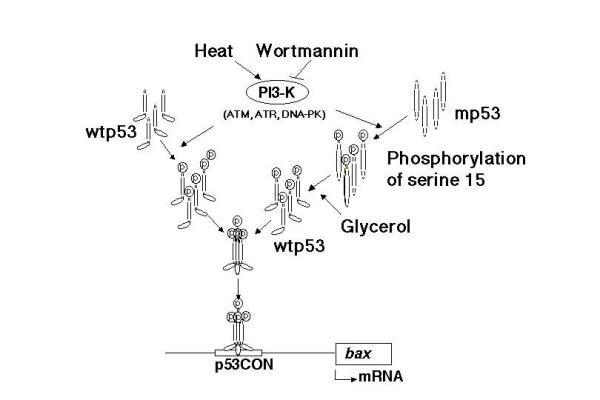
A-172/mp53 cells showed heat resistance compared with A-172/neo cells but A-172/mp53 cells in turn became heat sensitive when pre-treated with glycerol before heat treatment. The accumulation of Bax in the A-172/mp53 cells was induced by heating with glycerol pre-treatment, but not without it, whereas the accumulation in the A-172/neo cells was induced in both cases. Furthermore, mp53 extracted from heated cells came to bind to the sequence specific region after heating combined with glycerol pre-treatment. The phosphorylation of mp53 at serine15 was suppressed by an inhibitor of the phosphatidylinositol 3-kinase (PI3-K) family.
These results suggest that glycerol is effective in inducing conformational change of phosphorylated p53 and restoring mp53 to wtp53 function, leading to enhanced heat sensitivity through the induction of apoptosis. This novel tool for enhancement of heat sensitivity in cancer cells bearing mp53 may be applicable for p53-targeted hyperthermia, because mutation or inactivation of p53 is observed in approximately 50% of human cancers.
我们之前报道过,甘油作为一种化学伴侣,可在一些携带突变型p53的人类癌细胞系中恢复WAF1的表达。由于WAF1的表达受活化的野生型p53上调,甘油似乎可恢复野生型p53的功能。本研究的目的是检测甘油对转染了携带突变型p53基因的载体(A - 172/mp53细胞)或neo对照载体(A - 172/neo细胞)的人胶质母细胞瘤细胞(A - 172)中热诱导的p53依赖性凋亡的恢复作用。
与A - 172/neo细胞相比,A - 172/mp53细胞表现出耐热性,但在热处理前用甘油预处理时,A - 172/mp53细胞反而变得对热敏感。用甘油预处理后加热可诱导A - 172/mp53细胞中Bax的积累,而无甘油预处理则不会,而两种情况下A - 172/neo细胞中Bax的积累均可被诱导。此外,加热结合甘油预处理后,从加热细胞中提取的mp53开始与序列特异性区域结合。丝氨酸15位点的mp53磷酸化被磷脂酰肌醇3激酶(PI3 - K)家族的抑制剂所抑制。
这些结果表明,甘油可有效诱导磷酸化p53的构象变化,并将mp53恢复为野生型p53功能,通过诱导凋亡导致热敏感性增强。这种增强携带mp53的癌细胞热敏感性的新工具可能适用于p53靶向热疗,因为在大约一半的人类癌症中观察到p53的突变或失活。