Kim Kyung Jin, Shim Wan Joo, Jung Seong Won, Pak Hui Nam, Lee Soo Jin, Song Woo Hyuk, Kim Young Hoon, Seo Hong Seog, Oh Dong Joo, Ro Young Moo
Department of Internal Medicine, College of Medicine, Korea University, Seoul, Korea.
Korean J Intern Med. 2002 Jun;17(2):122-30. doi: 10.3904/kjim.2002.17.2.122.
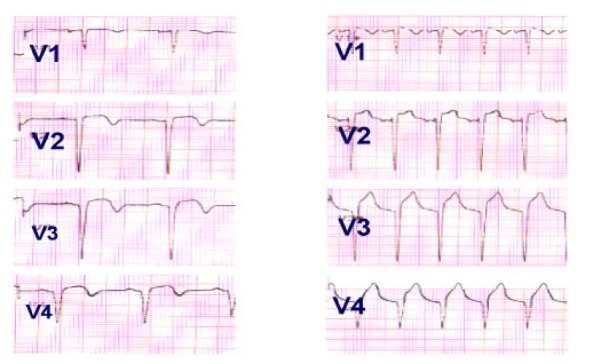
Several studies suggested that T-wave normalization (TWN) in exercise ECG indicates the presence of viable myocardium. But the clinical implication of this phenomenon in patients with acute myocardial infarction who received proper revascularization therapy was not determined. Precisely the aim of this study was to investigate the relationship between TWN in exercise ECG and myocardial functional recovery after acute myocardial infarction.
We studied 30 acute myocardial infarction patients with negative T waves in infarct related electrocardiographic leads and who had received successful revascularization therapy. Exercise ECG was performed 10-14 days after infarct onset using Naughton protocol. Patients were divided into 2 groups according to presence (group I; n = 14) or not (group II; n = 16) of TWN in exercise ECG. Exercise parameters and coronary angiographic findings were compared between groups. Baseline and follow-up (mean 11 months) regional and global left ventricular function was analyzed by echocardiography.
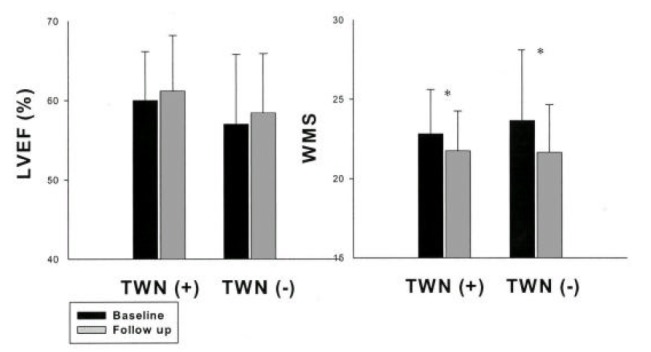
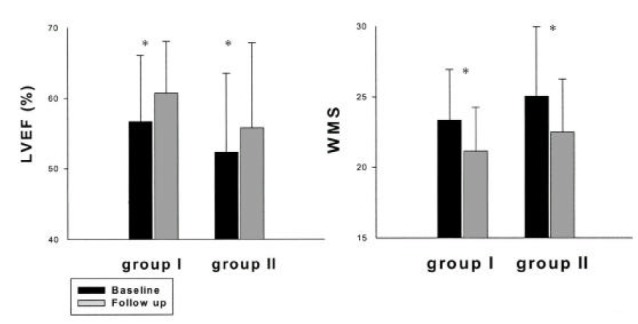
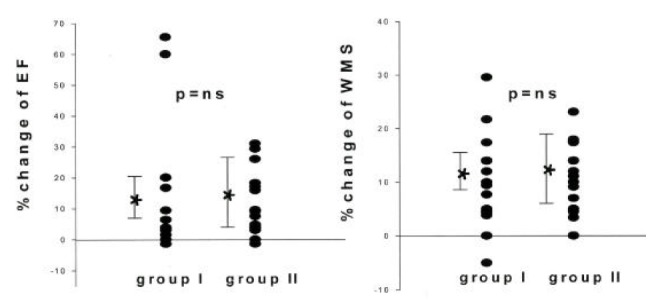
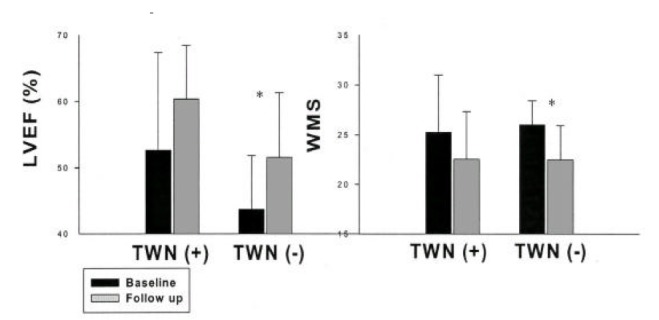
Exercise parameters were similar between groups. There was no difference in baseline ejection fraction and wall motion score between group I and II (EF; 56 +/- 12% vs 52 +/- 11%, p = ns. WMS; 21 +/- 3 vs 23 +/- 4, p = ns) and it was improved at the tenth month by similar magnitude (group I/group II, EF% change = 12 +/- 12% vs 7 +/- 6%, p = ns, WMS% change = 6 +/- 6% vs 7 +/- 5%, p = ns). The finding of no relation between TWN and functional recovery was observed also when the patients were analysed according to infarct location and presence or absence of Q-waves.
As the exercise-induced TWN in patients with acute myocardial infarction was not related with better functional recovery of dysfunctional regional wall motion and ejection fraction, TWN does not appear to be an indicator of myocardial viability.
多项研究表明,运动心电图中的T波正常化(TWN)提示存活心肌的存在。但对于接受了适当血运重建治疗的急性心肌梗死患者,这一现象的临床意义尚未明确。本研究的目的正是探究运动心电图中的TWN与急性心肌梗死后心肌功能恢复之间的关系。
我们研究了30例梗死相关心电图导联T波倒置且接受了成功血运重建治疗的急性心肌梗死患者。梗死发作后10 - 14天,采用诺顿方案进行运动心电图检查。根据运动心电图中是否出现TWN,将患者分为两组(I组;n = 14)和(II组;n = 16)。比较两组间的运动参数和冠状动脉造影结果。通过超声心动图分析基线及随访(平均11个月)时的局部和整体左心室功能。
两组间运动参数相似。I组和II组的基线射血分数和室壁运动评分无差异(射血分数:56 ± 12% 对 52 ± 11%,p = 无统计学意义。室壁运动评分:21 ± 3 对 23 ± 4,p = 无统计学意义),且在第10个月时改善幅度相似(I组/II组,射血分数变化百分比 = 12 ± 12% 对 7 ± 6%,p = 无统计学意义,室壁运动评分变化百分比 = 6 ± 6% 对 7 ± 5%,p = 无统计学意义)。当根据梗死部位以及Q波的有无对患者进行分析时,也发现TWN与功能恢复之间无关联。
由于急性心肌梗死患者运动诱发的TWN与功能失调的局部室壁运动和射血分数的更好功能恢复无关,TWN似乎不是心肌存活的指标。