Altroff Harri, Choulier Laurence, Mardon Helen J
Nuffield Department of Obstetrics and Gynaecology, University of Oxford, Women's Centre, John Radcliffe Hospital, Headington, Oxford OX3 9DU, United Kingdom.
J Biol Chem. 2003 Jan 3;278(1):491-7. doi: 10.1074/jbc.M209992200. Epub 2002 Oct 9.
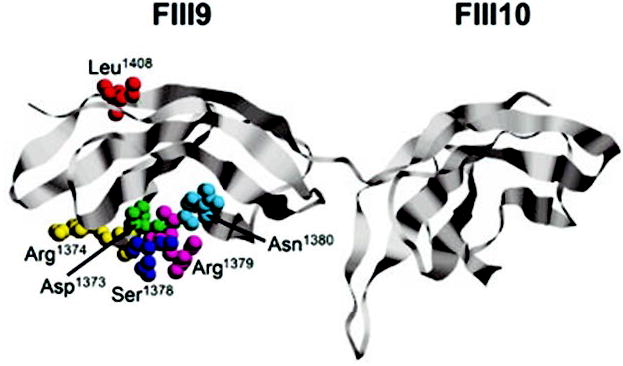
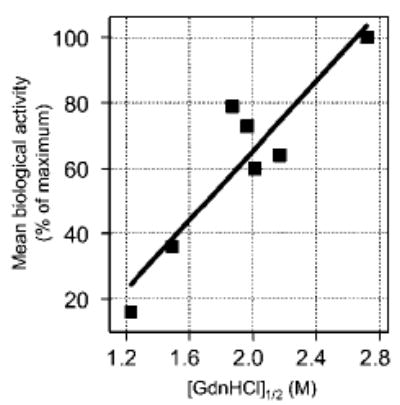
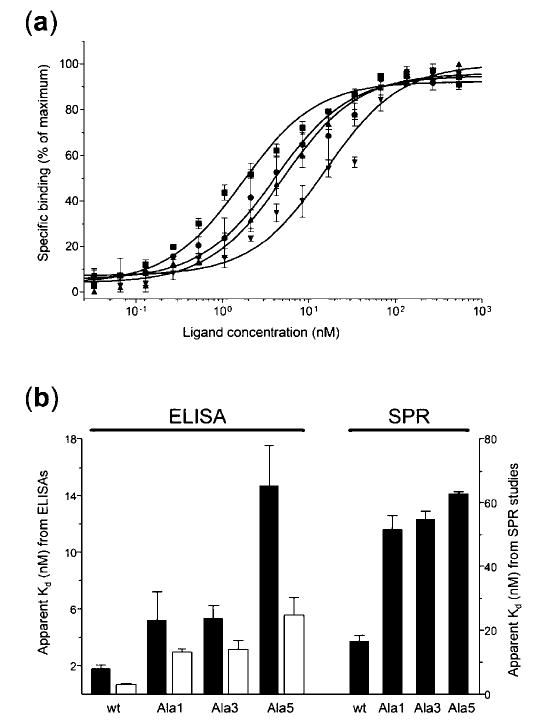
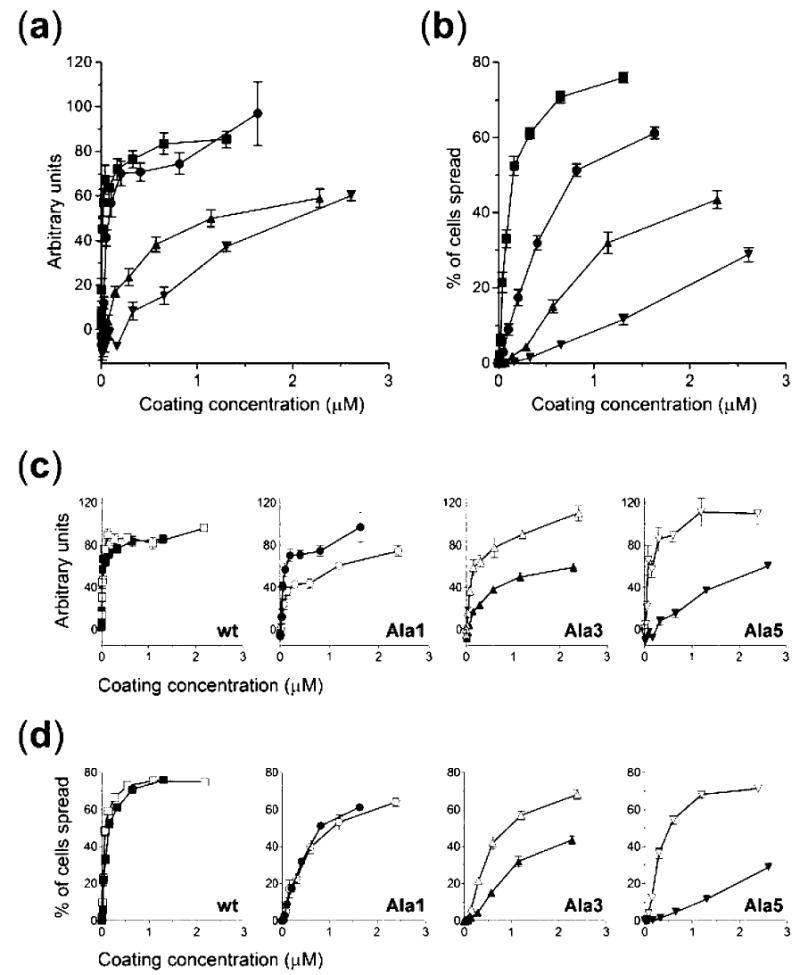
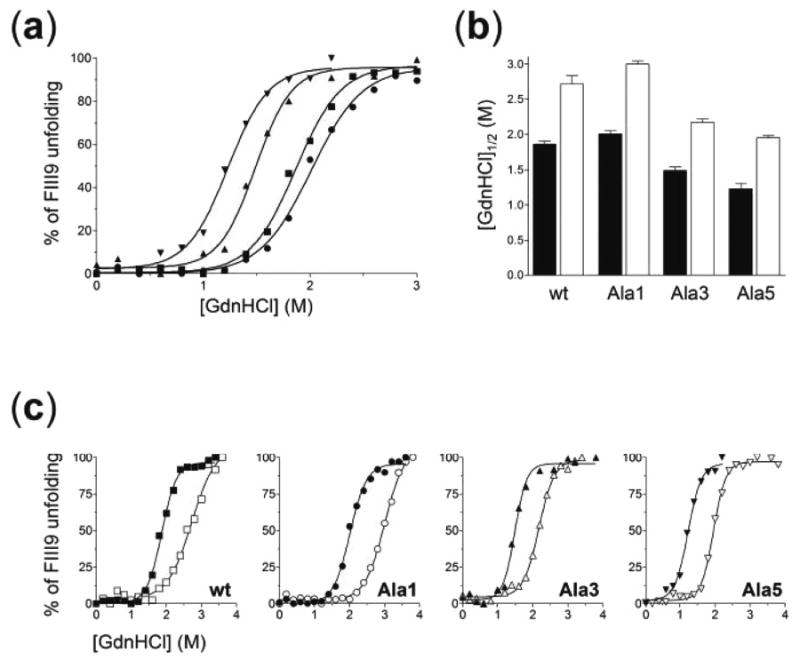
The ninth and tenth FIII domains (FIII9-10) of human fibronectin act in synergy to promote cell adhesion via the interaction with integrin receptors. Here we describe the functional and structural properties of a set of recombinant FIII9-10 mutants containing various alanine substitutions within the key synergistic site, DRVPHSRN in FIII9, either alone or in combination with another substitution (Leu(1408) to Pro), on the opposite face of FIII9, that increases stability and the functional capacity of FIII9-10. We show that the introduction of mutations into the synergistic sequence of FIII9-10 has a negative effect on the adhesion of baby hamster kidney fibroblasts and results in reduced ability of these ligands to recognize integrin alpha(5)beta(1). Conformational stability of the FIII9 domain in the synergy site mutants is likewise reduced in comparison with native FIII9. The Leu(1408) to Pro substitution in mutant FIII9-10 proteins carrying substitutions in the synergy site results in a substantial recovery of the adhesive activity of the mutants and affinity to alpha(5)beta(1). In keeping with the enhancement of functional activity, the Leu(1408) to Pro substitution in the FIII9-10 synergy site mutants also causes a significant increase in conformational stability of FIII9. These observations imply a strong positive correlation between the biological activity and conformational stability of the assessed FIII9-10 mutants and suggest that a Leu(1408) to Pro substitution restores the biological activity of the mutants via their ability to restore their conformational stability. We conclude that domain stability may be a major determinant of the synergistic potential of FIII9. Our data underscore the value of using more than one approach in such structure-function studies and the requirement for validating the global structural integrity of protein ligands in which sequences that disrupt function have been perturbed.
人纤连蛋白的第九和第十个III型结构域(FIII9-10)协同作用,通过与整合素受体相互作用促进细胞黏附。在此,我们描述了一组重组FIII9-10突变体的功能和结构特性,这些突变体在关键协同位点(FIII9中的DRVPHSRN)内含有各种丙氨酸取代,这些取代单独或与FIII9另一面上的另一个取代(Leu(1408)突变为Pro)相结合,该取代可增加FIII9-10的稳定性和功能能力。我们表明,在FIII9-10的协同序列中引入突变对幼仓鼠肾成纤维细胞的黏附具有负面影响,并导致这些配体识别整合素α(5)β(1)的能力降低。与天然FIII9相比,协同位点突变体中FIII9结构域的构象稳定性同样降低。在协同位点携带取代的突变FIII9-10蛋白中,Leu(1408)突变为Pro导致突变体的黏附活性和对α(5)β(1)的亲和力大幅恢复。与功能活性的增强一致,FIII9-10协同位点突变体中Leu(1408)突变为Pro也导致FIII9的构象稳定性显著增加。这些观察结果表明,所评估的FIII9-10突变体的生物活性与构象稳定性之间存在很强的正相关,并表明Leu(1408)突变为Pro通过恢复其构象稳定性的能力来恢复突变体的生物活性。我们得出结论,结构域稳定性可能是FIII9协同潜力的主要决定因素。我们的数据强调了在这种结构-功能研究中使用多种方法的价值,以及验证蛋白质配体整体结构完整性的必要性,其中破坏功能的序列已受到干扰。