Leung G M, Thach T Q, Lam T-H, Hedley A J, Foo W, Fielding R, Yip P S F, Lau E M C, Wong C-M
Department of Community Medicine, University of Hong Kong, 5/F, Academic & Administration Block, Faculty of Medicine Building, 21 Sassoon Road, Pokfulam, Hong Kong, China.
Br J Cancer. 2002 Oct 21;87(9):982-8. doi: 10.1038/sj.bjc.6600583.
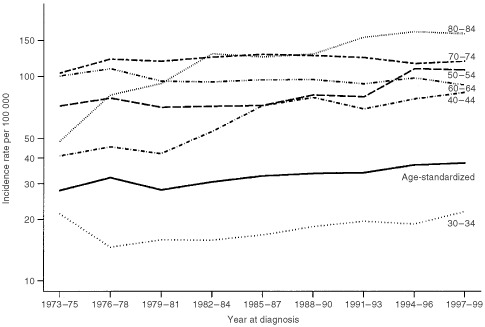
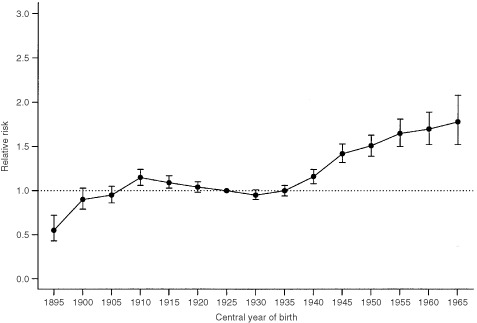
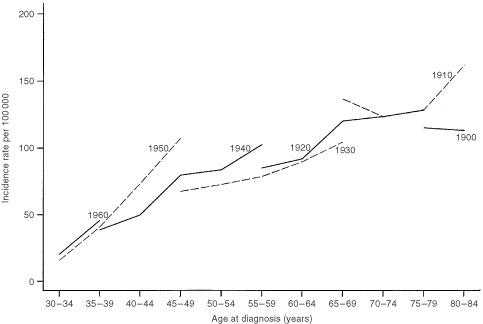
Hong Kong has the highest breast cancer incidence in Asia and studying secular changes in its rates may lead to hypotheses regarding disease aetiology and also predictions of future trends for China. We examined statistics from the Hong Kong Cancer Registry based on 26 566 cases of invasive breast cancer from 1973 to 1999. The trends in breast cancer incidence were studied using log-linear longitudinal models. We further analysed the independent effects of chronological age, time period and birth cohort on incidence trends using age-period-cohort modelling. The average annual per cent change of the age-standardised incidence was 3.6% during 1973-1999. Age-period-cohort modelling indicated the incidence development was predominantly a cohort effect, where the rise in relative risk was seemingly linear in successive birth cohorts, showing a 2-3-fold difference when comparing women born in the 1960's with those born around 1900. Our results suggest that direct and indirect consequences of westernisation may have been responsible for most of the observed increase in breast cancer incidence. As China moves towards a more westernised way of life, we can expect an emerging epidemic of breast cancer as Hong Kong's experience has demonstrated.
香港是亚洲乳腺癌发病率最高的地区,研究其发病率的长期变化可能会得出有关疾病病因的假设,也能预测中国未来的发病趋势。我们基于香港癌症登记处1973年至1999年的26566例浸润性乳腺癌病例数据进行了分析。采用对数线性纵向模型研究乳腺癌发病率的趋势。我们还使用年龄-时期-队列模型进一步分析了年龄、时期和出生队列对发病率趋势的独立影响。1973年至1999年期间,年龄标准化发病率的年均变化率为3.6%。年龄-时期-队列模型表明,发病率的上升主要是队列效应,即相对风险在连续出生队列中似乎呈线性上升,将20世纪60年代出生的女性与1900年左右出生的女性相比,相对风险相差2至3倍。我们的研究结果表明,西化的直接和间接后果可能是观察到的乳腺癌发病率上升的主要原因。正如香港经验所表明的,随着中国生活方式日益西化,预计乳腺癌将成为一种新出现的流行病。