Yousef G M, Borgoño C A, Scorilas A, Ponzone R, Biglia N, Iskander L, Polymeris M-E, Roagna R, Sismondi P, Diamandis E P
Department of Pathology and Laboratory Medicine, Mount Sinai Hospital, Toronto, Ontario, Canada.
Br J Cancer. 2002 Nov 18;87(11):1287-93. doi: 10.1038/sj.bjc.6600623.
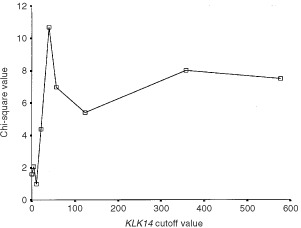
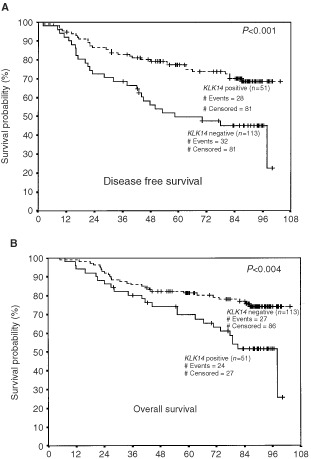
KLK14 (formerly known as KLK-L6) is a recently identified member of the human kallikrein gene family. This family harbours several genes aberrantly expressed in various cancers as well as established (PSA/hK3, hK2) and potential (hK6, hK10) cancer markers. Similar to other kallikrein genes, KLK14 was found to be regulated by steroid hormones, particularly androgens and progestins, in breast and ovarian cancer cell lines. Preliminary studies indicated that KLK14 is differentially expressed in breast, ovarian, prostatic and testicular tumours. Given the above, we determined the prognostic significance of KLK14 expression in breast cancer. We studied KLK14 expression in 178 histologically confirmed epithelial breast carcinomas by quantitative reverse transcription-polymerase chain reaction and correlated with clinicopathological variables (tumour stage, grade, histotype etc.) and with outcome (disease-free survival and overall survival), monitored over a median of 76 months. KLK14 mRNA levels ranged from 0 to 1,219 arbitrary units in breast cancer tissues, with a mean+/-s.e. of 136+/-22. An optimal cutoff value of 40.5 arbitrary units was selected, to categorise tumours as KLK14-positive or negative. Higher concentrations of KLK14 mRNA were more frequently found in patients with advanced stage (III) disease (P=0.032). No statistically significant association was found between KLK14 and the other clinicopathological variables. KLK14 overexpression was found to be a significant predictor of decreased disease-free survival (hazard ratio of 2.31, P=0.001) and overall survival (hazard ratio of 2.21, P=0.005). Cox multivariate analysis indicated that KLK14 was an independent prognostic indicator of disease-free survival and overall survival. KLK14 also has independent prognostic value in subgroups of patients with a tumour size </=2 cm and positive nodal, oestrogen receptor and progestin receptor status. We conclude that KLK14 expression, as assessed by quantitative reverse transcription-polymerase chain reaction, is an independent marker of unfavourable prognosis for breast cancer.
KLK14(以前称为KLK-L6)是人类激肽释放酶基因家族中最近发现的成员。该家族包含几个在各种癌症中异常表达的基因以及已确定的(前列腺特异性抗原/hK3、hK2)和潜在的(hK6、hK10)癌症标志物。与其他激肽释放酶基因类似,在乳腺癌和卵巢癌细胞系中发现KLK14受类固醇激素调节,特别是雄激素和孕激素。初步研究表明,KLK14在乳腺癌、卵巢癌、前列腺癌和睾丸肿瘤中差异表达。鉴于上述情况,我们确定了KLK14表达在乳腺癌中的预后意义。我们通过定量逆转录-聚合酶链反应研究了178例经组织学证实的乳腺上皮癌中KLK14的表达,并将其与临床病理变量(肿瘤分期、分级、组织类型等)以及预后(无病生存期和总生存期)相关联,中位随访时间为76个月。乳腺癌组织中KLK14 mRNA水平范围为0至1219任意单位,平均±标准误为136±22。选择40.5任意单位的最佳临界值,将肿瘤分为KLK14阳性或阴性。晚期(III期)疾病患者中更频繁地发现较高浓度的KLK14 mRNA(P=0.032)。未发现KLK14与其他临床病理变量之间存在统计学显著关联。发现KLK14过表达是无病生存期降低(风险比为2.31,P=0.001)和总生存期降低(风险比为2.21,P=0.005)的重要预测指标。Cox多变量分析表明,KLK14是无病生存期和总生存期的独立预后指标。KLK14在肿瘤大小≤2 cm且淋巴结、雌激素受体和孕激素受体状态为阳性的患者亚组中也具有独立的预后价值。我们得出结论,通过定量逆转录-聚合酶链反应评估的KLK14表达是乳腺癌预后不良的独立标志物。