Braden Christopher R, Crawford Jack T, Schable Barbara A
Centers for Disease Control and Prevention, Atlanta, GA 30333, USA.
Emerg Infect Dis. 2002 Nov;8(11):1210-5. doi: 10.3201/eid0811.020401.
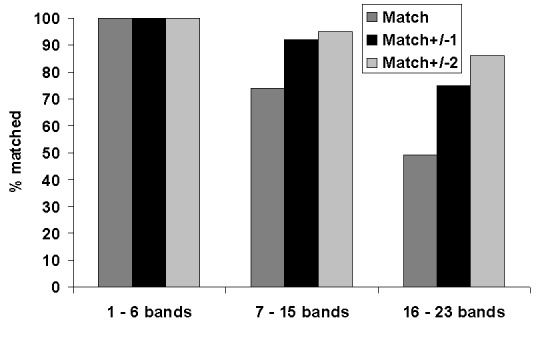
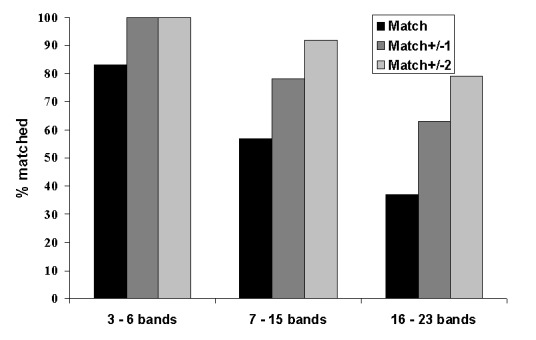
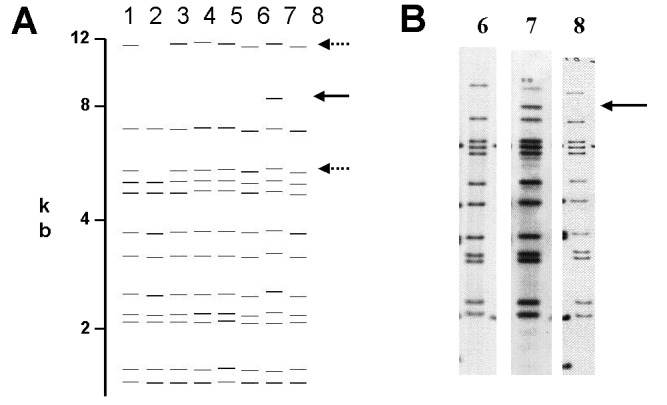
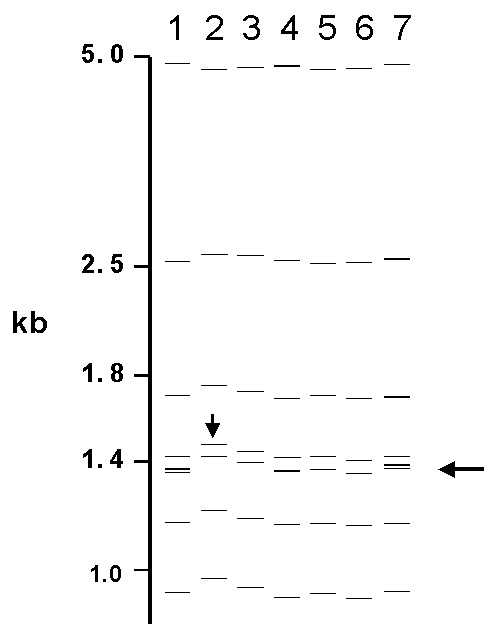
Quality assessment exercises were conducted to evaluate the reproducibility of IS6110 DNA fingerprinting performed by eight laboratories in the National Tuberculosis Genotyping and Surveillance Network. Three panels, each with 8 to 16 isolates, were typed at all laboratories, resulting in 280 images. When the pattern obtained by the majority for each isolate was used as the standard, exact matches were obtained for 73% of patterns; 90% and 97% of patterns matched within one- and two-band differences, respectively. A second approach involved retyping of randomly selected isolates at the Centers for Disease Control and Prevention. Retyping was done for 8-19 isolates per laboratory (76 total). Paired images matched exactly for 54% of isolates and within one and two band differences, 78% and 93%, respectively. We evaluated reasons for mismatching. We also evaluated the reproducibility of spoligotyping using a test panel of 13 isolates; a discrepancy of 1 in 91 results was noted.
开展了质量评估活动,以评估国家结核病基因分型与监测网络中8个实验室进行的IS6110 DNA指纹图谱分析的可重复性。向所有实验室提供了3组菌株,每组有8至16株,共产生280张图像。当将每个菌株大多数实验室获得的图谱作为标准时,73%的图谱能完全匹配;分别有90%和97%的图谱在相差1条带和2条带以内匹配。第二种方法是在美国疾病控制与预防中心对随机选择的菌株进行重新分型。每个实验室对8 - 19株菌株进行重新分型(共76株)。配对图像中,54%的菌株能完全匹配,相差1条带和2条带以内匹配的分别为78%和93%。我们评估了不匹配的原因。我们还使用一个由13株菌株组成的测试组评估了间隔寡核苷酸分型的可重复性;在91个结果中发现有1个差异。