Cronin Wendy A, Golub Jonathan E, Lathan Monica J, Mukasa Leonard N, Hooper Nancy, Razeq Jafar H, Baruch Nancy G, Mulcahy Donna, Benjamin William H, Magder Laurence S, Strickland G Thomas, Bishai William R
Maryland Department of Health and Mental Hygiene, Baltimore, Maryland 21201, USA.
Emerg Infect Dis. 2002 Nov;8(11):1271-9. doi: 10.3201/eid0811.020261.
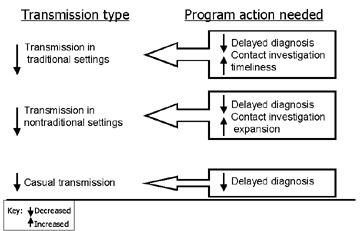
To assess the circumstances of recent transmission of tuberculosis (TB) (progression to active disease <2 years after infection), we obtained DNA fingerprints for 1172 (99%) of 1179 Mycobacterium tuberculosis isolates collected from Maryland TB patients from 1996 to 2000. We also reviewed medical records and interviewed patients with genetically matching M. tuberculosis strains to identify epidemiologic links (cluster investigation). Traditional settings for transmission were defined as households or close relatives and friends; all other settings were considered nontraditional. Of 436 clustered patients, 115 had recently acquired TB. Cluster investigations were significantly more likely than contact investigations to identify patients who recently acquired TB in nontraditional settings (33/42 vs. 23/72, respectively; p<0.001). Transmission from a foreign-born person to a U.S.-born person was rare and occurred mainly in public settings. The time from symptom onset to diagnosis was twice as long for transmitters as for nontransmitters (16.8 vs. 8.5 weeks, respectively; p<0.01). Molecular epidemiologic studies showed that reducing diagnostic delays can prevent TB transmission in nontraditional settings, which elude contact investigations.
为评估近期结核病(TB)传播情况(感染后<2年进展为活动性疾病),我们获取了1996年至2000年从马里兰州结核病患者中收集的1179株结核分枝杆菌分离株中1172株(99%)的DNA指纹图谱。我们还查阅了病历,并对结核分枝杆菌菌株基因匹配的患者进行访谈以确定流行病学关联(聚集性调查)。传统传播场所定义为家庭或近亲及朋友;所有其他场所视为非传统场所。在436例聚集性患者中,115例为近期感染结核病。聚集性调查比接触者调查更有可能识别出在非传统场所近期感染结核病的患者(分别为33/42和23/72;p<0.001)。外国出生者向美国出生者的传播很少见,主要发生在公共场所。传播者从症状出现到诊断的时间是非传播者的两倍(分别为16.8周和8.5周;p<0.01)。分子流行病学研究表明,减少诊断延迟可预防非传统场所的结核病传播,而这些场所难以通过接触者调查发现。