Wisor Jonathan P, O'Hara Bruce F, Terao Akira, Selby Chris P, Kilduff Thomas S, Sancar Aziz, Edgar Dale M, Franken Paul
Dept of Psychiatry and Behavioral Sciences, Stanford University School of Medicine, Stanford, CA, USA.
BMC Neurosci. 2002 Dec 20;3:20. doi: 10.1186/1471-2202-3-20.
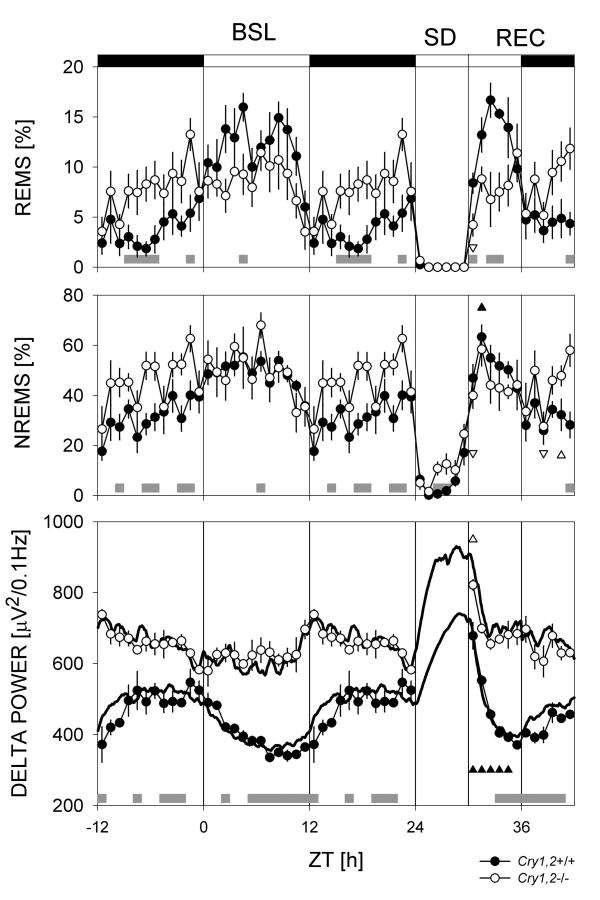
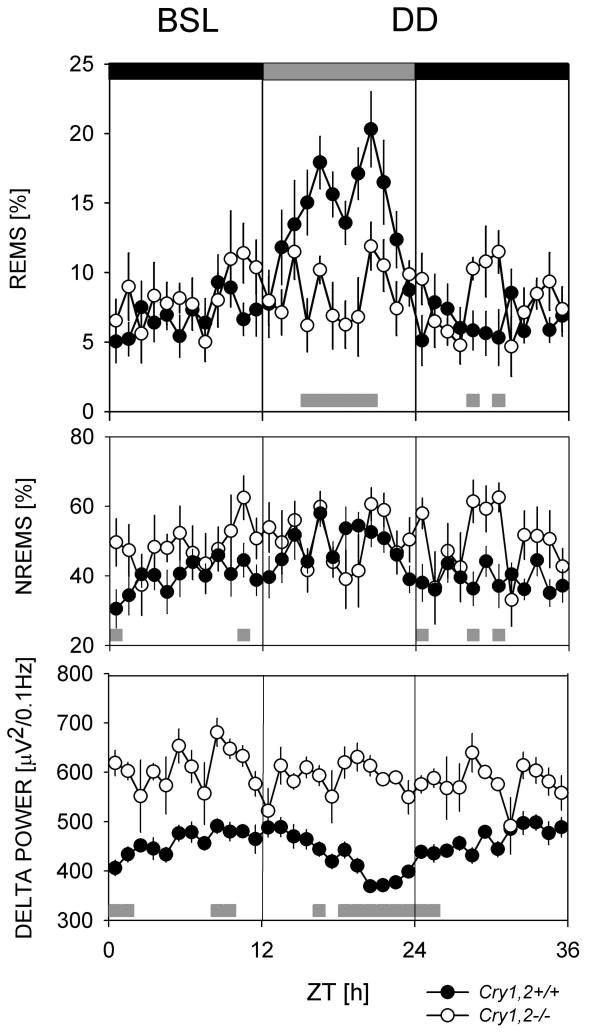
The cryptochrome 1 and 2 genes (cry1 and cry2) are necessary for the generation of circadian rhythms, as mice lacking both of these genes (cry1,2-/-) lack circadian rhythms. We studied sleep in cry1,2-/- mice under baseline conditions as well as under conditions of constant darkness and enforced wakefulness to determine whether cryptochromes influence sleep regulatory processes.
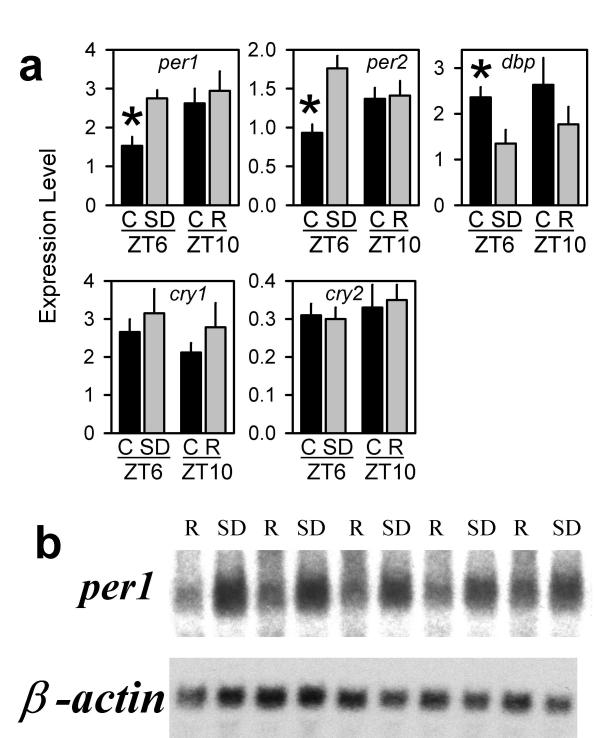
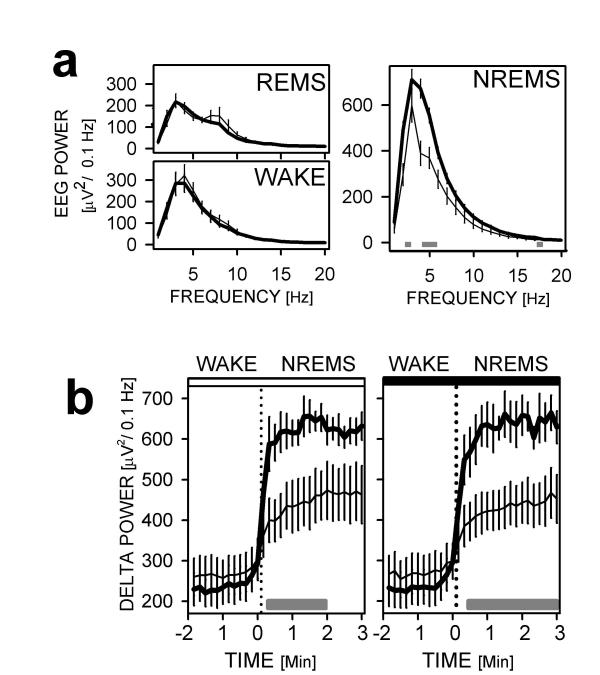
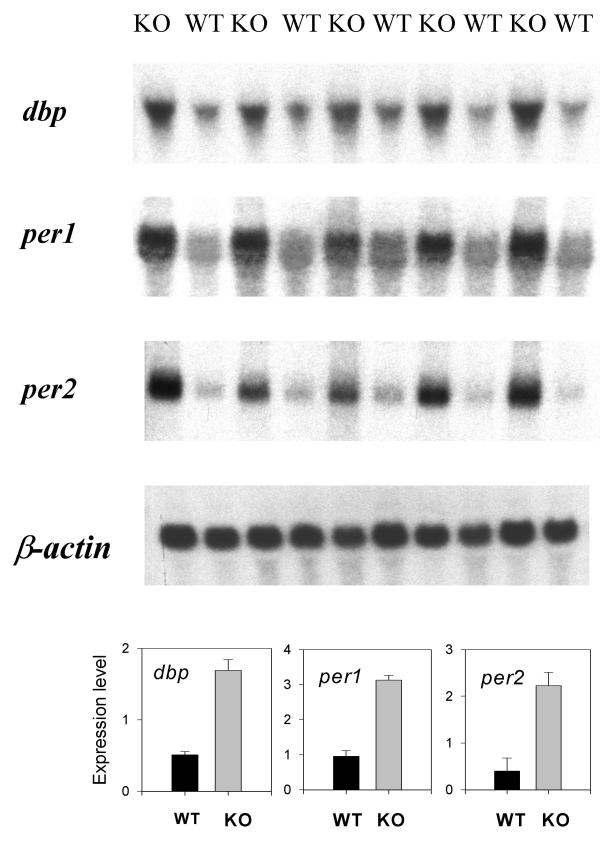
Under all three conditions, cry1,2-/- mice exhibit the hallmarks of high non-REM sleep (NREMS) drive (i.e., increases in NREMS time, NREMS consolidation, and EEG delta power during NREMS). This unexpected phenotype was associated with elevated brain mRNA levels of period 1 and 2 (per1,2), and albumin d-binding protein (dbp), which are known to be transcriptionally inhibited by CRY1,2. To further examine the relationship between circadian genes and sleep homeostasis, we examined wild type mice and rats following sleep deprivation and found increased levels of per1,2 mRNA and decreased levels of dbp mRNA specifically in the cerebral cortex; these changes subsided with recovery sleep. The expression of per3, cry1,2, clock, npas2, bmal1, and casein-kinase-1epsilon did not change with sleep deprivation.
These results indicate that mice lacking cryptochromes are not simply a genetic model of circadian arrhythmicity in rodents and functionally implicate cryptochromes in the homeostatic regulation of sleep.
隐花色素1和2基因(cry1和cry2)对于昼夜节律的产生是必需的,因为缺乏这两个基因的小鼠(cry1,2-/-)没有昼夜节律。我们研究了cry1,2-/-小鼠在基线条件下以及持续黑暗和强制清醒条件下的睡眠情况,以确定隐花色素是否影响睡眠调节过程。
在所有三种条件下,cry1,2-/-小鼠均表现出高非快速眼动睡眠(NREMS)驱动力的特征(即NREMS时间增加、NREMS巩固以及NREMS期间脑电图δ波功率增加)。这种意外的表型与period 1和2(per1,2)以及白蛋白d结合蛋白(dbp)的脑mRNA水平升高有关,已知这些基因会受到CRY1,2的转录抑制。为了进一步研究昼夜节律基因与睡眠稳态之间的关系,我们检查了睡眠剥夺后的野生型小鼠和大鼠,发现特别是在大脑皮层中per1,2 mRNA水平升高,dbp mRNA水平降低;这些变化在恢复睡眠后消退。per3、cry1、2、clock、npas2、bmal1和酪蛋白激酶-1ε的表达在睡眠剥夺后没有变化。
这些结果表明,缺乏隐花色素的小鼠不仅仅是啮齿动物昼夜节律失调的遗传模型,而且从功能上表明隐花色素参与了睡眠的稳态调节。