Schroeder Carl M, Meng Jianghong, Zhao Shaohua, DebRoy Chitrita, Torcolini Jocelyn, Zhao Cuiwei, McDermott Patrick F, Wagner David D, Walker Robert D, White David G
University of Maryland, College Park, USA.
Emerg Infect Dis. 2002 Dec;8(12):1409-14. doi: 10.3201/eid0812.0200770.
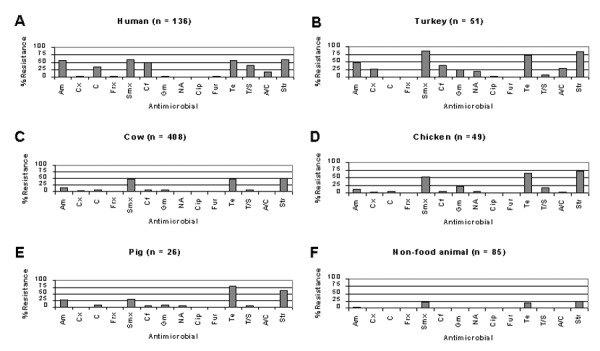
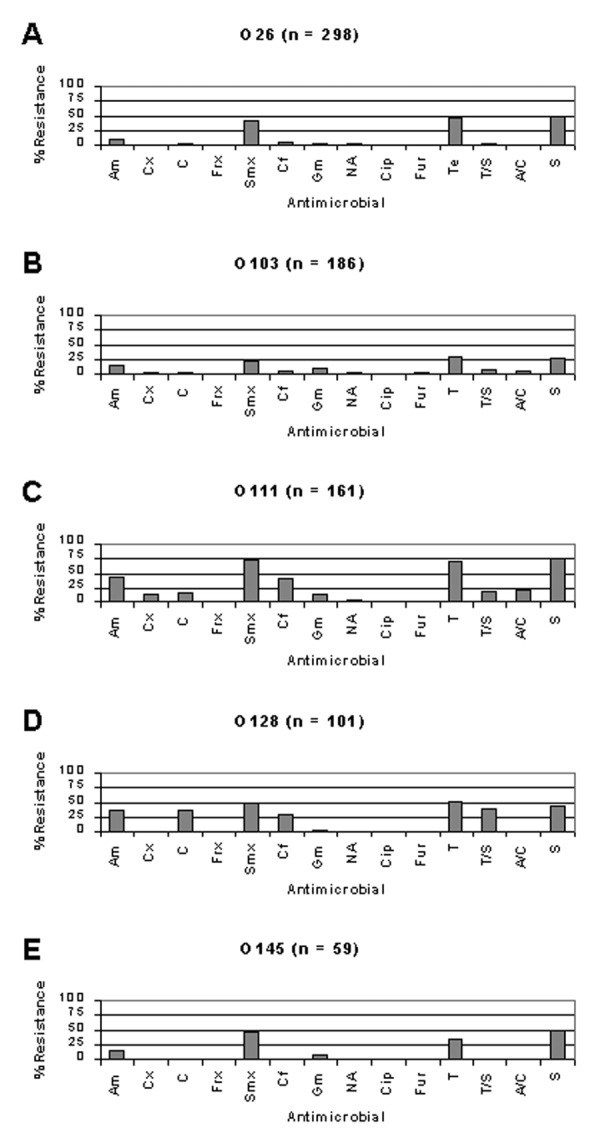
Susceptibilities to fourteen antimicrobial agents important in clinical medicine and agriculture were determined for 752 Escherichia coli isolates of serotypes O26, O103, O111, O128, and O145. Strains of these serotypes may cause urinary tract and enteric infections in humans and have been implicated in infections with Shiga toxin-producing E. coli (STEC). Approximately 50% of the 137 isolates from humans were resistant to ampicillin, sulfamethoxazole, cephalothin, tetracycline, or streptomycin, and approximately 25% were resistant to chloramphenicol, trimethoprim-sulfamethoxazole, or amoxicillin-clavulanic acid. Approximately 50% of the 534 isolates from food animals were resistant to sulfamethoxazole, tetracycline, or streptomycin. Of 195 isolates with STEC-related virulence genes, approximately 40% were resistant to sulfamethoxazole, tetracycline, or streptomycin. Findings from this study suggest antimicrobial resistance is widespread among E. coli O26, O103, O111, O128, and O145 inhabiting humans and food animals.
对752株O26、O103、O111、O128和O145血清型的大肠杆菌分离株测定了对临床医学和农业中重要的14种抗菌药物的敏感性。这些血清型的菌株可能会导致人类尿路感染和肠道感染,并与产志贺毒素大肠杆菌(STEC)感染有关。在从人类分离出的137株菌株中,约50%对氨苄西林、磺胺甲恶唑、头孢噻吩、四环素或链霉素耐药,约25%对氯霉素、甲氧苄啶-磺胺甲恶唑或阿莫西林-克拉维酸耐药。在从食用动物分离出的534株菌株中,约50%对磺胺甲恶唑、四环素或链霉素耐药。在195株携带STEC相关毒力基因的分离株中,约40%对磺胺甲恶唑、四环素或链霉素耐药。这项研究的结果表明,抗菌药物耐药性在居住于人类和食用动物体内的大肠杆菌O26、O103、O111、O128和O145中广泛存在。