Reid Tony, Warren Robert, Kirn David
Stanford University, Palo Alto Veterans Administration Hospital, Palo Alto, California, USA.
Cancer Gene Ther. 2002 Dec;9(12):979-86. doi: 10.1038/sj.cgt.7700539.
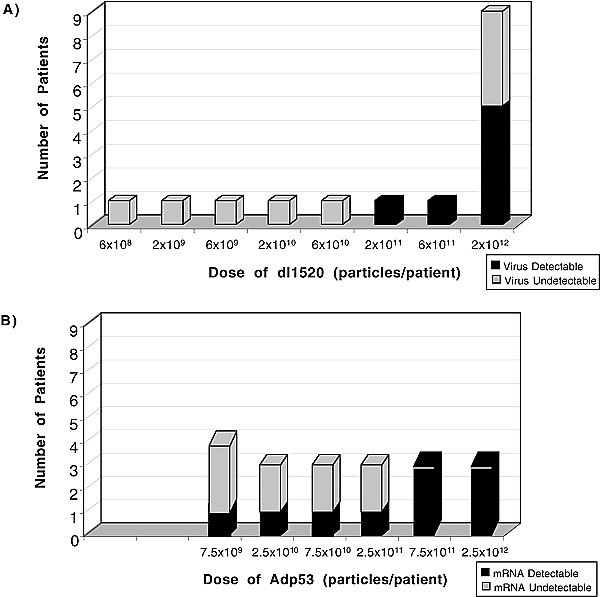
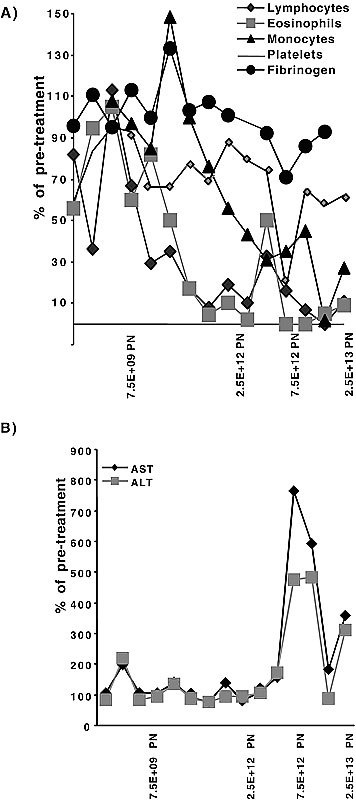
A large number of adenoviral agents are being developed for the treatment of cancer. However, the treatment-related death of a patient with ornithine transcarbamylase deficiency following adenovirus administration by hepatic artery has led to serious concerns regarding the safety of intravascular adenovirus. Both replication-incompetent (rAd.p53, e.g., SCH58500) and replication-selective (dl1520, aka Onyx-015; CG7870) oncolytic adenoviruses, by intravascular administration, are in clinical trials. We review Phases I and I/II results from these clinical trials. dl1520 and rAd.p53 were well-tolerated following hepatic artery infusion at doses of up to 2x10(12) and 2.5x10(13) particles, respectively. At a dose of 7.5x10(13) particles, rAd.p53 was associated with dose-limiting cardiac output suppression; dl1520 dose escalation did not proceed higher than 2x10(12). Intravenous (i.v.) infusions of dl1520 and CG7870 have been well tolerated by i.v. infusion at doses of 2x10(13) and 6x10(12), respectively, without identification of a maximally tolerated dose to date. Mild/moderate transaminitis was demonstrated in some patients on both the hepatic arterial and i.v. trials at doses >or=10(12) particles. Interleukin (IL)-6 and IL-10 were induced in a dose-dependent manner in most patients, but significant interpatient and intrapatient (on repeat doses) variabilities were demonstrated. Evidence of p53 gene expression (Ad.p53) or viral replication (dl1520) was demonstrated in the majority of patients receiving >or=10(12) particles. Over 100 cancer patients have been treated with intravascular adenovirus constructs to date with an acceptable toxicity profile; further clinical trial testing appears appropriate in cancer patients.
大量腺病毒制剂正在研发用于癌症治疗。然而,一名鸟氨酸转氨甲酰酶缺乏症患者在经肝动脉给予腺病毒后出现与治疗相关的死亡,这引发了人们对血管内腺病毒安全性的严重担忧。无复制能力的(如rAd.p53,例如SCH58500)和复制选择性的(dl1520,又名Onyx - 015;CG7870)溶瘤腺病毒,通过血管内给药,都在进行临床试验。我们回顾了这些临床试验的I期和I/II期结果。dl1520和rAd.p53在分别以高达2×10¹²和2.5×10¹³个颗粒的剂量经肝动脉输注后耐受性良好。在剂量为7.5×10¹³个颗粒时,rAd.p53与剂量限制性的心输出量抑制有关;dl1520的剂量递增未超过2×10¹²。静脉输注dl1520和CG7870分别以2×10¹³和6×10¹²的剂量静脉输注时耐受性良好,到目前为止尚未确定最大耐受剂量。在肝动脉和静脉试验中,一些接受剂量≥10¹²个颗粒的患者出现了轻度/中度转氨酶升高。大多数患者中白细胞介素(IL)-6和IL-10呈剂量依赖性诱导,但患者间和患者内(重复给药时)存在显著差异。在大多数接受≥10¹²个颗粒的患者中证实了p53基因表达(Ad.p53)或病毒复制(dl1520)的证据。迄今为止,已有超过100名癌症患者接受了血管内腺病毒构建体治疗,其毒性特征可接受;进一步的临床试验测试似乎适用于癌症患者。