Gao Zhan-Guo, Melman Neli, Erdmann Andreas, Kim Seong Gon, Müller Christa E, IJzerman Adriaan P, Jacobson Kenneth A
Molecular Recognition Section, Laboratory of Bioorganic Chemistry, NIDDK/National Institutes of Health, Bldg. 8A, Rm. B1A-19, Bethesda, MD 20892-0810, USA.
Biochem Pharmacol. 2003 Feb 15;65(4):525-34. doi: 10.1016/s0006-2952(02)01556-3.
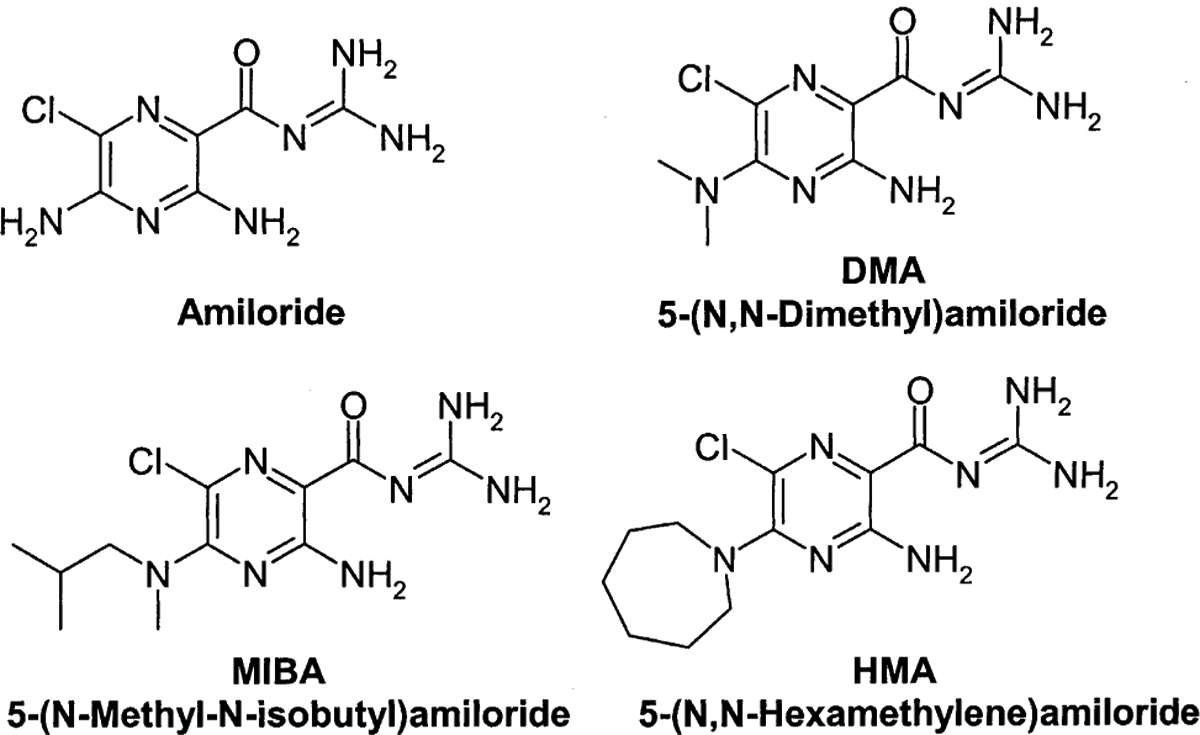
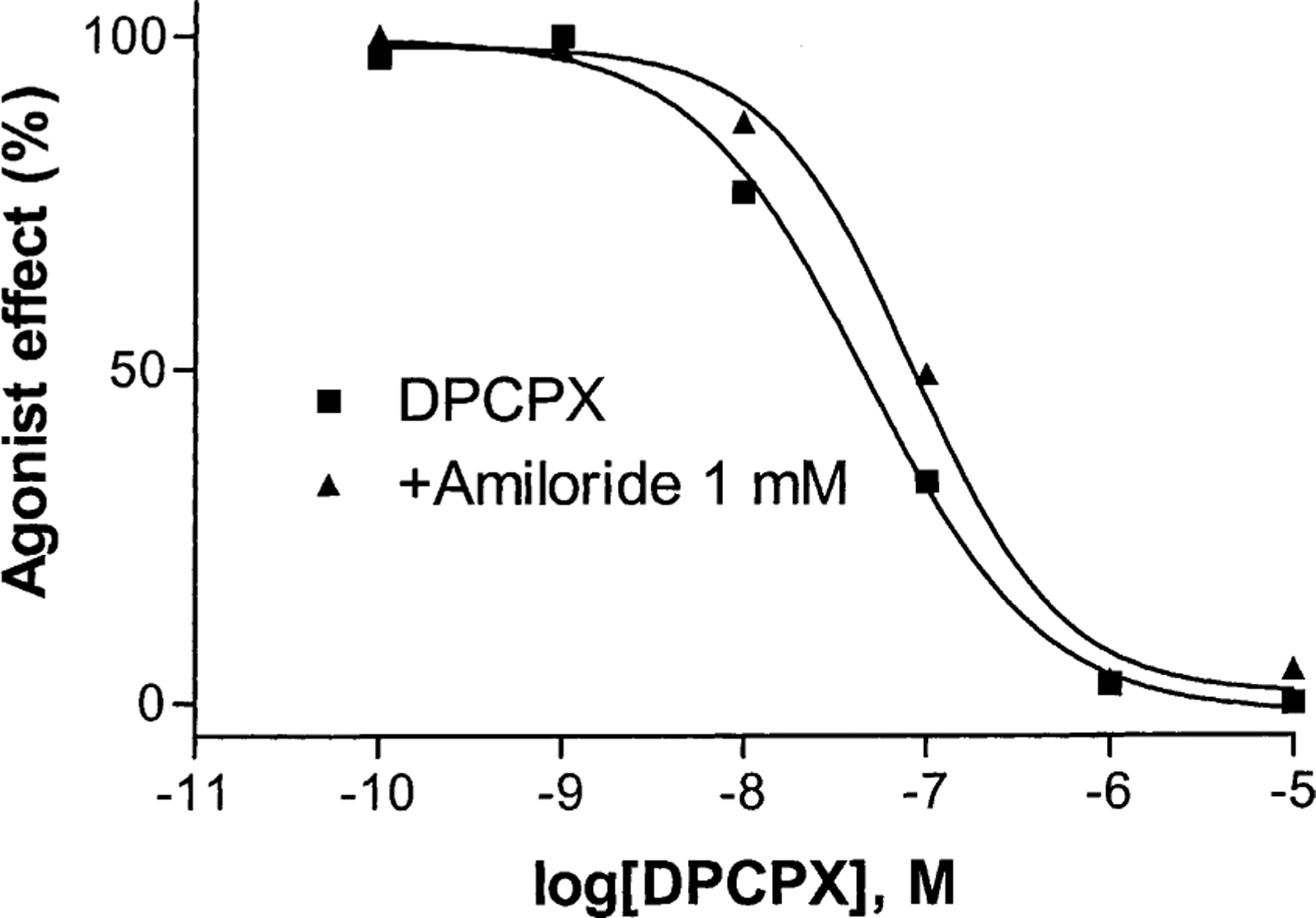
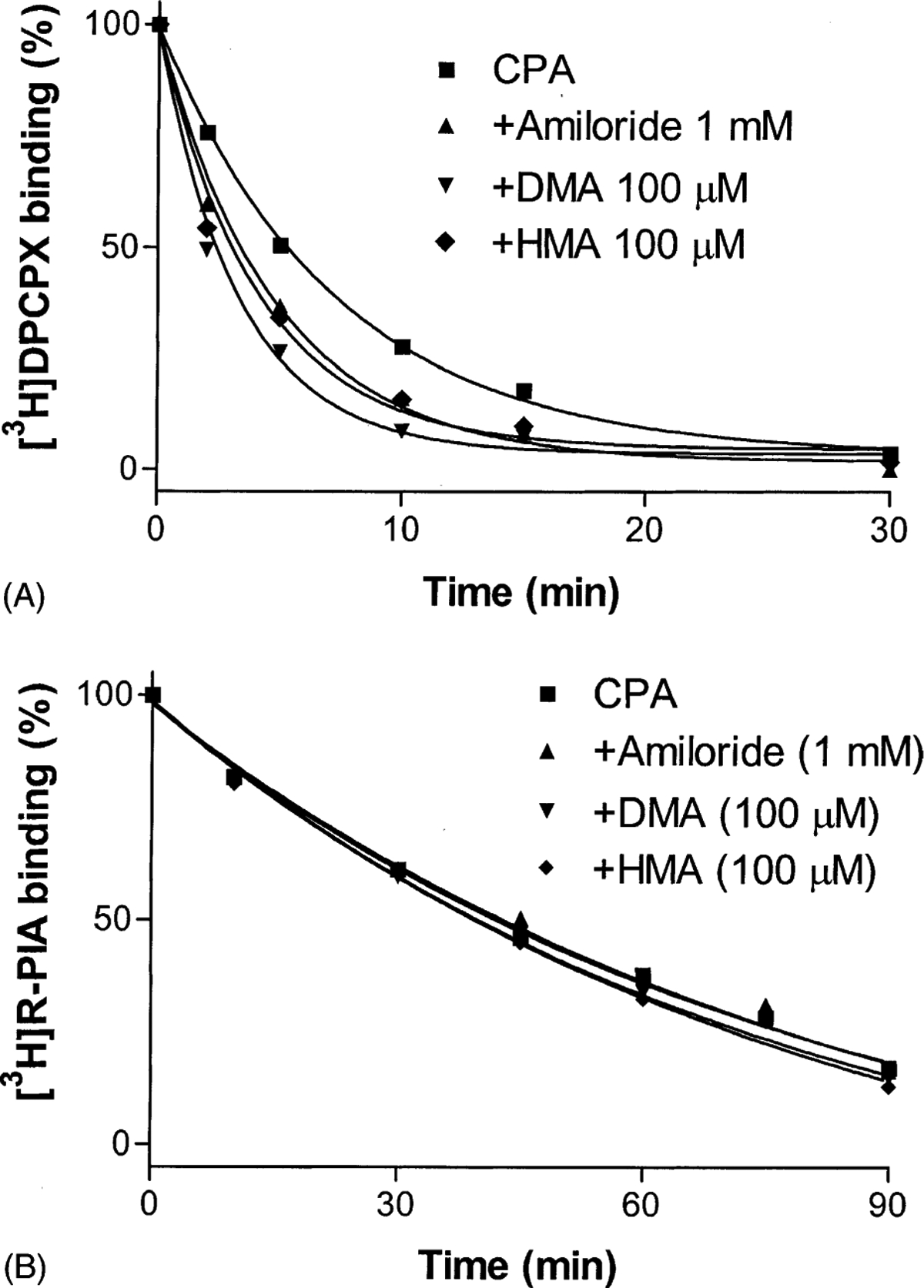
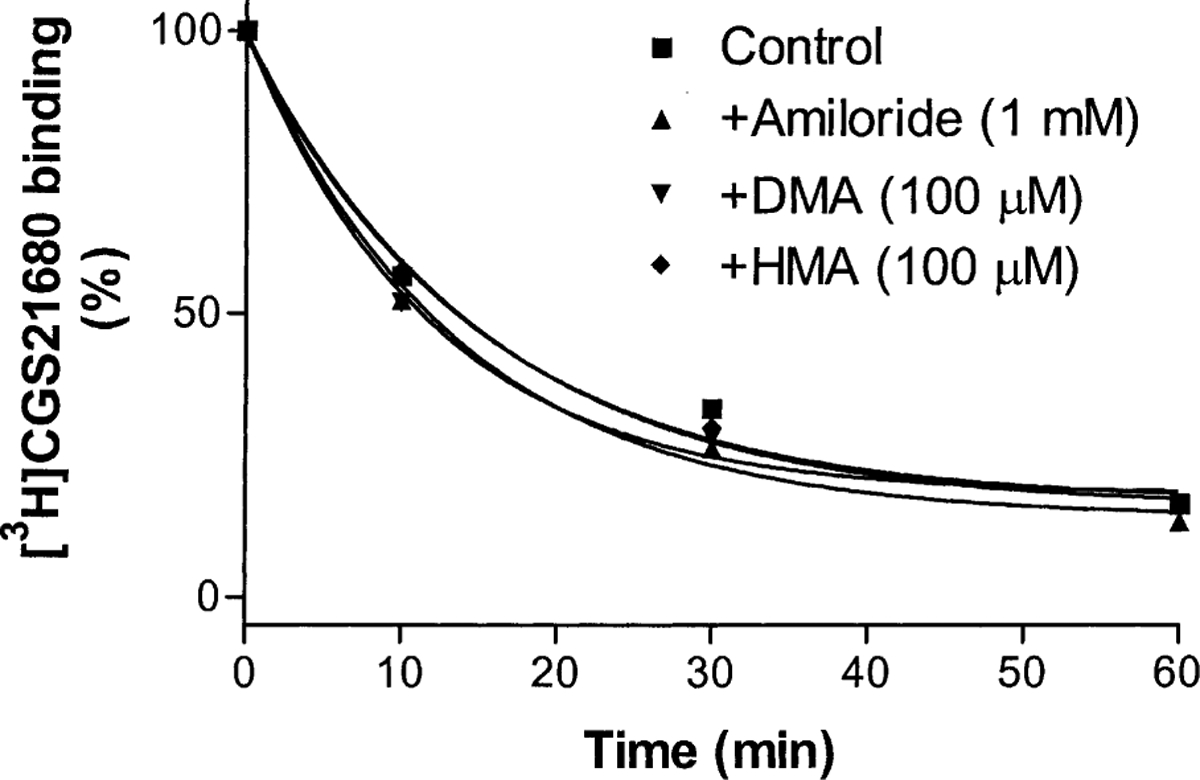
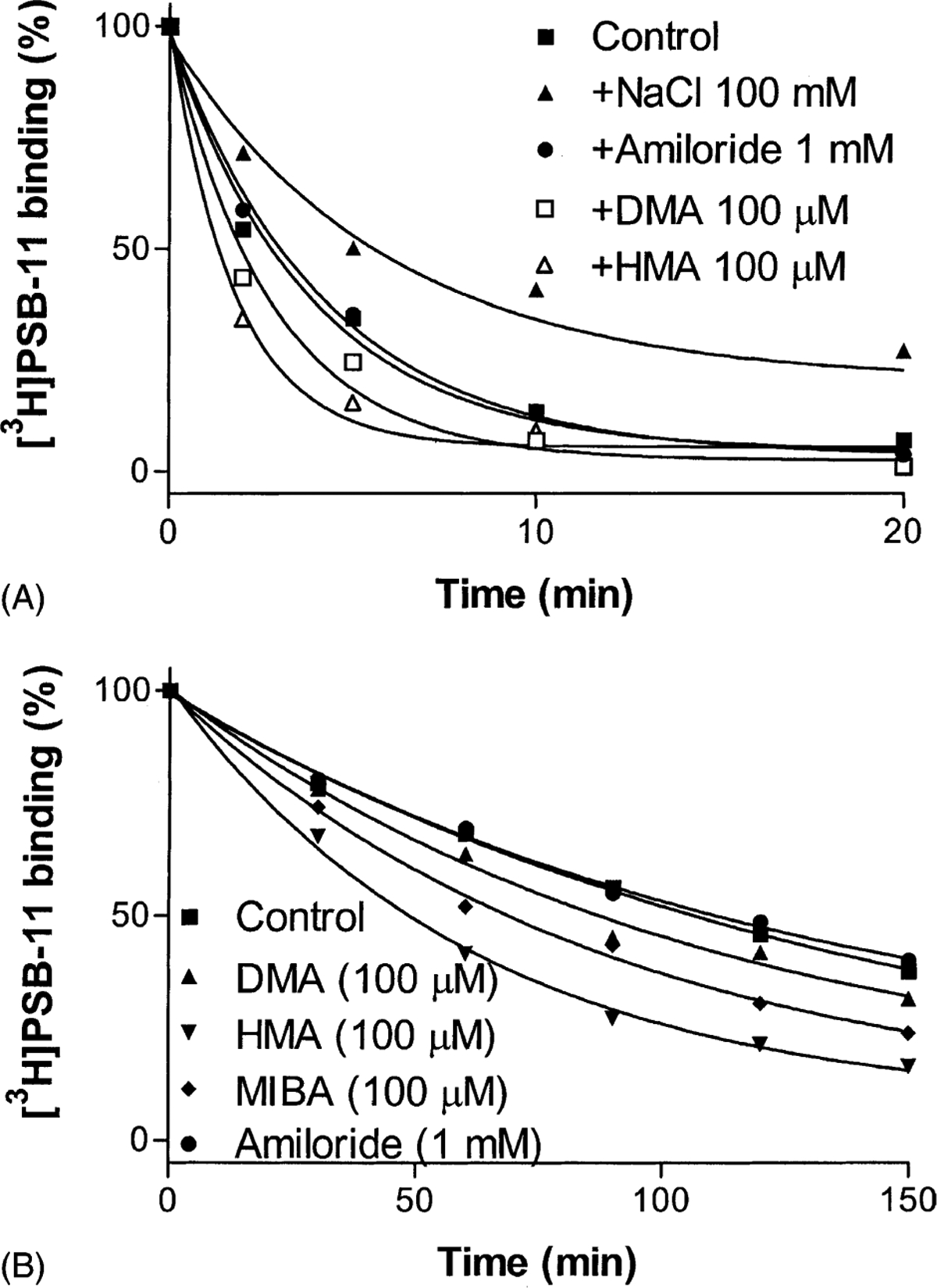
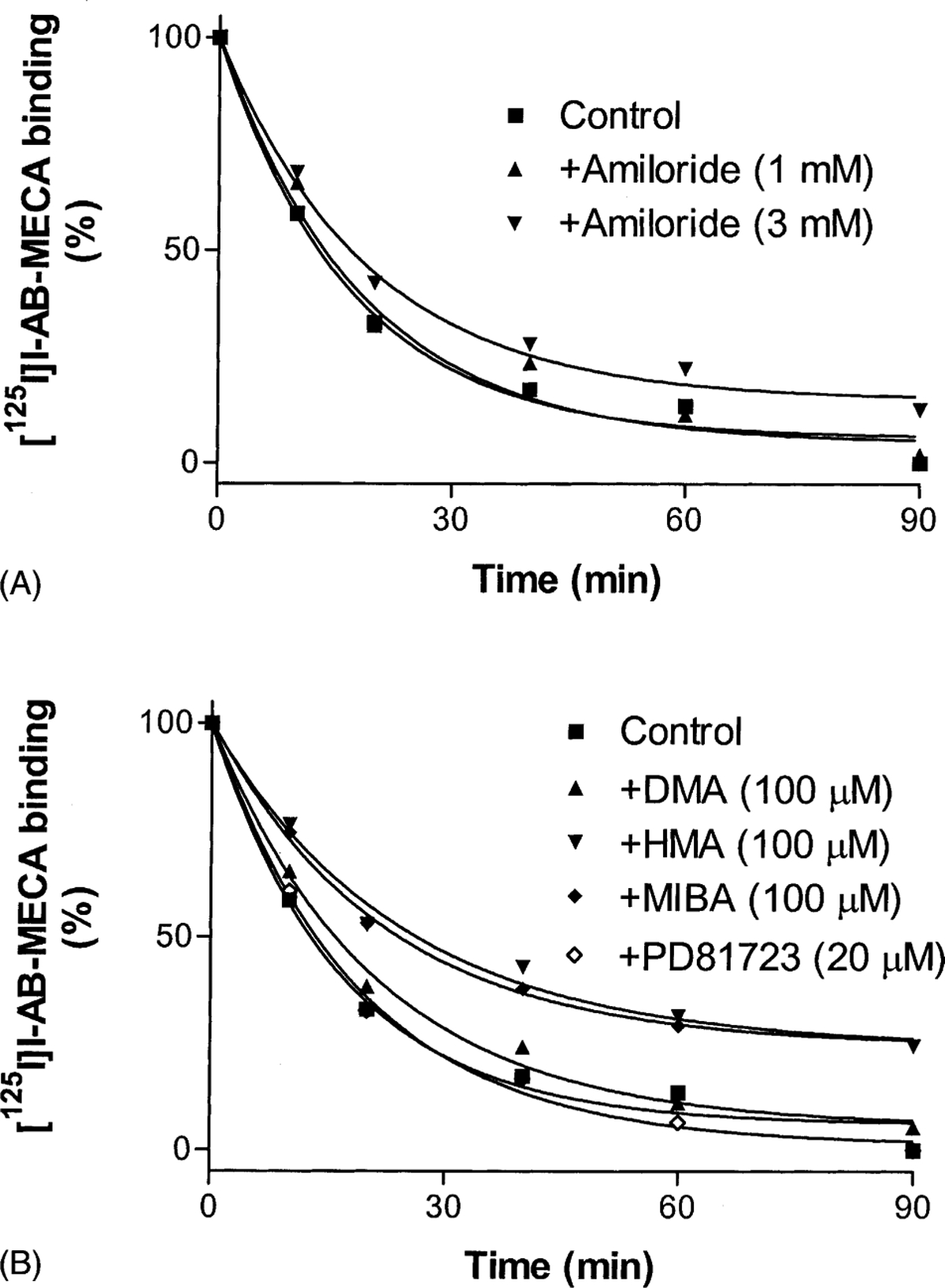
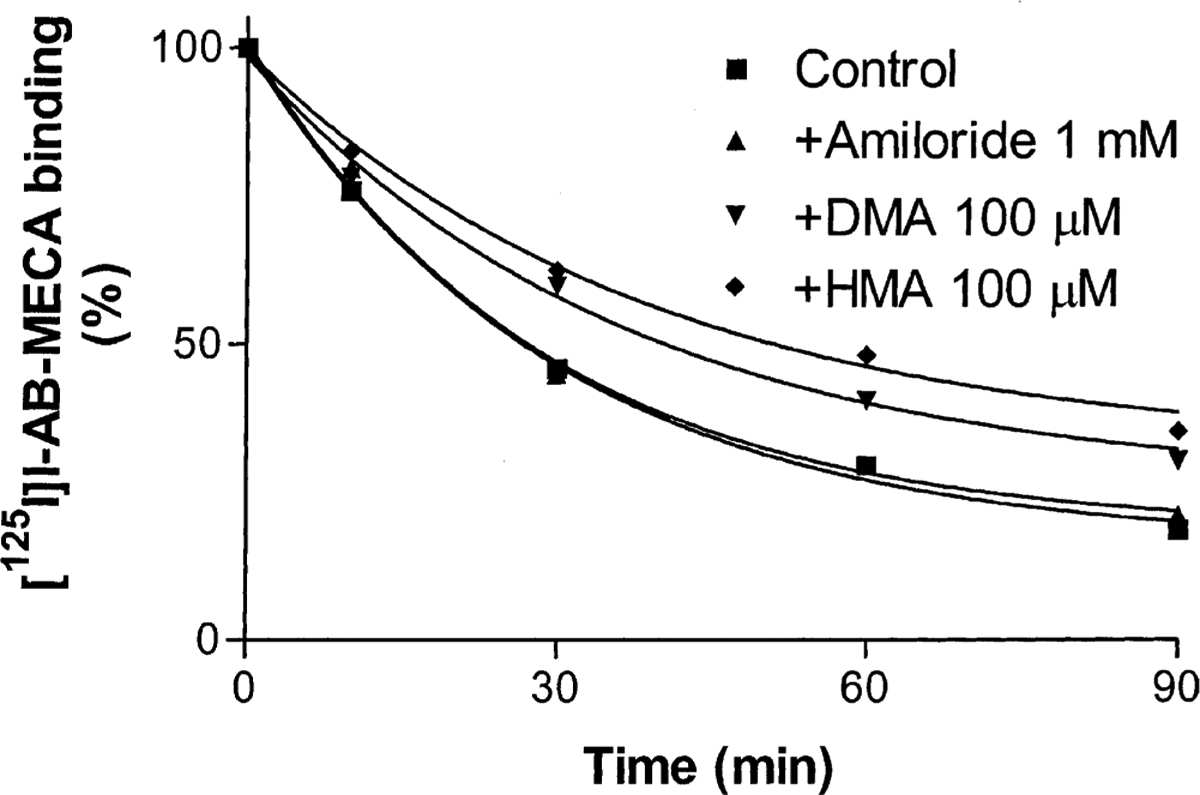
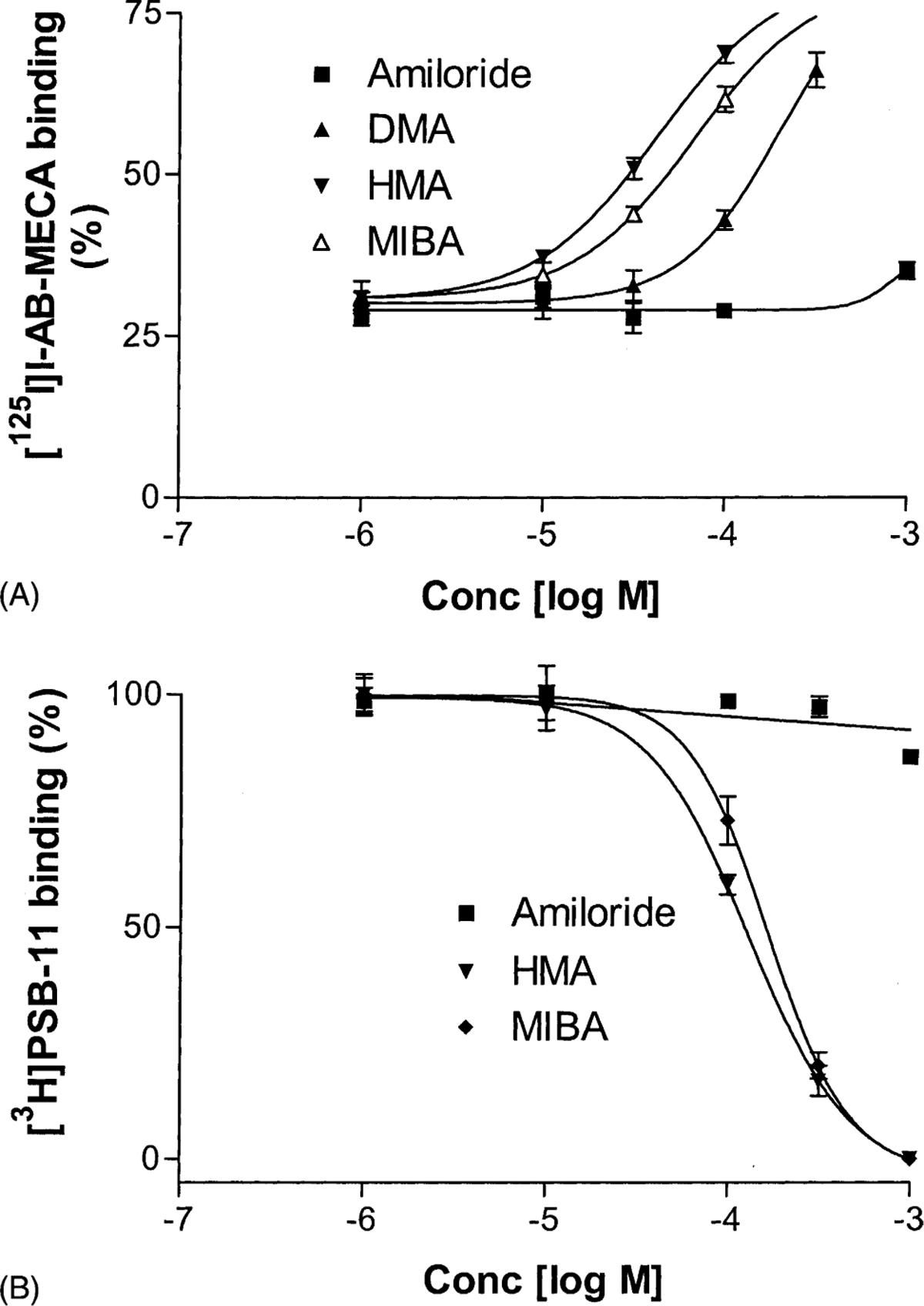
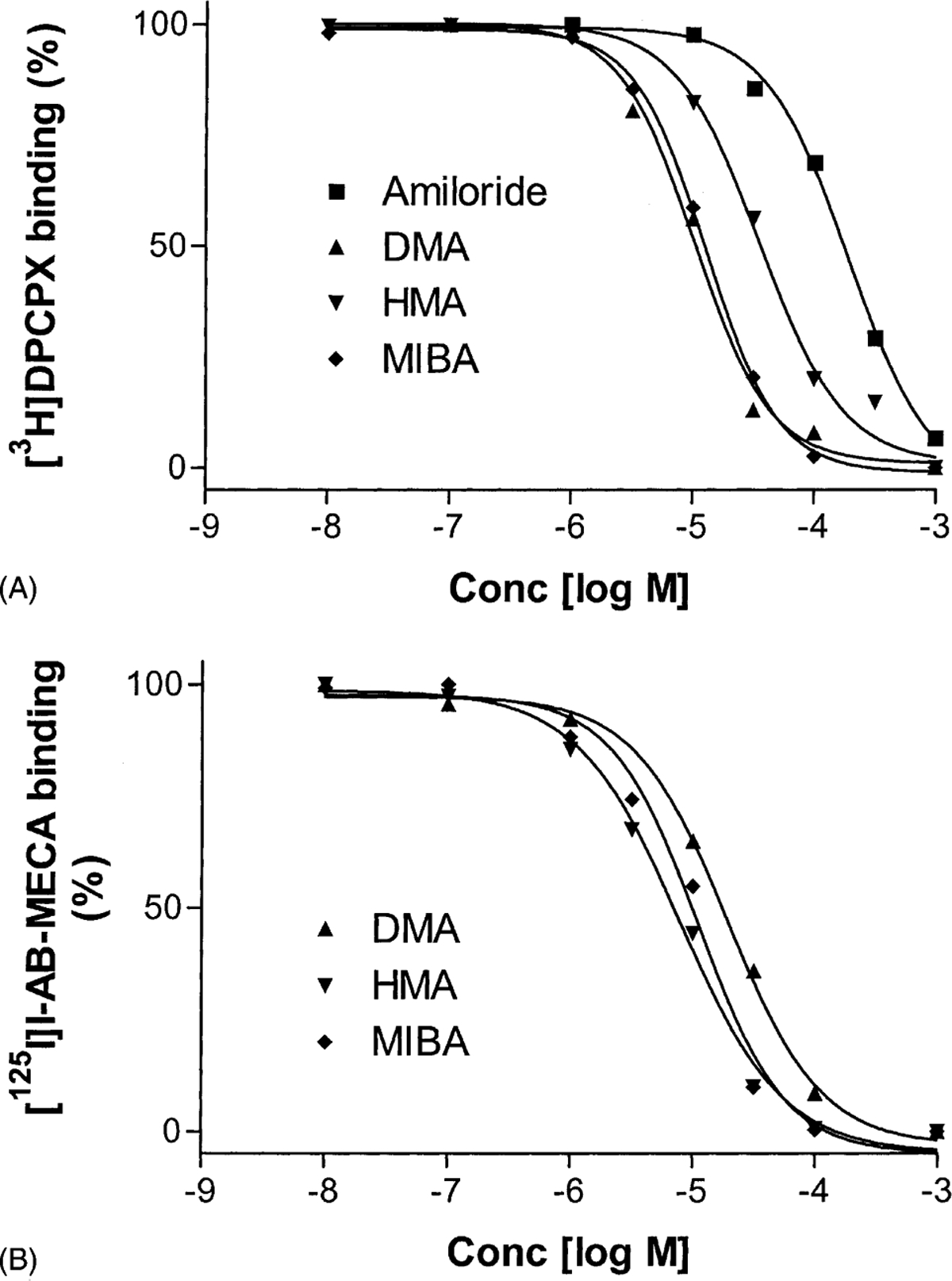
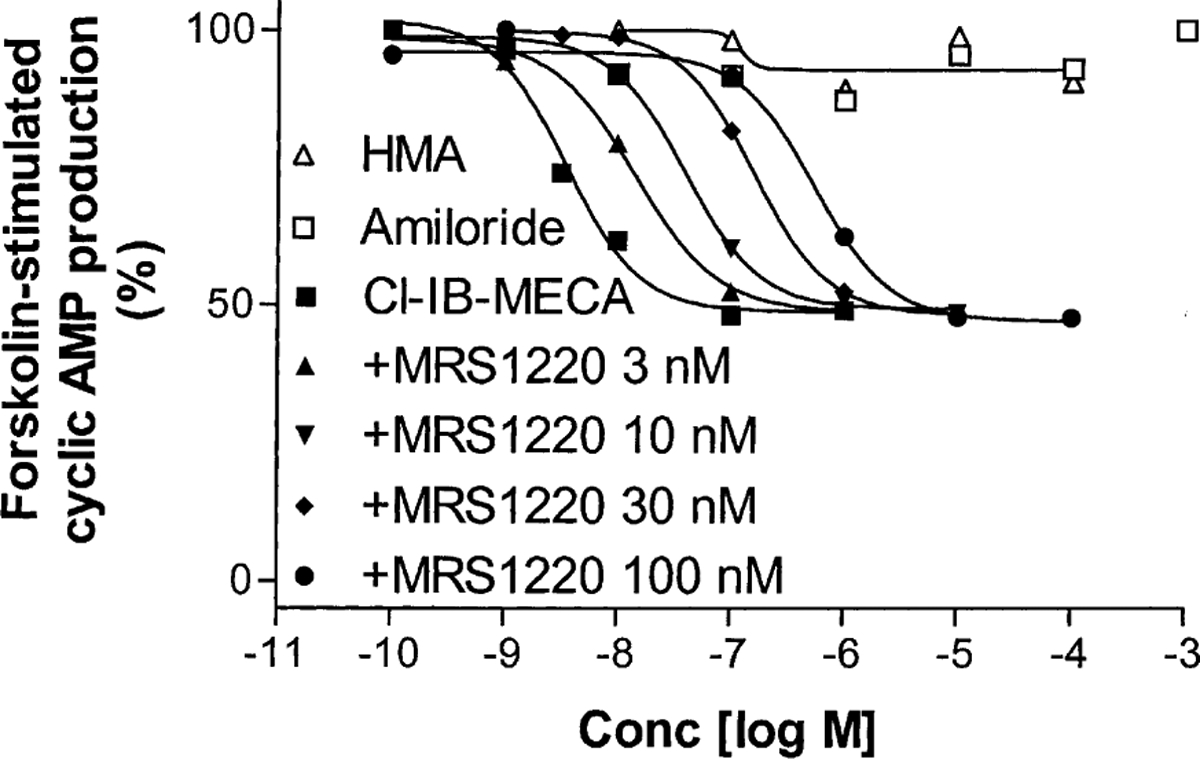
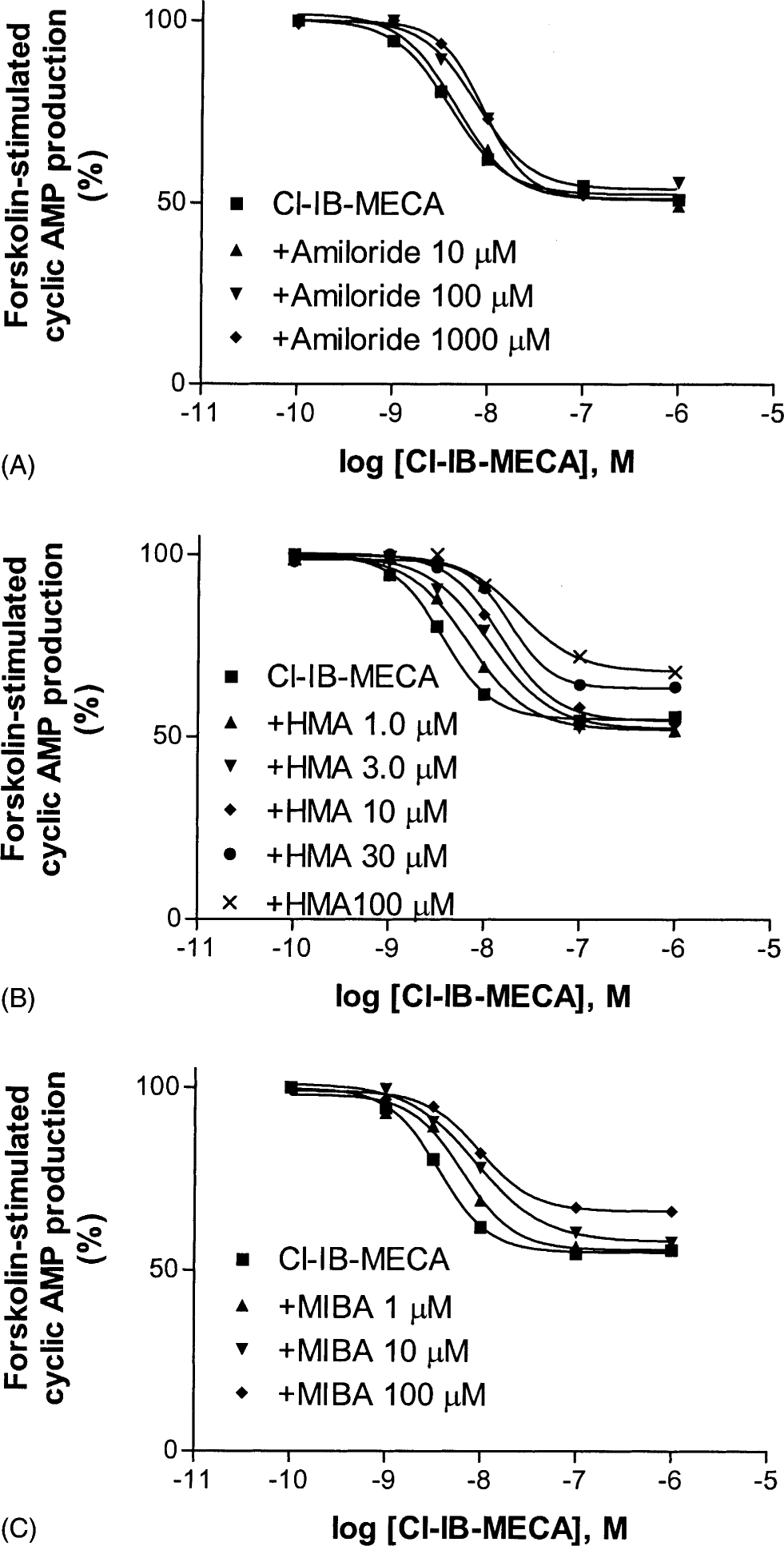
The diuretic drug amiloride and its analogues were found previously to be allosteric modulators of antagonist binding to A(2A) adenosine receptors. In this study, the possibility of the allosteric modulation by amiloride analogues of antagonist binding at A(1) and A(3) receptors, as well as agonist binding at A(1), A(2A), and A(3) receptors, was explored. Amiloride analogues increased the dissociation rates of two antagonist radioligands, [3H]8-cyclopentyl-1,3-dipropylxanthine ([3H]DPCPX) and [3H]8-ethyl-4-methyl-2-phenyl-(8R)-4,5,7,8-tetrahydro-1H-imidazo[2,1-i]purin-5-one ([3H]PSB-11), from A(1) and A(3) receptors, respectively. Amiloride and 5-(N,N-dimethyl)amiloride (DMA) were more potent at A(1) receptors than at A(3) receptors, while 5-(N,N-hexamethylene)amiloride (HMA) was more potent at A(3) receptors. Thus, amiloride analogues are allosteric inhibitors of antagonist binding at A(1), A(2A), and A(3) adenosine receptor subtypes. In contrast to their effects on antagonist-occupied receptors, amiloride analogues did not affect the dissociation rates of the A(1) agonist [3H]N(6)-[(R)-phenylisopropyl]adenosine ([3H]R-PIA) from A(1) receptors or the A(2A) agonist [3H]2-[p-(2-carboxyethyl)phenyl-ethylamino]-5'-N-ethylcarboxamidoadenosine ([3H]CGS21680) from A(2A) receptors. The dissociation rate of the A(3) agonist radioligand [125I]N(6)-(4-amino-3-iodobenzyl)adenosine-5'-N-methyluronamide ([125I]I-AB-MECA) from A(3) receptors was decreased significantly by amiloride analogues. The binding modes of amiloride analogues at agonist-occupied and antagonist-occupied receptors differed markedly, which was demonstrated in all three subtypes of adenosine receptors tested in this study. The effects of the amiloride analogues on the action of the A(3) receptor agonist were explored further using a cyclic AMP functional assay in intact CHO cells expressing the human A(3) receptor. Both binding and functional assays support the allosteric interactions of amiloride analogues with A(3) receptors.
先前发现利尿药阿米洛利及其类似物是拮抗剂与 A(2A) 腺苷受体结合的变构调节剂。在本研究中,探讨了阿米洛利类似物对拮抗剂与 A(1) 和 A(3) 受体结合以及激动剂与 A(1)、A(2A) 和 A(3) 受体结合的变构调节可能性。阿米洛利类似物分别提高了两种拮抗剂放射性配体 [3H]8-环戊基-1,3-二丙基黄嘌呤 ([3H]DPCPX) 和 [3H]8-乙基-4-甲基-2-苯基-(8R)-4,5,7,8-四氢-1H-咪唑并[2,1-i]嘌呤-5-酮 ([3H]PSB-11) 从 A(1) 和 A(3) 受体的解离速率。阿米洛利和 5-(N,N-二甲基)阿米洛利 (DMA) 对 A(1) 受体的作用比对 A(3) 受体更强,而 5-(N,N-六亚甲基)阿米洛利 (HMA) 对 A(3) 受体的作用更强。因此,阿米洛利类似物是 A(1)、A(2A) 和 A(3) 腺苷受体亚型拮抗剂结合的变构抑制剂。与它们对拮抗剂占据受体的作用相反,阿米洛利类似物不影响 A(1) 激动剂 [3H]N(6)-[(R)-苯异丙基]腺苷 ([3H]R-PIA) 从 A(1) 受体的解离速率,也不影响 A(2A) 激动剂 [3H]2-[对-(2-羧乙基)苯基-乙氨基]-5'-N-乙基羧酰胺腺苷 ([3H]CGS21680) 从 A(2A) 受体的解离速率。阿米洛利类似物对 A(3) 受体激动剂放射性配体 [125I]N(6)-(4-氨基-3-碘苄基)腺苷-5'-N-甲基脲酰胺 ([125I]I-AB-MECA) 从 A(3) 受体的解离速率有显著降低作用。在本研究中测试的所有三种腺苷受体亚型中,阿米洛利类似物在激动剂占据和拮抗剂占据受体上的结合模式明显不同。使用表达人 A(3) 受体的完整 CHO 细胞中的环磷酸腺苷功能测定法进一步探讨了阿米洛利类似物对 A(3) 受体激动剂作用的影响。结合和功能测定均支持阿米洛利类似物与 A(3) 受体的变构相互作用。